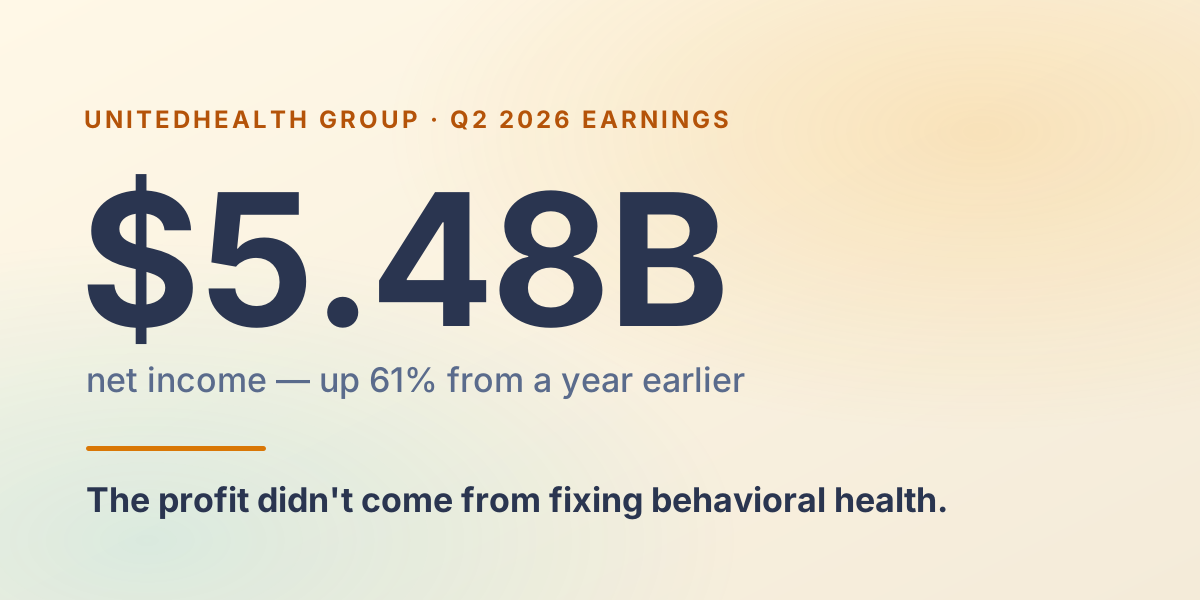
Quick answer: UnitedHealth reported $5.48 billion in net income for Q2 2026, and its own reporting credits pricing discipline, benefit design, and market exits for that beat, not behavioral health savings. On the same earnings call, the company said it’s seeing “early signs of improvement” on behavioral health cost trends, while Medicaid margins stay pressured through 2026. Those are two different stories, and only one of them belongs to the topline profit number.
UnitedHealth Group posted $5.48 billion in net income for the second quarter of 2026, up roughly 61% from $3.41 billion a year earlier (CNBC, July 16, 2026). Revenue hit $112.0 billion and earnings from operations rose 55% to $8.0 billion (UnitedHealth Group SEC 8-K, July 16, 2026). That’s a genuinely large quarter. It’s worth being precise about what produced it, because the company was not shy about naming a cost problem it hasn’t solved in the same breath.
What did UnitedHealth actually report for Q2 2026?
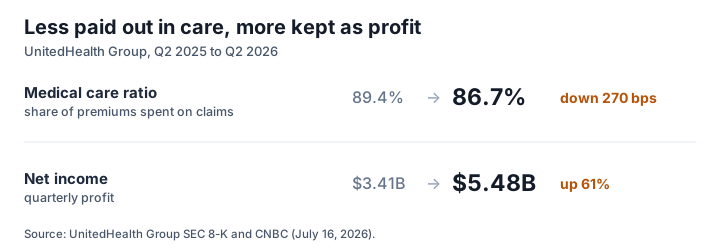
The headline number is the medical care ratio, the share of premium revenue UnitedHealth spends on actual medical claims. It fell to 86.7% in Q2 2026 from 89.4% a year earlier, a 270-basis-point drop, according to the company’s own SEC filing (UnitedHealth Group 8-K, July 16, 2026). A lower ratio means more of every premium dollar stayed with the company instead of going out the door in claims.
Adjusted earnings per share came in at $6.38, and UnitedHealth raised its full-year 2026 adjusted EPS guidance to a range of $19.50 to $20.00 (UnitedHealth Group SEC filing, July 16, 2026). Wall Street reads a raised guide as a company telling you it expects the good quarter to keep going. Yahoo Finance put the net income figure at $5.48 billion with $3.74 EPS (Yahoo Finance, July 16, 2026), consistent with the other tier-1 reporting.
What actually drove the profit beat, if not behavioral health?
UnitedHealth’s 270-basis-point improvement came from pricing discipline and portfolio decisions, not from a behavioral health fix. CNBC’s coverage of the release attributes the drop in medical costs to “benefit design and pricing discipline, member mix and medical cost management initiatives,” plus the company exiting unprofitable ACA and Medicare Advantage markets (CNBC, July 16, 2026).
That’s a mouthful, so translate it. Benefit design and pricing discipline means UnitedHealth priced its plans to make more room for profit this cycle. Member mix means the population it covers shifted, in ways that lower the average claims cost per person. Market exits mean the company simply stopped selling plans where it was losing money. None of those levers require behavioral health costs to have improved at all, and none of the tier-1 coverage of this release credited behavioral health for the topline beat.
That distinction matters because a different, narrower claim about behavioral health did surface, later in the same call, attached to a different business line entirely.
What did UnitedHealth actually say about behavioral health costs?
On the earnings call, UnitedHealth executives said the company is seeing “early signs of improvement” from initiatives including those “targeting elevated behavioral health cost trends,” but still expects Medicaid margins to remain pressured for 2026 (Q2 2026 earnings call transcript, as republished by Motley Fool, July 16, 2026). That language showed up specifically in the Medicaid-segment discussion, where UnitedHealth was explaining why that piece of the business is still struggling, not why the whole company had a good quarter.
Separately in the same transcript, behavioral healthcare services were named as one of several areas of continued cost pressure across the business, alongside specialty pharmacy and home and community-based services. That trend was described as “elevated versus pre-pandemic levels but stable” (Motley Fool transcript, July 16, 2026). Elevated and stable is not the same as fixed. It’s a company telling investors the number stopped climbing, not that it came down.
Worth being straight about the sourcing here. Exact wording and speaker attribution for these comments came from transcript coverage rather than a primary-source recording, so treat the phrasing as reported speech, not a verbatim quote from a named executive. What’s consistent across multiple reports is the substance: early signs, not results, and pressure that’s expected to continue.
Why the Medicaid detail matters more than the headline
UnitedHealth’s $5.48 billion net income (CNBC, July 16, 2026) is a real, verified number. Folding the Medicaid-segment admission, that behavioral health cost trends are showing only “early signs” of improvement while margins stay pressured, into that same headline is not accurate, and it changes how the quarter should read.
This is the correction worth sitting with. UnitedHealth did not say behavioral health cost initiatives explained its $5.4 billion quarter. It said, in a segment-specific aside about Medicaid, that it’s seeing early signs on a cost line that’s been elevated for years and is still not resolved. Those are two different sentences, and collapsing them into one makes the company sound like it solved something it explicitly said it hasn’t.
That’s not a small distinction if you’re an employer, a plan member, or a clinician reading the coverage. A company that says “we fixed it” invites less scrutiny than one that says “we’re seeing early signs, margins are still pressured, and this cost line has been elevated since before the pandemic.” The second sentence is the honest one, and it’s also the one that should prompt more questions, not fewer.
For context on how UnitedHealth’s ownership of Optum changes the incentive picture, see Optum Is Not Your Insurer’s Partner, It Is Your Insurer. When the entity managing your behavioral health benefit and the entity paying the claim are the same company, “cost management initiative” can mean several different things, and not all of them are good for the person trying to get an appointment.
What should employers and members ask before enrolling?
UnitedHealth’s medical care ratio fell 270 basis points this quarter, from 89.4% to 86.7% (UnitedHealth Group SEC 8-K, July 16, 2026), a number that reflects internal pricing and cost management, not a change any plan member would automatically notice at the point of booking an appointment. That gap between the boardroom number and the in-network experience is exactly what to probe before you enroll.
This is a reasonable moment to ask sharper questions of a UnitedHealth or Optum plan, though not to walk away from one. Treat “cost management initiatives” as a phrase that needs translating before you rely on it. Employers already spend heavily on behavioral health benefits that go unused, so a vague earnings-call phrase from the carrier is a good reason to ask for specifics (Mental Health Just Became an Employer Cost Driver in 2026, Mental Wealth Solutions).
Ask for the actual in-network behavioral health directory, not the marketing version, and call a handful of names on it. Ask whether “medical cost management” touches prior authorization, session limits, or network size, since all three affect whether a covered benefit turns into an actual appointment. A benefit that looks generous in a plan summary and thin in practice is a pattern we’ve written about before, and it doesn’t go away just because a quarter looked good (Employer Mental Health Benefits You’re Paying For, Not Using, Mental Wealth Solutions).
The plucky version of this story: a $5.4 billion quarter is not a reason to panic, and it’s not evidence of a cover-up either. It’s a company being candid, in one line buried in a call, that a cost problem it’s worked on for years is only showing early signs of easing. That candor is useful. Use it as a prompt to ask sharper questions, not as a reason to assume the problem already went away.
FAQ
Did UnitedHealth say behavioral health costs caused its Q2 2026 profit beat? No. UnitedHealth reported $5.48 billion in net income, and CNBC and Forbes both attribute the improved 86.7% medical care ratio to benefit design, pricing discipline, member mix, and market exits, not behavioral health initiatives. The behavioral health comment appeared separately, in Medicaid-segment commentary.
What actually drove UnitedHealth’s Q2 2026 profit? The medical care ratio dropped to 86.7% from 89.4% a year earlier, a 270-basis-point improvement, per the company’s SEC filing. Reporting on the release attributes that to pricing discipline, member mix, cost management, and exiting unprofitable ACA and Medicare Advantage markets.
What did UnitedHealth say about behavioral health costs on the earnings call? Transcript coverage reports executives saying the company sees early signs of improvement from initiatives including those targeting elevated behavioral health cost trends, while expecting Medicaid margins to stay pressured through 2026. Behavioral health was also named as one of several ongoing cost-pressure areas.
Does this earnings call change my UnitedHealth or Optum behavioral health coverage right now? Not directly. Earnings-call language describes internal cost management, not a change you’d see in your plan documents. A shrinking network or more claim denials would show up separately, and is worth confirming with your HR or benefits team.
What should I ask before enrolling in a UnitedHealth or Optum behavioral health plan? Ask for the current in-network behavioral health directory and call a few names to confirm they’re taking new patients on that plan. Ask what cost management initiatives mean for prior authorization and session limits before you sign up.
Sources
- CNBC, UnitedHealth Group (UNH) earnings Q2 2026: net income $5.48B, up 61% from $3.41B YoY, $3.74 EPS, MCR improvement attributed to benefit design, pricing discipline, member mix, and market exits. July 16, 2026.
- Forbes (Bruce Japsen), UnitedHealth Group Profits Hit $5.4 Billion As Costs Continue To Ease: $5.4 billion net income headline. July 16, 2026.
- Yahoo Finance, UnitedHealth Group Reports Second Quarter Results: net income $5.48B, EPS $6.04. July 16, 2026.
- UnitedHealth Group, SEC 8-K, earnings release: medical care ratio 86.7% vs 89.4% YoY, full-year adjusted EPS guidance raised to $19.50-$20.00. July 16, 2026.
- UnitedHealth Group, SEC 8-K, earnings supplement: consolidated revenue $112.0B, earnings from operations $8.0B (up 55% YoY), adjusted EPS $6.38. July 16, 2026.
- Motley Fool, UnitedHealth (UNH) Q2 2026 Earnings Call Transcript: Medicaid-segment comments on early signs of improvement targeting behavioral health cost trends, pressured 2026 Medicaid margins, and behavioral health named among areas of continued elevated-but-stable cost pressure. July 16, 2026.
- UnitedHealth Group, leadership announcement: Wayne DeVeydt named CFO effective September 2, 2025. July 31, 2025.
Disclaimer
This article is for educational and informational purposes only. It does not constitute medical, clinical, legal, or therapeutic advice, and reading it does not create a therapist-client relationship with Matthew Sexton, LCSW or Mental Wealth Solutions, Inc.. Although the author is a licensed clinical social worker, the content in this article is not clinical assessment, diagnosis, or treatment.
Earnings figures, cost ratios, and forward guidance discussed here reflect UnitedHealth Group’s public reporting for the quarter ended June 30, 2026, and may be revised or superseded by later filings and disclosures. This is financial and policy commentary, not investment advice, and nothing here is a substitute for reviewing a specific plan’s coverage documents with your HR or benefits team, your plan administrator, or qualified counsel. Individual coverage and network details vary by plan and by state.
If you are in immediate emotional crisis, you can reach the 988 Suicide & Crisis Lifeline by calling or texting 988 (US). If you are experiencing domestic violence or are in physical danger, contact the National Domestic Violence Hotline at 1-800-799-7233 or visit thehotline.org. In a life-threatening emergency, call 911.
Frequently asked questions.
- Did UnitedHealth say behavioral health costs caused its Q2 2026 profit beat?
- No. UnitedHealth reported $5.48 billion in net income for Q2 2026, and CNBC and Forbes both attribute the improved 86.7% medical care ratio to benefit design, pricing discipline, member mix, and exiting unprofitable markets, not to behavioral health initiatives. That framing appeared separately, in Medicaid-segment commentary on the same earnings call.
- What actually drove UnitedHealth's Q2 2026 profit?
- UnitedHealth's medical care ratio dropped to 86.7% in Q2 2026 from 89.4% a year earlier, a 270-basis-point improvement, per its SEC filing. CNBC and Forbes reporting on the release attributes that drop to benefit design and pricing discipline, member mix, medical cost management, and exiting unprofitable ACA and Medicare Advantage markets.
- What did UnitedHealth say about behavioral health costs on the earnings call?
- According to transcript coverage of the call, UnitedHealth executives said the company is seeing early signs of improvement from initiatives including those targeting elevated behavioral health cost trends, but still expects Medicaid margins to stay pressured through 2026. Behavioral health was also named as one of several areas of continued cost pressure, alongside specialty pharmacy and home care.
- Does this earnings call change my UnitedHealth or Optum behavioral health coverage right now?
- Not directly. Earnings-call language describes internal cost management, not a benefit change you'd see in your plan documents. If your therapist is leaving an Optum or UnitedHealthcare network, or your claims are getting flagged more often, that's a separate, plan-level issue worth confirming with your HR or benefits team.
- What should I ask before enrolling in a UnitedHealth or Optum behavioral health plan?
- Ask for the current in-network behavioral health directory, not a marketing list, and call two or three names on it to confirm they're actually taking new patients on that plan. Ask what 'medical cost management initiatives' means for prior authorization and session limits. A plan that looks full on paper can still be empty when you call.
If you're the therapist here.
Your clients get 4 sessions a month. The other 26 days they're on their own. VibeCheck.luxury is the between-session companion that carries those days back to you — clients check in daily, and you walk in already knowing what kind of week it was. Built by Matthew Sexton, LCSW, NATC.