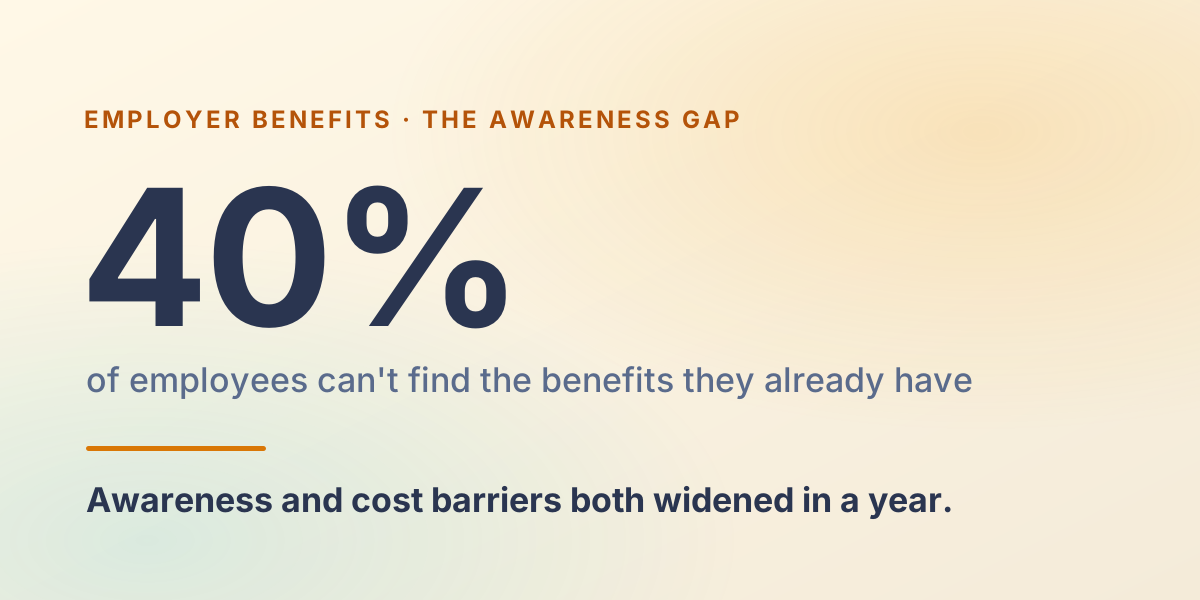
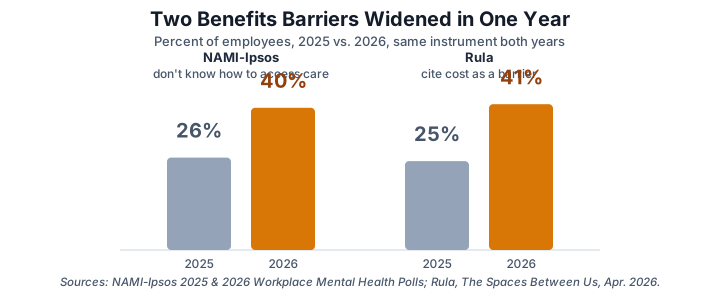
In the 2025 NAMI-Ipsos Workplace Mental Health Poll, 26% of employees said they didn’t know whether their employer offered mental health benefits at all. A year later, the same poll asked a sharper question and found something worse: 40% don’t know how to access the mental health care their employer-sponsored insurance already covers, meaning only 6 in 10 employees actually know how (NAMI-Ipsos, 2026). That’s not a static number. It’s a trend line, and it’s moving the wrong way.
Run a second trend line next to it and the picture gets clearer, not muddier. Rula’s 2026 State of Mental Health Report found the financial barrier to accessing mental health care climbed from 25% in 2025 to 41% in 2026, a same-source year-over-year jump (Rula, April 2026). Employees aren’t just confused about the door. A lot of them can’t afford to walk through it even once they find it.
Quick answer: Employers keep buying mental health benefits and forgetting to build the part employees actually use to get in. Two separate, same-source, year-over-year surveys now show it: the NAMI-Ipsos awareness gap moved from 26% to 40% in a year, and Rula’s financial-barrier figure moved from 25% to 41%. We built the door and forgot to install the handle. The upside is that both numbers are precise enough to fix. You can’t fix a vibe. You can fix a measured gap.
What employees don’t know about their employer mental health benefits
Roughly one in four employees didn’t know their employer offered mental health benefits at all in 2025, and by 2026 the confusion had shifted from does it exist to how do I use it. The 2025 NAMI-Ipsos poll put pure awareness at 26% unaware. The 2026 follow-up found 40% don’t know how to access care through their plan, and 57% have received zero training on what’s available (NAMI, 2026).
That’s a strange kind of progress. The company solved the first question, mostly. Employees now know the benefit exists. But the second question, how do I actually use this, got harder, not easier. In practice, I’ve sat across from clients who had good coverage on paper and could not tell me, when I asked directly, whether their plan covered therapy without a referral. Nobody had ever told them. The benefit existed in the handbook and nowhere else.
Training is the missing piece, and the 57% figure says so plainly. Over half of employees have never had anyone walk them through what their plan covers, who’s in-network, or how to book a first appointment. A benefit nobody explains behaves exactly like a benefit that doesn’t exist. The dollars get spent either way.
Why is the financial barrier getting worse, not better?
The share of people citing cost as a barrier to mental health care jumped from 25% to 41% in a single year, a 16-point swing that Rula measured using the same methodology both times (Rula, April 2026). That’s not inflation catching up gradually. That’s a sharp, one-year move, and it lands on people who may have already cleared the awareness hurdle.
This is the part that surprises HR leads the most. Awareness and affordability are two different walls, and clearing the first one doesn’t clear the second. An employee can know exactly where the benefits portal lives, log in, find a provider, and still stall out at the copay, the deductible, or the out-of-network gap between what the plan lists and who’s actually taking new patients. Most benefits communications are built to answer where do I click, when the harder question employees are actually stuck on is what will this cost me by the third session.
Rula’s finding matters because it’s a repeat measurement, not a one-off. A single survey year can be noisy. Two years, same source, same instrument, moving 16 points in the same direction, that’s a trend a benefits team can plan against instead of argue about.
Who carries the financial barrier the hardest?
Cost is the second-biggest reason employees skip mental health care, cited by 42% of the workforce and outranked only by lack of time, and women are 7 percentage points more likely than men to name it as the obstacle (Spring Health, 2026). A barrier that sounds generic on a company-wide slide deck lands unevenly once you look at who’s actually turned away.
That 7-point gap is worth sitting with. It suggests the financial barrier isn’t just about plan design in the abstract. It tracks with income, with caregiving load, with who’s more likely to be paying out of pocket for a partner’s or a kid’s care on top of their own. A flat, one-size benefit design doesn’t account for any of that, and the survey data shows the gap where it lands hardest.
None of this means the fix is complicated. It means the fix has to account for the fact that employees aren’t one uniform group with one uniform wallet.
Why do employers keep rebuying the same broken door?
Benefits get procured to satisfy a decision at the signing table, not the moment an employee actually needs care, and that mismatch is why awareness and affordability keep sliding even as spending goes up. The purchase happens once a year, in a boardroom, evaluated on price and plan design. The use happens, or doesn’t, in the middle of somebody’s worst week, evaluated on none of that.
That’s the behavioral piece employers keep missing. A benefits committee optimizes for the RFP. An employee in distress isn’t reading an RFP. They’re trying to remember a login, or wondering if the appointment shows up on a bill their partner will see, or deciding whether it’s worth the hassle at all. The gap between those two decision-makers, the buyer and the user, is exactly where the 26-to-40 and 25-to-41 lines come from. Nobody in the room signing the contract is the person who has to use it late on a Tuesday night.
We’re not going to pretend the whole system is designed around a struggling employee’s needs. It isn’t. Plenty of it is designed around what looks defensible in a benefits audit. But naming that plainly is different from being cynical about it. The two numbers above are proof the gap is real, specific, and shrinkable, not proof that nothing can move.
What would actually close the gap?
Companies that move these numbers put access instructions where employees already look, onboarding, pay stubs, team meetings, instead of a portal visited once a year, and they train managers directly instead of hoping a flyer does the work. The 57% who’ve had zero training on their mental health resources are the clearest, cheapest fix on this list. You don’t need a new benefit. You need someone to explain the one you already bought.
Start with the door employees can’t find. Put the access instructions in three places employees already look weekly: the onboarding sequence, the pay stub, and a standing line in team meetings. Stop assuming a portal visited once a year does any teaching.
Then close the cost surprise before it happens. Publish, in plain language, what a first session actually costs under the plan, copay included, before anyone has to call and ask. Uncertainty about price stops people faster than the price itself.
Finally, train the people employees already trust. A manager who can say here’s exactly how you book this in one sentence does more than another all-staff email. That’s the 57% number, turned into an action instead of a statistic.
Here’s the plucky part, and it’s genuinely true: both of these gaps are measured, dated, and repeatable. That’s rarer than it sounds in workplace mental health data. When a number moves 16 points in a year using the same instrument both times, you know exactly what to go fix. Most companies don’t get that clean a signal. This one’s sitting right there.
FAQ
What percent of employees don’t know if their employer offers mental health benefits? In the 2025 NAMI-Ipsos Workplace Mental Health Poll (n=2,153, companies with 100+ employees), 26% said they didn’t know whether their employer offered mental health benefits at all, roughly one in four workers unaware the benefit even exists.
How many employees don’t know how to access their employer’s mental health benefits in 2026? 40% don’t know how to access mental health care through their employer-sponsored insurance, meaning only 6 in 10 know how, per the 2026 NAMI-Ipsos poll (fielded Jan 27 to Feb 2, 2026). The same poll found 57% had received no training on their workplace’s mental health resources.
How much has the financial barrier to mental health care grown? It rose from 25% in 2025 to 41% in 2026, according to Rula’s State of Mental Health Report, titled The Spaces Between Us (n=2,037, published April 29, 2026), a same-source year-over-year comparison showing more than 4 in 10 people now cite cost as a barrier.
Who is most likely to say cost is a barrier to mental health care? Spring Health’s 2026 Workplace Mental Health Annual Report found 42% of employees cite cost as a barrier, second only to lack of time. Women were 7 percentage points more likely than men to name cost as the obstacle.
What can employers actually do to close the awareness gap? Put access instructions where employees already look, onboarding, pay stubs, team meetings, instead of a benefits portal nobody opens twice. Train managers directly since 57% of employees report zero training on available resources.
Sources
- 2026 NAMI-Ipsos Workplace Mental Health Poll, fielded Jan 27 to Feb 2, 2026. 40% don’t know how to access mental health care through employer insurance; 57% have received no training on workplace mental health resources.
- 2025 NAMI-Ipsos Workplace Mental Health Poll, n=2,153, released Feb 2025. 26% of employees didn’t know whether their employer offered mental health benefits at all.
- Rula, State of Mental Health Report, The Spaces Between Us, n=2,037, published April 29, 2026. Financial barrier to accessing mental health care rose from 25% (2025) to 41% (2026).
- Spring Health, 2026 Workplace Mental Health Annual Report. 42% of employees cite cost as a barrier to care, second only to lack of time; women 7 points more likely than men to cite cost.
Figures current as of July 2026.
Disclaimer
This article is for educational and informational purposes only. It does not constitute medical, clinical, legal, or therapeutic advice, and reading it does not create a therapist-client relationship with Matthew Sexton, LCSW or Mental Wealth Solutions, Inc. Although the author is a licensed clinical social worker, the content in this article is not clinical assessment, diagnosis, or treatment.
Survey findings on benefits awareness, financial barriers, and training rates reflect the specific samples and dates described above, and mental health benefit design, cost-sharing, and plan access vary by employer, insurer, and state, and may change after this article is published. Nothing here is a substitute for confirming the details of a specific plan with your HR or benefits team, your plan administrator, or qualified counsel. Organizations and circumstances differ, and what is described here may not match your situation.
If you are in immediate emotional crisis, you can reach the 988 Suicide & Crisis Lifeline by calling or texting 988 (US). If you are experiencing domestic violence or are in physical danger, contact the National Domestic Violence Hotline at 1-800-799-7233 or visit thehotline.org. In a life-threatening emergency, call 911.
Frequently asked questions.
- What percent of employees don't know if their employer offers mental health benefits?
- In the 2025 NAMI-Ipsos Workplace Mental Health Poll (n=2,153 full-time employees at companies with 100+ employees), 26% said they didn't know whether their employer offered mental health benefits at all. That's roughly one in four workers unaware the benefit even exists.
- How many employees don't know how to access their employer's mental health benefits in 2026?
- 40% of employees say they don't know how to access mental health care through their employer-sponsored insurance, meaning only 6 in 10 know how, according to the 2026 NAMI-Ipsos Workplace Mental Health Poll (fielded Jan 27 to Feb 2, 2026). The same poll found 57% had received no training on their workplace's mental health resources.
- How much has the financial barrier to mental health care grown?
- It rose from 25% in 2025 to 41% in 2026, according to Rula's State of Mental Health Report, titled The Spaces Between Us (n=2,037, published April 29, 2026). That's a same-source, year-over-year comparison, not a one-time snapshot, and it means more than 4 in 10 people now cite cost as a reason they can't get care.
- Who is most likely to say cost is a barrier to mental health care?
- Spring Health's 2026 Workplace Mental Health Annual Report found 42% of employees cite cost as a barrier to care, second only to lack of time. Women were 7 percentage points more likely than men to name cost as the obstacle.
- What can employers actually do to close the awareness gap?
- Put access instructions where employees already look, onboarding, pay stubs, and team meetings, instead of a benefits portal nobody opens twice. Train managers directly: the 2026 NAMI-Ipsos poll found 57% of employees have had zero training on what's available to them. Naming the gap precisely is what makes it fixable.
Want to discuss this for your program?
Book a 30-min conversation. We'll walk you through deployment, the BAA, and what your rollout looks like in production.
Book a 30-min conversation