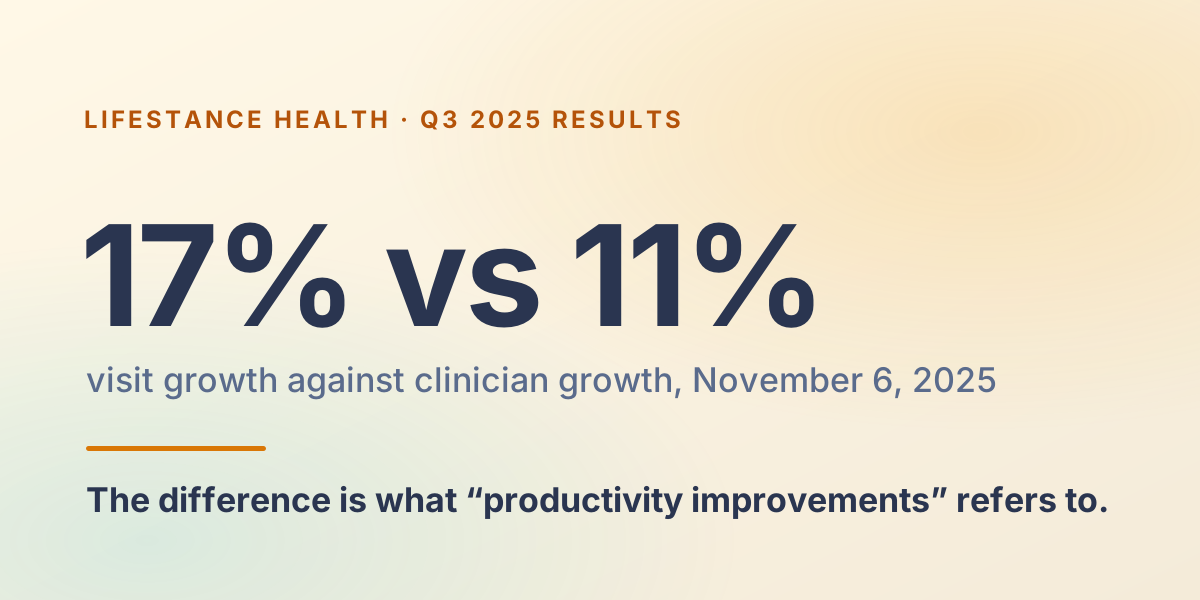
Quick answer: shareholder-run and clinician-led mental health AI are two business models, and only one of them has been measured. On November 6, 2025, LifeStance Health told shareholders it delivered 2.3 million visits, up 17%, on 11% clinician growth, credited to “our strongest-ever organic productivity improvements.” Private-equity penetration, clinic closure rates, an advertising-data settlement and an open federal inquiry into engagement monetization are all documented for the investor-owned side. There is no published study comparing clinician-owned tools against investor-owned ones on care outcomes. The absence is itself the finding.
By Matthew Sexton, LCSW, NATC — a licensed clinical social worker who builds clinician-led mental health software at Mental Wealth Solutions, Inc.
Mental health software is being built twice right now, by two kinds of organizations with two different sets of owners. One kind reports to a cap table. The other reports to a license. Most coverage of this treats it as a values debate, which is a comfortable way to have an argument nobody can lose. I would rather look at what has been counted about each model, and be honest about which side has a record and which side mostly has an absence.
The sentence that explains the whole model
LifeStance Health trades on the Nasdaq. In its third-quarter 2025 results (November 6, 2025), the company reported revenue of $363.8 million, up 16%. It reported 2.3 million visits, up 17%. It reported 7,996 clinicians, a net add of 288 for the quarter, and adjusted EBITDA of $40.2 million, up 31%, at an 11.1% margin. The CEO’s own summary of the quarter reads: “We delivered 17% organic visit growth, fueled by our strongest-ever organic productivity improvements and clinician net adds—bringing our team to approximately 8,000 clinicians.”
Do the arithmetic on those two growth rates. Visits up 17%, clinicians up 11%. The difference between them is what “productivity improvements” refers to, and the company reported it as a record.
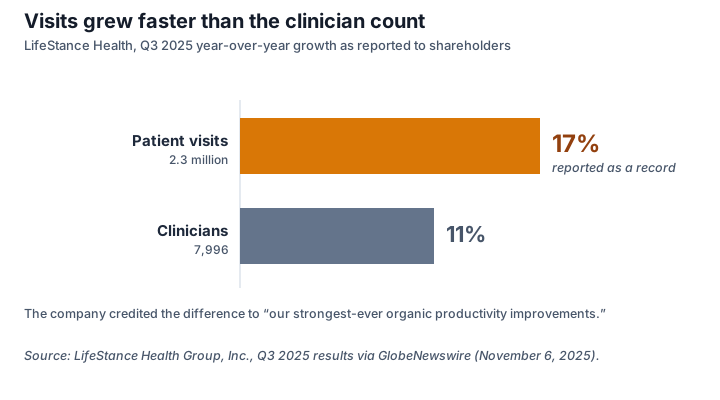
Nothing there is hidden, unusual, or wrong. It is a public company doing the thing public companies are legally organized to do, disclosed in plain language on the required schedule. My claim is a structural one.
“Once visits-per-clinician appears on an earnings deck, it becomes a number that gets managed. Anything not on that deck becomes a number that gets absorbed.” — Matthew Sexton, LCSW, NATC
Where the money went in 2025
The same logic runs at the level of capital allocation. Rock Health’s 2025 year-end funding overview (January 12, 2026) counted $14.2 billion raised by U.S. digital health startups, a 35% increase over 2024’s $10.5 billion. Deal count went the other way, falling 5% to 482 from 509. AI-enabled companies took 54% of the total, up from 37% the year before.
More money into fewer companies, with the AI label attached to most of it. That is concentration, and concentration is what determines whose product a therapist gets handed in 2027. It also determines whose product gets studied.
What ownership has already been measured doing
Zhu and colleagues, writing in JAMA Psychiatry (July 2024), tracked private equity acquisitions of behavioral health facilities between January 2012 and July 2023. Nationally, private equity firms picked up 6.2% of all U.S. mental health facilities and 7.1% of all substance use disorder facilities. National averages hide the shape of it. Colorado sits at 26.5%, Texas at 23.9%, North Carolina at 23.0%. Acquisition of mental health practices peaked in 2022 at 223 practices.
A second study went a layer deeper. Shields, Yang and Busch, also in JAMA Psychiatry (published online May 21, 2025), counted 87 private-equity-owned hospitals among 617 freestanding psychiatric hospitals by 2021. That works out to 14.10% of them, holding 4,660 beds. In 2013 the count was 42, so ownership climbed 75.59%, and 63.22% of the 87 sit in the southern United States. In adjusted models, those hospitals had fewer registered nurses per patient day (0.115 versus 0.151) and fewer medical social workers per patient day (0.015 versus 0.040).
Most write-ups of that paper stop right there, so here is the rest of it. The same study found private-equity ownership associated with better performance on several quality measures: restraint use, 7- and 30-day follow-up visits, and 30-day all-cause readmission. Anyone telling you this research proves private equity delivers worse psychiatric care has not read past the abstract.
So what does it show? Fewer nurses and fewer social workers per patient, with scored quality performance that held up. The measured things stayed fine. The reduction landed on the parts nobody scores: the nurse who happens to be in the hallway when a patient starts to spiral, the social worker who knows the discharge plan is fiction because the family will not take him back. That is not a moral failure of anyone working in those buildings. It is what happens when an organization is very good at optimizing and the scorecard is incomplete.
Bought, then closed
Ownership also decides which doors stay open. An independent analysis by Seth Glickman, MD, of the Center for Health and Democracy, published on HEALTH CARE un-covered (July 15, 2026), examined the outpatient behavioral health entities UnitedHealth Group acquired. Of the 70 entities it looked at, 37 have closed entirely or closed at least one office, which is 53%. At the level of individual practice locations, 108 of 216 have closed across 21 states, or 50%.
The label on that source matters, because the figure already circulates with the wrong one attached. It is an independent analysis published on a newsletter, not a government finding and not a Senate report. The same publication notes that a separate, earlier piece of work, Wendell Potter’s Sunlight Report on UnitedHealth’s subsidiary structure, was presented to the Senate HELP Committee (HEALTH CARE un-covered, July 15, 2026). Different report, different question, and the two get conflated constantly. I have not found an independent replication of the 37-of-70 count, so read it as one investigation’s finding.
In 2022, Optum paid more than $1 billion for Refresh Mental Health, a private-equity roll-up of more than 300 outpatient locations across 37 states, purchased from Kelso & Company. I have written before about what vertical integration does to behavioral health and about the closure figures themselves. A clinic is a building with a lease and a waitlist. When it closes, the people on that waitlist do not transfer anywhere. They stop being counted.
The product behaves the way the business model pays it to
Software leaves the same kind of trail.
In March 2023, BetterHelp agreed to pay $7.8 million in consumer refunds to resolve FTC charges, according to reporting on the settlement (FTC action announced March 3, 2023; final order approved July 2023). The charges said the company shared users’ email addresses, IP addresses and health questionnaire responses with Facebook, Snapchat, Criteo and Pinterest for advertising. Roughly 5.6 million individuals were targeted with ads as a result. Over one six-month period, 70,000 visitors’ email addresses went to Criteo. The order bans the company from sharing consumers’ health data for advertising.
Sit with what a mental health intake questionnaire contains. Those answers were an advertising input.
Two and a half years later, on September 11, 2025, the FTC issued Section 6(b) orders to seven companies operating consumer-facing generative AI companion chatbots. Per DLA Piper’s summary (September 2025), the orders demand information on age restrictions, pre-deployment and ongoing safety testing, character approval processes, complaint handling, and how the companies monetize user engagement.
Notice the last item. Faced with software that people talk to about their inner lives, the federal regulator’s opening question was about how the product makes money, not about how the model was built. If you run benefits for a company and you are evaluating an EAP or a mental health vendor, you are being handed the FTC’s question list for free. What you are buying is an incentive structure, and a vendor’s own investor materials will describe what it optimizes for more honestly than its sales deck will. The people on the other side of that purchase already have opinions about it, which I have written about separately in the employer-employee trust gap on AI mental health benefits.
Six years, or ninety-three million dollars
Therabot was built at Dartmouth’s Geisel School of Medicine by Michael Heinz and Nicholas Jacobson, in development since 2019. Its randomized controlled trial ran 106 treatment participants against 104 waitlist controls. Depression symptoms dropped 51% on average and anxiety symptoms 31%, and participants at risk for eating disorders reported a 19% reduction in body-image and weight concerns. The trial was published in NEJM AI on March 27, 2025, and remains the only published randomized trial of a generative-AI therapy chatbot (Dartmouth, March 27, 2025).
Read what its own builders said about it. Jacobson: “While AI-powered therapy is still in critical need of clinician oversight, it has the potential to provide real-time support.” Heinz: “No generative AI agent is ready to operate fully autonomously in mental health where there is a very wide range of high-risk scenarios.” Six years of work produced positive results and a refusal to claim autonomy.
Four months after that paper, on July 22, 2025, Slingshot AI launched Ash, marketed as the first AI designed for therapy, backed by $93 million from Andreessen Horowitz, Radical Ventures, Forerunner Ventures, Felicis and Menlo Ventures. It was tested with more than 50,000 beta users and launched free, with a planned subscription priced, per the company, similarly to Netflix (Forbes, July 22, 2025). No published clinical outcome data for Ash itself accompanied that launch.
I am not calling that dishonest, and I am not saying the second product is bad. Free-at-launch followed by subscription is a normal, legal, well-understood growth shape. I am pointing at the sequence. One path runs evidence first and distribution second. The other runs distribution first and evidence whenever. Neither team chose their sequence out of character. They chose it out of who was paying and what that money needed back.
The professional bodies have noticed. On November 13, 2025, the American Psychological Association issued a health advisory stating that AI chatbots and wellness apps “currently lack the scientific evidence and the necessary regulations to ensure users’ safety,” that “the ability of these tools to safely guide someone experiencing crisis is limited and unpredictable,” and that existing regulatory frameworks are “inadequate to address the reality of AI in mental health care.” The advisory noted that even tools built on high-quality psychological science “do not have enough evidence to show that they are effective or safe to use in mental health care.”
Shareholder-run vs. clinician-led mental health AI, side by side
Put the published record in one place and the shape of it is obvious. The right-hand column is mostly empty, and that emptiness is not a compliment to anybody.
| What has been counted | Shareholder-run / investor-owned model | Clinician-led model |
|---|---|---|
| Clinician productivity as a reported metric | 2.3 million visits, up 17%, on 11% clinician growth to 7,996 clinicians; credited to “our strongest-ever organic productivity improvements” (LifeStance Health Q3 2025, November 6, 2025) | No published record |
| Capital raised in 2025 | $14.2 billion across 482 deals, up 35% from $10.5 billion, on 5% fewer deals than 2024’s 509; AI-enabled companies took 54%, up from 37% (Rock Health, January 12, 2026) | Not separately reported in that dataset |
| Facility ownership | Private equity acquired 6.2% of U.S. mental health facilities and 7.1% of substance use disorder facilities, January 2012 to July 2023; Colorado 26.5%, Texas 23.9%, North Carolina 23.0% (Zhu et al., JAMA Psychiatry, July 2024) | No published record |
| Staffing per patient day, freestanding psychiatric hospitals | 87 of 617 hospitals (14.10%) private-equity owned by 2021. Fewer registered nurses (0.115 vs. 0.151) and fewer medical social workers (0.015 vs. 0.040) per patient day — and better performance on restraint use, 7- and 30-day follow-up visits, and 30-day all-cause readmission (Shields et al., JAMA Psychiatry, published online May 21, 2025) | No published record |
| What happened after acquisition | 37 of 70 acquired outpatient behavioral health entities (53%) and 108 of 216 individual locations (50%) closed across 21 states — an independent analysis by Seth Glickman, MD, Center for Health and Democracy, July 15, 2026, not a Senate report | No published record |
| Handling of intake data | BetterHelp paid $7.8 million in consumer refunds over FTC charges that questionnaire responses went to four advertising platforms; roughly 5.6 million individuals targeted (FTC action announced March 3, 2023) | No published record |
| Federal inquiry | FTC Section 6(b) orders to seven companies operating consumer AI companion chatbots, demanding information on how they monetize user engagement (September 11, 2025) | No published record |
| Care outcomes by ownership structure | Not studied | Not studied |
Table 1. Every figure above appears earlier in this post with its source and date. The last row is the point: no peer-reviewed or government analysis compares clinician-owned health technology against investor-owned equivalents on care outcomes, so neither column can claim that ground. A longer version of the ownership argument is in why clinician-built mental health AI is different.
Disclosure: I have a commercial interest in this comparison — Mental Wealth Solutions, Inc. builds a clinician-led product. Nothing in the table should be read as evidence that clinician-led tooling performs better. No such evidence exists.
The part I cannot prove
I went looking for the study that would have made this an easy post to write. Something peer-reviewed or governmental, comparing clinician-owned health technology against investor-owned equivalents on care outcomes.
It does not exist. This is not a case where the results came back mixed; there is no literature at all. The nearest adjacent research covers clinicians participating in hospital leadership and in device evaluation, which is a different question wearing similar clothes.
You should know where I am standing while I tell you that. Mental Wealth Solutions, Inc. builds a clinician-led product, VibeCheck.luxury, so I have a stake in how this argument lands. I would rather say so than perform a neutrality I do not have.
And having said it, I still cannot tell you clinician-led tools produce better outcomes, because nobody has shown it. What I can tell you is why the record is lopsided. Research follows scale, and scale follows capital. A consolidated, publicly traded, private-equity-backed sector generates filings, facility counts, staffing ratios and settlement orders, which is exactly the raw material a researcher needs. A few hundred small clinician-owned companies generate almost none of that. The investor-owned model has a paper trail because it got big enough to leave one.
So the fair version of this argument is that one model has been examined and found to behave in specific documented ways, while the other has mostly been left alone. If you are choosing between them, you are choosing between a known pattern and an unknown one. That is a real decision, and it deserves to be made with the evidence gap visible rather than papered over by whoever is selling you something.
What to actually ask
For an employer or a benefits committee, four questions get you most of the way:
- Who owns this vendor, and what do they report to their owners? Public companies publish it quarterly. Read one release before the demo.
- What happens to intake responses? BetterHelp’s questionnaire answers reached four advertising platforms. Ask where yours go, in writing.
- Does a licensed human review anything the tool produces that touches care? Therabot’s own developers say clinician oversight is still required. If a vendor claims otherwise, ask what evidence they have that the Dartmouth team does not. This is the same line I have drawn before on AI in mental health triage.
- What does this product count as success? Engagement minutes and clinical improvement are different targets, and only one of them shows up on an earnings call.
For an individual, it is shorter. Ask who built the thing, ask what they get paid for, and notice whether the answer takes one sentence or a link to a terms-of-service page.
None of this requires anyone to be a villain, and I would rather it did not. Clinicians inside investor-owned groups are doing careful work under productivity targets they did not set. The failure is structural. We let capital allocation decide what gets built for the most private hour of a person’s week, and then never funded the research that would tell us whether that was a good idea. If you want to talk through what this means for your practice or your benefits program, book a call.
FAQ
What is the difference between shareholder-run and clinician-led mental health AI? It is a difference in who the product answers to. A shareholder-run company owes a fiduciary duty to investors and reports the metrics investors bought, which is why LifeStance Health’s Q3 2025 release (November 6, 2025) presented 17% visit growth driven by record organic productivity improvements as good news. A clinician-led company answers first to the license of the person using it, because a board complaint lands on that person and not on the cap table. Both models can produce good software. They differ in what they count, and what gets counted is what gets protected when budgets tighten.
Is there evidence that clinician-led mental health tools produce better outcomes? No, and anyone claiming otherwise is ahead of the research. There is no peer-reviewed or government analysis comparing clinician-owned health technology against investor-owned equivalents on care outcomes. The investor-owned model has been studied repeatedly because it is large, publicly traded, and consolidated enough to generate data. The clinician-led model has almost no published record because it has never held enough capital to attract researchers. The honest position today is that one model has been measured and the other has not.
Does private equity ownership make psychiatric care worse? The published evidence does not support that sentence. Shields, Yang and Busch in JAMA Psychiatry (published online May 21, 2025) found that private-equity-owned freestanding psychiatric hospitals had fewer registered nurses per patient day (0.115 vs. 0.151) and fewer medical social workers per patient day (0.015 vs. 0.040). The same study found those hospitals performed better on measures of restraint use, 7- and 30-day follow-up visits, and 30-day all-cause readmission. Thinner staffing with quality-measure performance that did not decline is the accurate summary, and stretching it into a blanket quality claim misreads the source.
What should an employer ask a mental health vendor before buying? Start with the questions the FTC asked. Its September 11, 2025 orders to seven companies operating consumer AI companion chatbots demanded information on how those companies monetize user engagement, what age restrictions apply, what pre-deployment and ongoing safety testing exists, and how complaints are handled (DLA Piper, September 2025). A benefits buyer should ask the same things, plus who owns the vendor, what happens to intake responses, whether a licensed clinician reviews any output that shapes care, and what the vendor’s own earnings materials count as success. BetterHelp’s $7.8 million FTC settlement over sharing health questionnaire responses with advertising platforms is the reason those questions belong in procurement rather than in a footnote.
Sources
- LifeStance Reports Third Quarter 2025 Results, LifeStance Health Group, Inc. via GlobeNewswire (November 6, 2025). Revenue $363.8 million up 16%, 2.3 million visits up 17%, 7,996 clinicians up 11%, adjusted EBITDA $40.2 million up 31%, and the CEO’s productivity quote.
- 2025 Year-End Digital Health Funding Overview: A Tale of Two Markets, Rock Health (January 12, 2026). $14.2 billion across 482 deals, up 35% from $10.5 billion, deal count down 5% from 509, AI-enabled companies at 54% of funding.
- Geographic Penetration of Private Equity Ownership in Outpatient and Residential Behavioral Health, Zhu JM, Greenberg E, King M, Busch S, JAMA Psychiatry 2024;81(7):732-735 (July 2024). 6.2% of U.S. mental health facilities and 7.1% of substance use disorder facilities; Colorado 26.5%, Texas 23.9%, North Carolina 23.0%; 2022 peak of 223 practices.
- Private Equity Among US Psychiatric Hospitals, Shields MC, Yang Y, Busch SH, JAMA Psychiatry 2025;82(7), published online May 21, 2025. 87 of 617 freestanding psychiatric hospitals (14.10%) and 4,660 beds; 75.59% increase from 2013; staffing differences for registered nurses and medical social workers; higher performance on restraint, follow-up and readmission measures.
- Bought, Then Shuttered: What UnitedHealth Group did with the Behavioral Health Clinics it Acquired, Seth Glickman, MD, Center for Health and Democracy / HEALTH CARE un-covered (July 15, 2026). An independent investigation, not a Senate report: 53% (37 of 70) of acquired entities and 50% (108 of 216) of individual locations closed across 21 states; Optum’s $1 billion-plus purchase of Refresh Mental Health in 2022.
- BetterHelp Settlement Agreed with FTC to Resolve Health Data Privacy Violations, HIPAA Journal (FTC action announced March 3, 2023; final order approved July 2023). $7.8 million in consumer refunds, data shared with Facebook, Snapchat, Criteo and Pinterest, approximately 5.6 million individuals targeted, 70,000 email addresses to Criteo over six months.
- AI companion bots: Top points from recent FTC and government actions, DLA Piper (September 2025). FTC Section 6(b) orders of September 11, 2025 to seven companies, including demands regarding how companies monetize user engagement.
- First Therapy Chatbot Trial Yields Mental Health Benefits, Dartmouth (March 27, 2025), on the NEJM AI publication. 106 treatment and 104 waitlist participants, 51% depression and 31% anxiety symptom reduction, 19% reduction in body-image and weight concerns; the Jacobson and Heinz quotes on clinician oversight and autonomy.
- Can A Chatbot Be Your Therapist? Casper’s Neil Parikh Launches A New $93 Million-Backed Startup To Try, Forbes (July 22, 2025). Ash’s launch, $93 million in backing, investor list, 50,000-plus beta users, free launch with planned subscription.
- Artificial intelligence, wellness apps alone cannot solve mental health crisis, American Psychological Association health advisory (November 13, 2025). The evidence, crisis-guidance and regulatory-adequacy quotes.
Disclaimer
This article is for educational and informational purposes only. It does not constitute medical, clinical, legal, or therapeutic advice, and reading it does not create a therapist-client relationship with Matthew Sexton, LCSW or Mental Wealth Solutions, Inc. Although the author is a licensed clinical social worker, the content in this article is not clinical assessment, diagnosis, or treatment.
Company ownership, funding totals, acquisition counts, regulatory inquiries and product terms described here reflect public filings, published research and press coverage as of the dates cited, and any of them may change after this article is published. The staffing and quality findings summarized here describe groups of facilities studied in aggregate rather than any individual clinic, clinician, or reader’s experience, and the author has a commercial interest in clinician-led mental health software. Nothing here is a substitute for reviewing a specific vendor’s contract, privacy terms and ownership structure with your own compliance team, benefits advisor, or qualified counsel.
If you are in immediate emotional crisis, you can reach the 988 Suicide & Crisis Lifeline by calling or texting 988 (US). If you are experiencing domestic violence or are in physical danger, contact the National Domestic Violence Hotline at 1-800-799-7233 or visit thehotline.org. In a life-threatening emergency, call 911.
Frequently asked questions.
- What is the difference between shareholder-run and clinician-led mental health AI?
- It is a difference in who the product answers to. A shareholder-run company owes a fiduciary duty to investors and reports the metrics investors bought, which is why LifeStance Health's Q3 2025 release (November 6, 2025) presented 17% visit growth driven by record organic productivity improvements as good news. A clinician-led company answers first to the license of the person using it, because a board complaint lands on that person and not on the cap table. Both models can produce good software. They differ in what they count, and what gets counted is what gets protected when budgets tighten.
- Is there evidence that clinician-led mental health tools produce better outcomes?
- No, and anyone claiming otherwise is ahead of the research. There is no peer-reviewed or government analysis comparing clinician-owned health technology against investor-owned equivalents on care outcomes. The investor-owned model has been studied repeatedly because it is large, publicly traded, and consolidated enough to generate data. The clinician-led model has almost no published record because it has never held enough capital to attract researchers. The honest position today is that one model has been measured and the other has not.
- Does private equity ownership make psychiatric care worse?
- The published evidence does not support that sentence. Shields, Yang and Busch in JAMA Psychiatry (published online May 21, 2025) found that private-equity-owned freestanding psychiatric hospitals had fewer registered nurses per patient day (0.115 vs. 0.151) and fewer medical social workers per patient day (0.015 vs. 0.040). The same study found those hospitals performed better on measures of restraint use, 7- and 30-day follow-up visits, and 30-day all-cause readmission. Thinner staffing with quality-measure performance that did not decline is the accurate summary, and stretching it into a blanket quality claim misreads the source.
- What should an employer ask a mental health vendor before buying?
- Start with the questions the FTC asked. Its September 11, 2025 orders to seven companies operating consumer AI companion chatbots demanded information on how those companies monetize user engagement, what age restrictions apply, what pre-deployment and ongoing safety testing exists, and how complaints are handled. A benefits buyer should ask the same things, plus who owns the vendor, what happens to intake responses, whether a licensed clinician reviews any output that shapes care, and what the vendor's own earnings materials count as success. BetterHelp's $7.8 million FTC settlement over sharing health questionnaire responses with advertising platforms is the reason those questions belong in procurement rather than in a footnote.
Want to discuss this for your program?
Book a 30-min conversation. We'll walk you through deployment, the BAA, and what your rollout looks like in production.
Book a 30-min conversation