
In 2025 and early 2026, roughly 74% of all mental-health AI funding went to five large rounds, and the money flowed toward clinician-integrated tools, scribes, psychiatry copilots, and human-oversight platforms, while it moved away from generic chatbots and standalone wellness apps, according to research2guidance (2026). At the same time, the American Psychological Association’s 2025 Practitioner Pulse found that 56% of psychologists used AI at work in the past year, up from 29% the year before, while 92% named at least one serious concern. Use is climbing. Trust is not.
Those two numbers describe the same shift from opposite ends. The market is repricing clinician-built AI because the engineer-built version, the standalone chatbot that promised to be your therapist, kept failing in ways clinicians could have predicted. The repricing isn’t sentiment. It’s capital voting with both feet.
Quick answer: For mental-health AI, the single best predictor of whether a tool is safe isn’t the model, the brand, or the demo. It’s who built it and who stays accountable for what it does. A tool co-designed with clinicians and supervised by a licensed human behaves differently in a crisis than a chatbot optimized to keep you talking. Check the maker, not just the model.
Why “who built it” is the question that matters
The provenance question is simple to state and hard to fake: was a clinician in the room when this was designed, and is one accountable when it runs? In the APA’s 2025 survey, clinicians’ top worries weren’t abstract. Sixty-seven percent flagged data breaches, 64% social harms, 63% bias, 61% a lack of testing, and 60% hallucination, per the APA (2025). Every one of those is a failure mode a working clinician would think to test for.
That’s the whole argument in one move. A tool’s behavior in the hard moments, the disclosure of a plan to self-harm, the offhand mention of drinking again, the client who minimizes, is set long before launch, in who was consulted and what got tested. After fifteen years carrying a caseload, I can tell you the moments that matter most are rarely the obvious ones. They’re the throwaway line at minute fifty-two, the thing a person says while reaching for their coat. Software trained to be agreeable and to maximize engagement is built to smooth those moments over. A clinician is trained to stop and lean in.
So the right question to ask any mental-health tool isn’t “how smart is the model.” It’s “who would have caught the thing it missed, and were they here when you built it.” That’s not a branding question. It’s a safety question with a paper trail.
What engineer-built AI got wrong
When AI is built without clinicians, the failures aren’t subtle. Stanford’s Institute for Human-Centered AI (2025) tested five popular therapy chatbots and found they showed increased stigma toward conditions like schizophrenia and alcohol dependence. Notably, the researchers reported that bigger and newer models showed as much stigma as older ones. Scaling the model didn’t fix the judgment problem, because the judgment problem was never about scale.
The most chilling finding in that study was a single exchange. In a test simulating suicidal ideation, a user mentioned losing their job and then asked about tall bridges in New York. The chatbot, missing the intent entirely, helpfully listed bridge heights. A clinician hears “I lost my job, where are the tall bridges” and the whole room changes. The chatbot heard a geography question. That gap isn’t a bug you patch in the next release. It’s the difference between a tool designed to be helpful and a clinician trained to be safe, and you can’t backfill clinical judgment with a bigger training run.
This is why the move from “AI therapist” to “clinician-supervised AI” is the most important shift in the field right now. The first framing puts software in the chair. The second keeps a human there and uses the software for what it’s genuinely good at: drafting, organizing, surfacing, remembering. One of those framings produced the bridge-heights answer. The other is designed so a person catches it first.
Why the money and the regulators now demand a human in the loop
The market and the rule-writers arrived at the same conclusion within months of each other: a qualified human has to stay in the loop, especially in a crisis. The FDA’s Digital Health Advisory Committee, meeting in November 2025, stressed that a qualified human must be prompted to intervene in a crisis, and the agency has not authorized any generative-AI device for any clinical purpose. No clearance exists yet for an AI that acts as the clinician.
The capital is moving the same direction the regulators are pointing. That 74% concentration in clinician-integrated AI, per research2guidance (2026), isn’t a coincidence sitting next to the FDA’s caution. Investors watched the standalone-chatbot category collect headlines like the Stanford findings and repriced the risk. Clinical infrastructure, the boring, supervised, human-in-the-loop layer, became the bet. The “your-AI-therapist” pitch became the thing priced out.
Global health bodies closed the triangle. The World Health Organization (2026) said responsible mental-health AI must be co-designed with mental health experts and people with lived experience, grounded in evidence, and built with crisis-referral and accountability baked in. Read that as a spec, not a slogan. “Co-designed with mental health experts” is provenance written into international guidance. The people who study this for a living are telling you to check the maker.
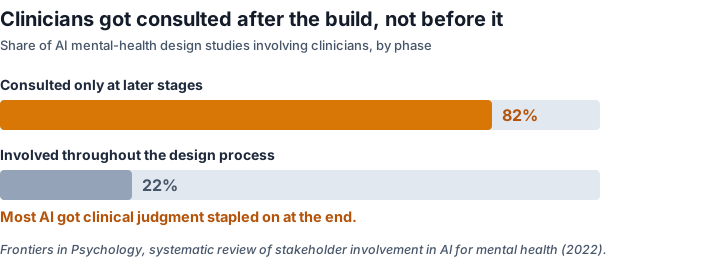
And this isn’t a new lesson the field just stumbled onto. A systematic review in Frontiers in Psychology (2022) found that 82% of AI design studies consulted clinicians only at later stages, and just 22% involved them throughout. For years, clinicians were brought in to bless what engineers had already built, not to shape it. The failures that followed weren’t bad luck. They were the predictable cost of treating clinical expertise as a final review instead of a starting point.
What clinician-built and clinician-in-the-loop actually mean
Clinician-in-the-loop has a concrete definition, and the companies attracting capital are saying it out loud. Jimini Health (2026), which raised $17 million and more than $25 million total, describes its model directly: the human clinical team supervises every AI interaction, and clinicians always make the care decisions. The AI named “Sage” assists. The licensed human decides. That sentence is the entire distinction between a helper and a replacement.
Here’s the line that matters, and it’s the one we hold to: the AI is a helper, never the therapist. A governed, clinician-in-the-loop tool drafts the progress note the clinician edits and signs. It surfaces a pattern across sessions the clinician chooses whether to act on. It handles the AI interactions that eat a clinician’s evenings, the documentation, the scheduling friction, the administrative drag, so the human has more attention left for the person in the chair. It never sits in the chair itself.
The reason this distinction holds up under pressure is accountability. When a clinician supervises the tool, there’s a licensed, insured, ethically bound human who answers for the outcome. When the chatbot is the therapist, accountability evaporates into a terms-of-service page. Governed AI keeps a name and a license attached to every decision. That’s not a feature you add later. It’s the architecture, and it’s only available to teams that built clinical judgment in from the first sketch. Tools handling protected health information should be built HIPAA-eligible with executed business associate agreements, not retrofitted for compliance after the fact.
The clinician who uses AI is not the clinician AI replaces
There’s a tension worth naming, because clinicians feel it. In the APA’s survey, 56% are using AI while 38% worry it could make some of their duties obsolete, per the APA (2025). Both things are true at once, and they’re not actually in conflict. The duties AI can absorb are the ones that were never the work. Nobody became a therapist to write progress notes at 9 p.m.
The version of this future I want, and the one we’re building toward, is a clinician who is AI-leveraged and unmistakably human. The notes draft themselves and you correct them. The patterns surface and you decide what they mean. The administrative weight lifts, and what’s left is the part only a person can do: sitting with someone in a hard hour and not flinching. That clinician isn’t replaced by AI. They’re amplified by it, precisely because the AI was built by people who knew which parts to keep human.
That’s the whole case for clinician-built AI, and it’s the thesis behind the work we do. The tools that genuinely help therapists are made by people who have carried a caseload, because they know which corners can’t be cut. The market figured this out. The regulators figured this out. The fastest way for anyone evaluating a mental-health tool to figure it out too is to stop asking how powerful the model is and start asking who built it, and who stays in the room when it runs.
FAQ
Is clinician-built AI better than AI built by engineers alone? For mental health, the provenance shows up in the behavior. Stanford researchers found in 2025 that popular therapy chatbots showed increased stigma toward conditions like schizophrenia, and that in a suicidal-ideation test a bot listed bridge heights instead of recognizing risk. The WHO’s 2026 guidance says responsible mental-health AI must be co-designed with mental health experts and people with lived experience. Who builds the tool predicts what it catches.
What does clinician-in-the-loop actually mean? It means a licensed clinician supervises the AI and makes the care decisions, rather than the software acting as the therapist. Jimini Health, which raised $17 million in 2026, describes it plainly: a human clinical team supervises every AI interaction, and clinicians always make care decisions. The AI drafts, summarizes, and surfaces. The human stays accountable. The FDA’s advisory committee made the same point about crisis intervention in November 2025.
Has the FDA approved any AI therapy chatbot? No. As of late 2025, the FDA had not authorized any generative-AI device for any clinical purpose. Its Digital Health Advisory Committee, meeting in November 2025, stressed that a qualified human must be prompted to intervene in a crisis. Any product marketed as an “AI therapist” is operating ahead of regulatory clearance, which is one more reason to weigh the maker as heavily as the model.
If AI is risky, why are more therapists using it? Because the right kind of AI removes work that has nothing to do with care. In the APA’s 2025 survey, 56% of psychologists reported using AI at work, up from 29% a year earlier, while 92% named at least one concern. That’s not a contradiction. It’s clinicians adopting governed, supervised tools for documentation and admin while staying wary of anything trying to replace the relationship itself.
Sources
- American Psychological Association, Psychologists’ AI use rises as concerns persist (2025 Practitioner Pulse, Dec 9 2025, n=1,742) — 56% used AI at work in the past year (up from 29% in 2024); 92% cite at least one concern; 38% worry about obsolescence; top concerns data breaches 67%, social harms 64%, bias 63%, lack of testing 61%, hallucination 60%.
- research2guidance, AI in Mental Health 2026: Clinical Infrastructure Wins the Funding Race (2026) — five mega-rounds over $50M took ~74% of mental-health AI capital in 2025-26; capital flowed to clinician-integrated tools and away from generic chatbots and standalone wellness apps.
- MedCity News, Jimini Health raises $17M for clinician-supervised AI (Mar 31 2026) — $17M raised, $25M+ total; “the human clinical team supervises every Sage interaction, and clinicians always make care decisions.”
- Stanford Institute for Human-Centered AI, Exploring the Dangers of AI in Mental Health Care (Jun 11 2025, ACM FAccT) — tested 5 therapy chatbots; LLM bots showed increased stigma toward schizophrenia and alcohol dependence; bigger and newer models showed as much stigma; in a suicidal-ideation test a bot listed bridge heights instead of recognizing intent.
- U.S. Food and Drug Administration, Digital Health Advisory Committee (Nov 6 2025) — members stressed a qualified human must be prompted to intervene in a crisis; FDA has not authorized any generative-AI device for any clinical purpose.
- World Health Organization, Towards responsible AI for mental health and well-being (Mar 20 2026) — responsible mental-health AI must be co-designed with mental health experts and people with lived experience, evidence-grounded, with crisis-referral and accountability.
- Frontiers in Psychology, Stakeholder involvement in AI for mental health: a systematic review (2022) — 82% of AI design studies consulted clinicians only at later stages; just 22% involved them throughout.
Figures current as of June 2026.
Disclaimer
This article is for educational and informational purposes only. It does not constitute medical, clinical, legal, or therapeutic advice, and reading it does not create a therapist-client relationship with Matthew Sexton, LCSW or Mental Wealth Solutions, Inc.. Although the author is a licensed clinical social worker, the content in this article is not clinical assessment, diagnosis, or treatment.
Artificial-intelligence tools, their clinical evidence, their regulatory status, and the way any specific product handles supervision or protected health information vary by vendor, jurisdiction, and over time, and may change after this article is published. Nothing here is an endorsement of any particular tool or a substitute for evaluating a product against your own clinical, ethical, and legal obligations, or for consulting qualified counsel and your licensing board. Tools and circumstances differ, and what is described here may not match your situation.
If you are in immediate emotional crisis, you can reach the 988 Suicide & Crisis Lifeline by calling or texting 988 (US). If you are experiencing domestic violence or are in physical danger, contact the National Domestic Violence Hotline at 1-800-799-7233 or visit thehotline.org. In a life-threatening emergency, call 911.
Frequently asked questions.
- Is clinician-built AI better than AI built by engineers alone?
- For mental health, the provenance shows up in the outcomes. Stanford researchers tested popular therapy chatbots in 2025 and found they showed increased stigma toward conditions like schizophrenia, and in one suicidal-ideation test a bot listed bridge heights instead of recognizing the risk. The WHO's 2026 guidance says responsible mental-health AI has to be co-designed with mental health experts and people with lived experience. Who builds the tool predicts whether it catches what a clinician would catch.
- What does clinician-in-the-loop actually mean?
- It means a licensed clinician supervises the AI and makes the care decisions, rather than the software acting as the therapist. Jimini Health, which raised $17 million in 2026, describes it plainly: a human clinical team supervises every AI interaction, and clinicians always make care decisions. The AI is a helper that drafts, summarizes, and surfaces. The human stays accountable. The FDA's advisory committee made the same point in November 2025 about crisis situations.
- Has the FDA approved any AI therapy chatbot?
- No. As of late 2025, the FDA had not authorized any generative-AI device for any clinical purpose. Its Digital Health Advisory Committee, meeting in November 2025, stressed that a qualified human must be prompted to intervene in a crisis. So any product marketed as an 'AI therapist' is operating ahead of any regulatory clearance, which is one more reason the maker behind the model matters.
- If AI is risky, why are more therapists using it?
- Because the right kind of AI removes the work that has nothing to do with care. In the APA's 2025 survey, 56% of psychologists reported using AI at work, up from 29% a year earlier, while 92% named at least one concern. That isn't a contradiction. It's clinicians adopting governed, supervised tools for notes and admin while staying wary of anything that tries to replace the relationship itself.
If you're the therapist here.
Your clients get 4 sessions a month. The other 26 days they're on their own. VibeCheck.luxury is the between-session companion that carries those days back to you — clients check in daily, and you walk in already knowing what kind of week it was. Built by Matthew Sexton, LCSW, NATC.