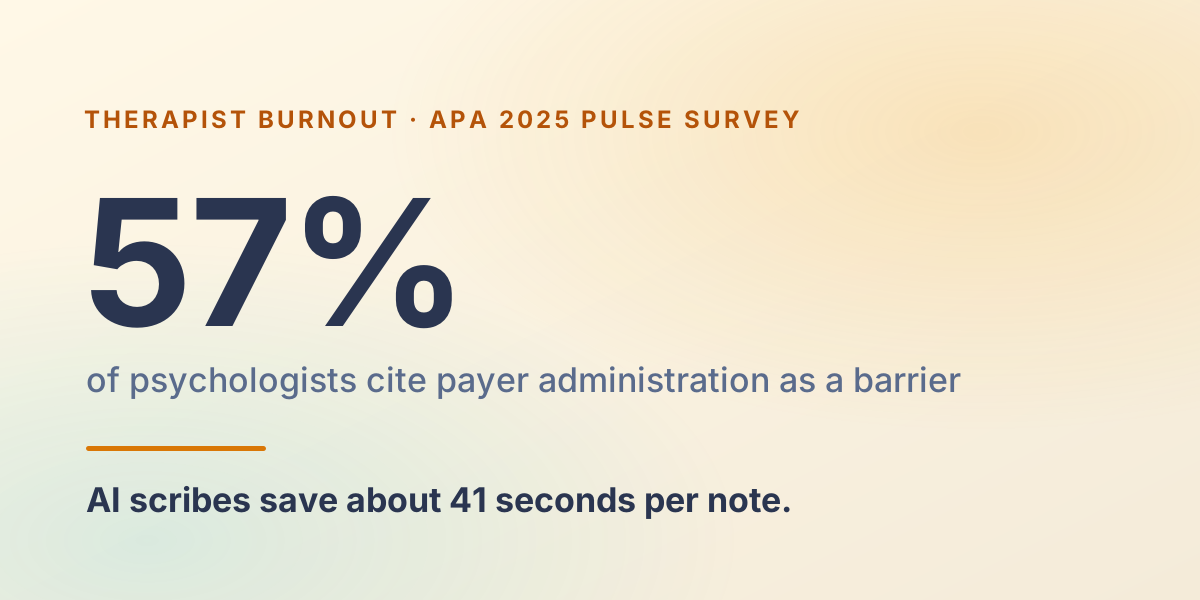
Ask psychologists why they will not take your insurance and the second answer on the list is paperwork. In the American Psychological Association’s 2025 Practitioner Pulse Survey of 1,742 practitioners (December 2025), 57% named administrative issues with insurance payers as a barrier to accepting plans, behind insufficient reimbursement at 75% and ahead of payment-reliability concerns at 43%. Ten percent said they had stopped participating in a private or commercial insurance panel within the past year. Nothing in that answer is about the clinical work.
Quick answer: administrative friction with commercial payers is the second-most-cited reason psychologists refuse insurance panels, at 57% (APA Practitioner Pulse Survey, December 2025). One in ten left a private or commercial panel last year. AI scribes cut documentation time by 9.5%, about 41 seconds per note, and only for one of two products tested (NEJM AI, November 2025).
By Matthew Sexton, LCSW, NATC, a Licensed Clinical Social Worker and Certified Narcissistic Abuse Treatment Clinician in private practice.
The exit door is administrative
I have written before about why clinicians are quitting and what that does to access. This post is about the specific mechanism, because the mechanism is where the fixes get aimed.
Go back a year and the same survey tells a familiar story. In APA’s 2024 Practitioner Pulse Survey, among psychologists who had not accepted, had left, or had stopped taking insurance, 62% reported administrative issues such as preauthorization requirements or audits, and 82% reported insufficient reimbursement rates. About a third of psychologists reported feeling burned out. The administrative complaint moved from 62% to 57% in a year. That is a small drift, and I would not read it as improvement.
Meanwhile the demand side keeps climbing. In the 2025 survey, 46% of practitioners had no openings for new patients at all, 40% were maintaining a waitlist, and 45% reported an increase in symptom severity among the patients they already had. Clinicians are leaving panels in a market where demand already exceeds the supply of appointments, which suggests the administrative push weighs more heavily on them than a full schedule does.
The paperwork has a sender
Documentation does not appear from nowhere. Somebody requires it, and somebody benefits from the friction it creates. I have written about how insurers use prior authorization as a cost-control lever before; this is the same machinery, seen from the clinician’s desk.
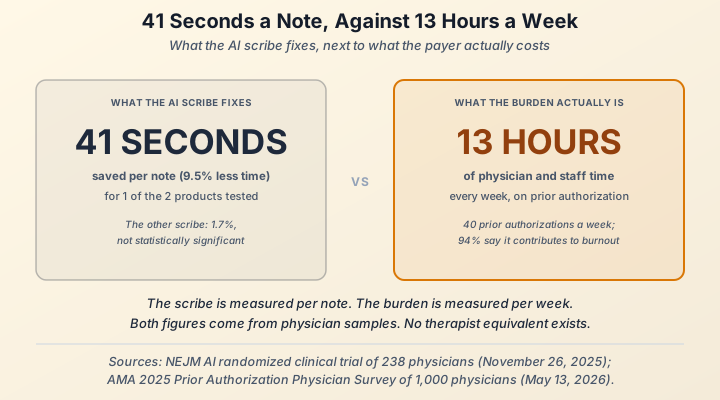
The cleanest recent measurement covers physicians instead of therapists, and it concerns commercial payers. The American Medical Association surveyed 1,000 practicing physicians for its 2025 prior authorization survey, released May 13, 2026. Prior authorization consumed an average of 13 hours of physician and staff time each week. Physicians completed an average of 40 prior authorizations inside those hours. Ninety-four percent said the process contributes to burnout.
Denials, and who reviews them
The rest of the survey shows what is behind that number. Seventy-four percent said denials have increased over the past five years, and 32% said requests are often or always denied. When a denial cites medical necessity, only 24% said a qualified clinician consistently reviews it.
Two more numbers are worth holding onto. Twenty-six percent of physicians reported that prior authorization led to a serious adverse event for a patient in their care, and only 33% believed the insurance industry’s latest reform pledge will make a meaningful difference.
That is a physician survey, and I am labeling it that way on purpose. Even so, those 13 hours a week are spent asking a commercial payer for permission, and the payer is the party that sets how much permission-asking the work requires.
Nobody is counting what administrative burden costs therapists
While researching this piece I went looking for a defensible figure on how many hours a week a therapist loses to administrative work. There isn’t one.
Every number in circulation, and there are many, traces back to an EHR vendor’s marketing page. Hours lost per week, minutes per progress note, the share of the workday swallowed by documentation, the percentage of stress an AI scribe supposedly removes. Chase any of them upstream and the trail ends at a software company’s blog with no study, no sample, and no citation. I am not going to reprint those figures here, even to knock them down. A number that gets quoted often enough starts to count as a fact, regardless of where it came from. A statistic with no study behind it is a marketing asset wearing a lab coat.
The closest verified data is about physicians
What does exist is physician data, and it is old. A peer-reviewed analysis in the International Journal of Health Services (2014, using 2008 survey data from 4,720 physicians) found U.S. physicians spent an average of 8.7 hours per week, 16.6% of working hours, on administration. Psychiatrists carried the highest administrative share of any specialty at 20.3%. That data is nearly two decades old. Treat it as history.
One finding in it still matters. The same paper found that EMR adoption was associated with greater administrative workload. Software sold as documentation relief became documentation labor. I traced how that happened in your EHR, the unpaid transcriptionist.
The honest state of the evidence is lopsided. We can measure what the payer costs a physician, and we cannot measure what documentation costs a therapist, because nobody with academic rigor has counted it. In that vacuum, the only figures on offer are the ones written by the companies selling the software.
What AI actually gets right about therapist burnout and administrative burden
The best evidence available is a genuine randomized trial, and it deserves a close read of the paper itself.
UCLA Health ran a three-arm pragmatic randomized clinical trial of 238 physicians across 14 specialties, published in NEJM AI on November 26, 2025 and available in full text. Roughly 72,000 patient encounters. Physicians using the Nabla ambient scribe reduced documentation time by 9.5% versus usual care (95% CI −17.2% to −1.8%, p=.02), which works out to about 41 seconds per note, from 4:30 down to 3:49. Physicians using Microsoft DAX showed a 1.7% reduction that was not statistically significant.
Burnout scores improved too, by roughly 7% across both AI arms, per the UCLA Health release. On validated instruments that came to a Mini-Z 2.0 improvement of 2.76 points (p<.001), a Professional Fulfillment Index work-exhaustion change of −0.27 (p=.01), and a task-load reduction of 35.8 points (p=.01). Fewer than 10% of patients declined to have the scribe used.
Those are real findings, peer-reviewed and statistically significant, and I am not going to pretend otherwise. A clinician who is not typing can look at the person in front of them. That matters even at 41 seconds.
Now the limitations, which the authors state themselves. One institution, a two-month intervention, a majority-female sample, and time metrics drawn from the EHR’s own analytics that do not account for time spent editing inside the AI platforms. Editing an AI draft is work, and it is not counted here. The honest reading of the strongest trial we have is that AI scribes save a modest amount of documentation time, and the true figure may be smaller than the reported one.
What AI gets wrong
Accuracy is where the trade-off shows up.
A validated blinded evaluation published in Frontiers in Artificial Intelligence (October 22, 2025) reviewed 97 clinical encounters, 194 notes and 388 paired reviews. It found hallucinated content in 31% of AI ambient-scribe notes versus 20% of physician-authored notes (p=0.01). Overall quality scores were nearly identical, 4.20 versus 4.25 on a five-point scale, and reviewers preferred the AI note 47% of the time against 39% for the physician note. AI notes scored better on thoroughness and organization. Human notes scored better on succinctness and accuracy.
One caveat, stated plainly. That study covered general medicine, pediatrics, OB/GYN, orthopedics and adult cardiology. No behavioral health specialty was in the sample. Nobody has run this evaluation on therapy notes, where the content is a person’s most private hour instead of a lab value.
The UCLA trial found the same shape from the inside. Physicians reported clinically significant inaccuracies occurring occasionally, at 2.7 for DAX and 2.8 for Nabla on a five-point scale, with no meaningful difference between the products. One Grade 1 adverse event, a mild patient safety event, was logged during the study period.
Put the two sets of findings side by side. A tool that saves 41 seconds per note while hallucinating at a higher rate than a human is a trade the clinician has to manage, session by session. That review work is a new job, and the state rules governing it attach to your license rather than to the vendor’s.
Clinicians are adopting it anyway
The adoption curve has already settled this argument. In the APA’s 2025 survey, the share of psychologists who had never used AI to assist with their practice fell from 71% in 2024 to 44% in 2025. Twenty-nine percent now use AI at least monthly, up from 11% the year before, and 8% report daily use. Back in 2024, 27% of psychologist AI users were already using it for note-taking or dictation.
Therapists are going to use these tools. So what does the evidence on therapist burnout, administrative burden, and AI actually support — are the tools pointed at the thing pushing people out? Compare the numbers honestly: 41 seconds saved per note, against 13 hours a week of prior authorization, 74% of physicians reporting denials on the rise, and 57% of psychologists naming payer administration as a reason to stay off panels.
Nobody has published the arithmetic that connects those two figures, so here it is with its assumption showing. Assume a clinician carries 25 sessions in a week and writes one note for each. That caseload is my stated assumption rather than a study finding, and you can substitute your own.
At 41 seconds saved per note, an AI scribe hands back 1,025 seconds a week, which comes to about 17 minutes. Set those 17 minutes beside the 13 hours a week the AMA measured for prior authorization, and the scribe returns roughly 2% of the administrative time the payer creates.
Vary the caseload and the shape holds. Twenty sessions a week returns about 14 minutes and 40 sessions returns about 27 minutes, so the answer stays under half an hour at any caseload a human can actually see. Both inputs come from physician samples, so read this as an order-of-magnitude comparison and not as a therapist measurement. The scribe is winning a race at the note while the exit keeps happening at the payer.
| What was measured | Figure | Source |
|---|---|---|
| Documentation time saved, Nabla ambient scribe | 9.5%, about 41 seconds per note | NEJM AI randomized trial, November 26, 2025 |
| Documentation time saved, Microsoft DAX | 1.7%, not statistically significant | NEJM AI randomized trial, November 26, 2025 |
| Burnout score improvement, both AI arms | About 7% | NEJM AI / UCLA Health, November 2025 |
| Prior authorization time, physician and staff | 13 hours per week | AMA 2025 prior authorization survey |
| Prior authorizations completed per physician | 40 per week | AMA 2025 prior authorization survey |
| Physicians saying prior authorization contributes to burnout | 94% | AMA 2025 prior authorization survey |
| Physicians reporting denials rose over five years | 74% | AMA 2025 prior authorization survey |
| Psychologists citing payer administration as a panel barrier | 57% | APA 2025 Practitioner Pulse Survey, December 2025 |
The top three rows are what the tool changes. The bottom four are what the clinician is leaving over. The NEJM AI and AMA rows come from physician samples; only the last row is psychologists.
“The scribe is winning a race at the note while the exit keeps happening at the payer.”
— Matthew Sexton, LCSW, NATC
What would have to change
If you employ clinicians, or you buy the benefits plan that covers your workforce, this is where you have pull. A scribe subscription is a cheap, visible gesture that photographs well in a retention slide deck. It buys back seconds. Prior-authorization volume, denial rates, audit frequency and panel administration buy back hours, and those are negotiable terms in a contract somebody at your company signs. The subscription is something a company purchases, and the contract terms are something a company decides to reopen.
For clinicians, the reasonable position sits between refusal and rescue. Use the tool, read every line it writes, and keep your name attached to the note, because the license is yours and so is the liability. That is the standard we hold ourselves to in how VibeCheck.luxury is built.
And notice who is not the villain in any of this. The client did not design the authorization workflow. The therapist is doing unpaid clerical labor at the end of a clinical day. The burnout-to-exit pipeline is a set of administrative requirements issued by parties with a financial interest in friction, and it will keep running at full capacity no matter how fast the notes get written. If you want to talk through what this means for your workforce or your practice, book a call.
FAQ
Why are therapists leaving insurance panels? Money first, paperwork second. In the APA 2025 Practitioner Pulse Survey of 1,742 practitioners (December 2025), 75% of psychologists cited insufficient reimbursement as a barrier to accepting insurance plans. Administrative issues with payers were cited by 57%, ahead of payment-reliability concerns at 43%. Ten percent had stopped participating in a private or commercial insurance panel within the past year. Thirty-eight percent accept no insurance at all. The 2024 edition found that among psychologists who had not accepted, had left, or had stopped taking insurance, 62% named administrative issues such as preauthorization requirements or audits, so the complaint is persistent rather than new.
Do AI scribes actually reduce burnout? Measurably, and modestly. A three-arm randomized trial of 238 physicians across 14 specialties, published in NEJM AI on November 26, 2025 (full text), found roughly a 7% improvement in burnout scores among clinicians using either of two ambient AI scribes: a Mini-Z 2.0 improvement of 2.76 points and a work-exhaustion change of −0.27 on the Professional Fulfillment Index. Documentation time fell 9.5% for one product, about 41 seconds per note, and by a statistically insignificant 1.7% for the other. The trial itself ran from November 4, 2024 to January 3, 2025, and 60.5% of the enrolled physicians were female. The authors note the trial ran two months at a single institution and that their time metrics do not capture editing time inside the AI platforms, so the true saving may be smaller than reported.
How many hours a week do therapists lose to administrative work? Nobody has rigorously measured it. Every widely circulated therapist-specific figure traces back to EHR-vendor marketing pages with no study behind them, so this article does not use any of them. The closest verified data comes from physicians. U.S. physicians spend an average of 8.7 hours per week on administration, or 16.6% of working hours. Psychiatrists carry the highest share of any specialty at 20.3% (International Journal of Health Services, 2014, analyzing 2008 survey data from 4,720 physicians practicing at least 20 hours a week). Separately, the AMA’s 2025 prior authorization survey of 1,000 physicians found prior authorization alone consumes 13 hours of physician and staff time each week. In that same survey, only 16% of physicians said the reviewers handling peer-to-peer appeals often or always have appropriate qualifications. Both are physician numbers, and the therapist-specific gap is real.
Are AI-generated clinical notes accurate? They are comparable in quality and worse on accuracy. A blinded evaluation published in Frontiers in Artificial Intelligence (October 22, 2025) reviewed 97 clinical encounters, 194 notes and 388 paired reviews. It found hallucinated content in 31% of AI ambient-scribe notes versus 20% of physician-authored notes. Overall quality scores were nearly identical at 4.20 versus 4.25 on a five-point scale, and reviewers preferred the AI note 47% of the time. The AI edge on thoroughness was significant at p<0.001 and on organization at p=0.03, while physician notes scored better on succinctness and accuracy. That study included no behavioral health specialty, so it has not been tested on therapy notes. In the UCLA randomized trial, physicians reported clinically significant inaccuracies occurring occasionally, and one mild patient safety event was logged.
Sources
- AI in the Therapist’s Office: 2025 Practitioner Pulse Survey, American Psychological Association (December 2025). 1,742 respondents. The 57% administrative-issues figure, 75% reimbursement, 43% payment reliability, 10% panel departures, 38% accepting no insurance, 46% with no new-patient openings, 40% maintaining waitlists, 45% reporting increased symptom severity, and the AI adoption figures (71% to 44% never-used, 29% monthly, 8% daily).
- Barriers to Care in a Changing Practice Environment: 2024 Practitioner Pulse Survey, American Psychological Association (fielded September 2024). 853 respondents. The 62% administrative issues, 82% insufficient reimbursement, one-third burnout, and 27% of AI users using it for note-taking or dictation.
- AMA survey: Prior authorization reform pledge falls short with physicians, American Medical Association (survey fielded 2025, released May 13, 2026). 1,000 practicing physicians. The 13 hours per week, 40 prior authorizations per week, 94% burnout contribution, 74% rising denials, 32% often-or-always denied, 24% qualified-clinician review, 26% serious adverse events, and 33% confidence in the reform pledge.
- A Randomized Clinical Trial of Two Ambient Artificial Intelligence Scribes: Measuring Documentation Efficiency and Physician Burnout, NEJM AI (November 26, 2025), full text via PubMed Central. 238 physicians, 14 specialties, roughly 72,000 encounters. The 9.5% Nabla reduction, the non-significant 1.7% DAX result, the 41-seconds-per-note figure, the roughly 7% burnout improvement, Mini-Z 2.0 +2.76, PFI work exhaustion −0.27, task load −35.8, the occasional clinically significant inaccuracies, the single Grade 1 adverse event, and the stated limitation that time metrics exclude in-platform editing time.
- UCLA study finds AI scribes may reduce documentation time, UCLA Health (November 2025). The approximately 7% burnout-score improvement and the under-10% patient decline rate.
- Assessing the quality of AI-generated clinical notes: validated evaluation of a large language model ambient scribe, Frontiers in Artificial Intelligence (October 22, 2025). 97 encounters, 194 notes, 388 paired reviews. The 31% versus 20% hallucination rates, 4.20 versus 4.25 quality scores, 47% versus 39% reviewer preference, and the absence of any behavioral health specialty in the sample.
- Administrative Work Consumes One-Sixth of U.S. Physicians’ Working Hours and Lowers Their Career Satisfaction, Woolhandler S and Himmelstein DU, International Journal of Health Services (2014, analyzing the 2008 Health Tracking Physician Survey, 4,720 physicians). The 8.7 hours per week, 16.6% of working hours, the 20.3% psychiatry figure, and the association between EMR adoption and greater administrative workload.
Disclaimer
This article is for educational and informational purposes only. It does not constitute medical, clinical, legal, or therapeutic advice, and reading it does not create a therapist-client relationship with Matthew Sexton, LCSW or Mental Wealth Solutions, Inc. Although the author is a licensed clinical social worker, the content in this article is not clinical assessment, diagnosis, or treatment.
The survey results, trial findings, and documentation figures described here reflect groups of clinicians studied at particular moments, and several of them come from physician samples rather than therapist samples. They are not a measurement of any individual practice, workload, or product, and your experience may differ. Administrative requirements, payer policies, and AI documentation tools vary by plan, by state, by vendor, and over time, and may change after this article is published. Nothing here is a substitute for reviewing a specific contract, payer policy, or software agreement with your billing or compliance team, your licensing board, or qualified counsel.
If you are in immediate emotional crisis, you can reach the 988 Suicide & Crisis Lifeline by calling or texting 988 (US). If you are experiencing domestic violence or are in physical danger, contact the National Domestic Violence Hotline at 1-800-799-7233 or visit thehotline.org. In a life-threatening emergency, call 911.
Frequently asked questions.
- Why are therapists leaving insurance panels?
- Money first, paperwork second. In the APA 2025 Practitioner Pulse Survey of 1,742 practitioners (December 2025), 75% of psychologists cited insufficient reimbursement as a barrier to accepting insurance plans. Administrative issues with payers were cited by 57%, ahead of payment-reliability concerns at 43%. Ten percent had stopped participating in a private or commercial insurance panel within the past year. Thirty-eight percent accept no insurance at all. The 2024 edition of the same survey found that among psychologists who had not accepted, had left, or had stopped taking insurance, 62% named administrative issues such as preauthorization requirements or audits, so the administrative complaint is persistent rather than new.
- Do AI scribes actually reduce burnout?
- Measurably, and modestly. A three-arm randomized trial of 238 physicians across 14 specialties, published in NEJM AI (November 26, 2025), found roughly a 7% improvement in burnout scores among clinicians using either of two ambient AI scribes: a Mini-Z 2.0 improvement of 2.76 points and a work-exhaustion change of −0.27 points on the Professional Fulfillment Index. Documentation time fell 9.5% for one product, about 41 seconds per note, and by a statistically insignificant 1.7% for the other. The trial itself ran from November 4, 2024 to January 3, 2025, and 60.5% of the enrolled physicians were female. The authors note the trial ran two months at a single institution, and that their time metrics do not capture time spent editing inside the AI platforms, meaning the true saving may be smaller than reported.
- How many hours a week do therapists lose to administrative work?
- Nobody has rigorously measured it. Every widely circulated therapist-specific figure traces back to EHR-vendor marketing pages with no study behind them, so this article does not use any of them. The closest verified data comes from physicians. U.S. physicians spend an average of 8.7 hours per week on administration, or 16.6% of working hours. Psychiatrists carry the highest share of any specialty at 20.3% (International Journal of Health Services, 2014, analyzing 2008 survey data from 4,720 physicians practicing at least 20 hours a week). Separately, the AMA's 2025 prior authorization survey of 1,000 physicians found prior authorization alone consumes 13 hours of physician and staff time each week. In that same survey, only 16% of physicians said the reviewers handling peer-to-peer appeals often or always have appropriate qualifications. Both are physician numbers, and the therapist-specific gap is real.
- Are AI-generated clinical notes accurate?
- They are comparable in quality and worse on accuracy. A blinded evaluation published in Frontiers in Artificial Intelligence (October 22, 2025) reviewed 97 clinical encounters, 194 notes and 388 paired reviews. It found hallucinated content in 31% of AI ambient-scribe notes versus 20% of physician-authored notes. Overall quality scores were nearly identical at 4.20 versus 4.25 on a five-point scale, and reviewers preferred the AI note 47% of the time. The AI edge on thoroughness was significant at p<0.001 and on organization at p=0.03, while physician notes scored better on succinctness and accuracy. That study included no behavioral health specialty, so it has not been tested on therapy notes. In the UCLA randomized trial, physicians reported clinically significant inaccuracies occurring occasionally, and one mild patient safety event was logged.
Want to discuss this for your program?
Book a 30-min conversation. We'll walk you through deployment, the BAA, and what your rollout looks like in production.
Book a 30-min conversation