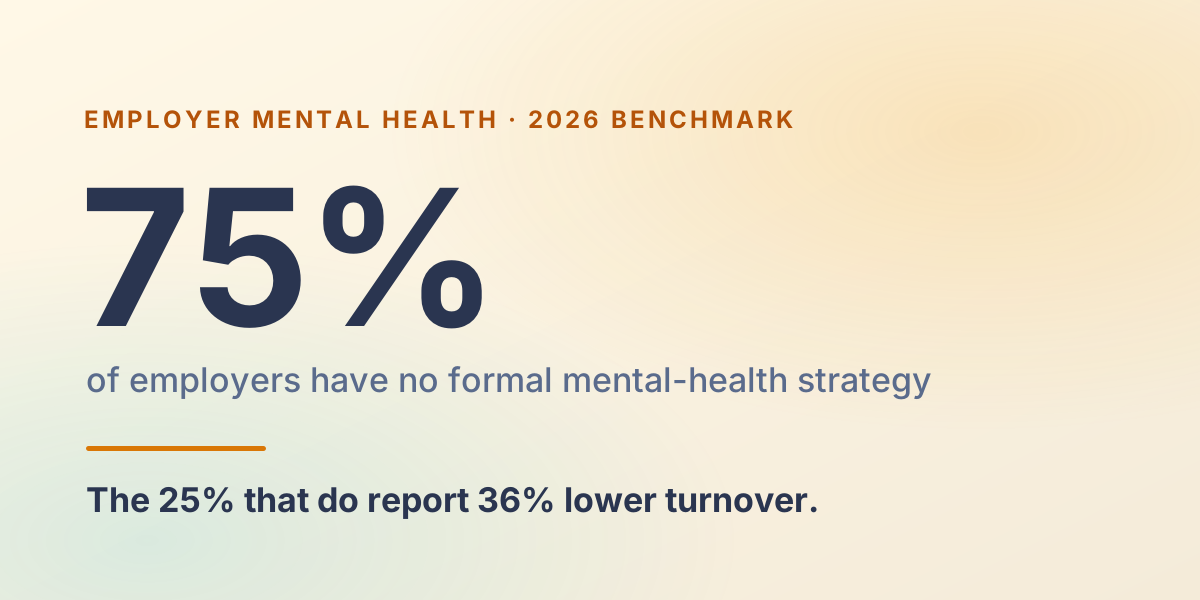
Only 1 in 4 organizations have a formal, written mental health strategy, according to a June 2026 benchmarking report from One Mind at Work that scored 149 organizations covering 2.75 million workers across 25 industries and 23 countries. The other three-quarters are buying programs without a plan, and the data shows what that costs: organizations with a real strategy report 36% lower voluntary turnover than the ones without.
That’s the ROI number employers keep asking me for. What’s harder to hear is the second finding in the same report, and it’s a different question entirely: three-quarters of organizations aren’t even measuring whether any of it works.
Quick answer: only 25% of organizations have a formal mental health strategy, and those that do report 36% lower voluntary turnover (One Mind at Work, 2026). Separately, 75% of organizations don’t systematically measure whether their mental health efforts are working at all. Those are two different failures in the same benchmark, and most employers are stacking both.
What Counts as a “Formal Mental Health Strategy,” and Who Actually Has One?
A formal strategy means a written plan with a named owner, stated goals, and a budget tied to outcomes, not just a benefits list. Only 25% of the 149 organizations One Mind at Work benchmarked in 2026 had one (One Mind at Work, 2026). The rest had programs, not plans.
That distinction matters more than it sounds like it should. Most employers already offer something: an EAP, a wellness stipend, maybe a mental health day policy. What they don’t have is a document that says who owns mental health outcomes, what “better” looks like this year, and how the spend connects to a result. Without that, every initiative is a standalone purchase instead of part of anything.
I see the same pattern from the outside, working with clinicians who take employer referrals. The employers with an actual strategy know what they’re trying to move. The rest are just hoping the benefit gets used and don’t have a way to check.
Does Having a Real Strategy Actually Lower Turnover?
Organizations with a formal mental health strategy report 36% lower voluntary turnover than organizations without one, per One Mind at Work’s 2026 Index (One Mind at Work, 2026). That’s a striking gap for something as unglamorous as a written plan.
Worth being honest about what this number is and isn’t. It’s benchmark data from self-reported organizational scores, not a randomized trial, so we can’t say the strategy alone caused the turnover drop. Companies disciplined enough to write a mental health strategy are probably disciplined about other retention drivers too. Still, a 36-point swing shows up across 149 organizations in 25 industries, which is a wide enough sample that it’s not noise.
The same report found the flip side sharper. Organizations that never connect their mental health efforts to performance metrics see close to 25% of their workforce turn over annually (One Mind at Work, 2026). Spend without a strategy doesn’t just fail to help. It correlates with the exact outcome it was supposed to prevent.
Where Employers Spend Big and Score Low
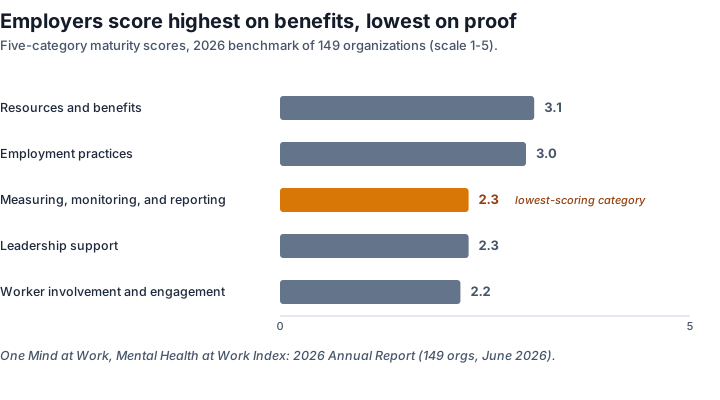
Employers score highest on resources and benefits (3.1 out of 5) and lowest on measuring, monitoring, and reporting (2.3 out of 5), based on One Mind at Work’s maturity scoring across five categories in 2026. Money goes toward things you can buy. It doesn’t go toward proof that any of it worked.
The full picture, on a 5-point maturity scale where 5 is highest (One Mind at Work, 2026):
- Resources and benefits: 3.1
- Employment practices: 3.0
- Measuring, monitoring, and reporting: 2.3
- Leadership support: 2.3
- Worker involvement and engagement: 2.2
Look at the order. The two categories that cost real money, benefits and formal practices, score highest. The three categories that cost attention instead of budget, measurement, leadership visibility, and actually asking workers what they need, score lowest. That’s not a coincidence. It’s easier to write a check for an app than to sit in a room and figure out whether the app changed anything.
Why Isn’t Anyone Measuring Whether This Works?
Three-quarters of organizations don’t systematically measure whether their mental health efforts are working, and the ones that do measure are less than half as likely to report declining engagement the following year (One Mind at Work, 2026). Measurement isn’t a nice-to-have here. It’s the difference between a program that improves and one that just repeats.
Most companies that skip measurement aren’t being careless. They genuinely don’t know what to track. Usage rate is easy to pull and mostly useless on its own. What the higher-maturity organizations track instead: usage relative to eligible population, time to first appointment, return rate after a first use, and whether any of that tracks against turnover or engagement scores over a full year. None of it is exotic. It’s the same rigor a marketing team applies to an ad campaign, just pointed at a benefit instead of a funnel.
Here’s the part I’d push back on if I were in the room. Employers treat “we offer the benefit” as the finish line, when it’s closer to launch day. You wouldn’t run an ad campaign for a year without checking whether it converted. Mental health spending gets that exact treatment constantly, and the 2.3-out-of-5 measurement score is what that habit looks like when you benchmark it.
What Are Employees Actually Telling Employers They Want?
69% of employees say mental health benefits are very or extremely important when deciding whether to accept or stay in a job, rising to 83% among workers 18 to 34, according to Spring Health’s 2026 Workplace Mental Health Annual Report (Spring Health, 2026). That’s a separate survey from the One Mind data, worth noting since it hasn’t been independently benchmarked the way the 149-organization index has, but the direction lines up.
The generational split is the part employers underweight. A benefit that barely registers with a 50-year-old can be a deciding factor for the 25-year-old they’re trying to hire. As the workforce skews younger, “we have an EAP” stops being a differentiator and starts being table stakes, while a documented, measured strategy becomes the thing that’s actually rare enough to matter in an offer conversation.
In practice, what I hear from workers isn’t a request for more perks. It’s a question about whether anyone at the company would notice if the benefit didn’t work, which is really a question about whether leadership is paying attention at all.
What Should Employers Actually Do With This Data?
Start with the document, not the vendor. Write down who owns mental health outcomes, what you’re trying to move this year, and how you’ll know if it worked. That single step moves an organization out of the 75% with nothing formal and into the group reporting a 36-point turnover advantage.
Then pick two or three numbers and track them the same way you’d track any other business metric: usage relative to eligible population, time to first appointment, and one outcome measure like turnover or an engagement score, reviewed on a schedule instead of once a year. The employers scoring 2.2 and 2.3 on measurement and worker involvement aren’t behind because the problem is hard. They’re behind because nobody assigned it to anyone.
The gap isn’t a spending gap. Resources and benefits already score highest of any category in this benchmark. The gap is between money spent and proof collected, and closing it doesn’t require a bigger budget. It requires someone whose job it is to check the work.
FAQ
What percentage of employers have a formal mental health strategy? Only 25% of organizations have a formal, documented mental health strategy, according to One Mind at Work’s 2026 Mental Health at Work Index, which benchmarked 149 organizations covering 2.75 million workers. The other 75% are running mental health programs without a written plan, an owner, or a budget tied to outcomes.
Does a formal mental health strategy actually reduce turnover? Organizations with a formal mental health strategy report 36% lower voluntary turnover than those without one, per the same 2026 One Mind at Work benchmark. The finding is observational, drawn from self-reported organizational data rather than a controlled trial, but the gap held across 25 industries and 23 countries.
Why don’t more employers measure whether their mental health programs work? Measuring and reporting is the lowest-scoring category in One Mind at Work’s 2026 benchmark, and 75% of organizations don’t systematically track whether their mental health efforts work. Organizations that do measure are less than half as likely to report declining employee engagement the following year.
What do employees actually want from employer mental health benefits? 69% of employees say mental health benefits are very or extremely important when deciding whether to take or keep a job, rising to 83% among workers 18 to 34, according to Spring Health’s 2026 Workplace Mental Health Annual Report. Benefits have become a retention lever, not a perk.
What’s the first step for an employer with no mental health strategy? Write one down. One Mind at Work’s 2026 benchmark shows resources and benefits score highest (3.1 of 5) while measuring and reporting scores lowest (2.3 of 5), meaning most employers already have something to build on. The gap is ownership, goals, and tracking results, not more spending.
Sources
One Mind at Work, Mental Health at Work Index: 2026 Annual Report (released June 2, 2026, 149 organizations, 2.75 million workers, 25 industries, 23 countries) for the 25% formal-strategy rate, the 36% turnover differential, the 75% non-measurement rate, the engagement-reporting differential, the roughly 25% annual turnover for organizations without metric-linked efforts, and the five-category maturity scores (resources/benefits 3.1, employment practices 3.0, measuring/monitoring/reporting 2.3, leadership support 2.3, worker involvement/engagement 2.2). WorldatWork/WorkSpan Daily, coverage of the One Mind at Work 2026 Index (June 2026), corroborating findings. Spring Health, 2026 Workplace Mental Health Annual Report (2026) for the 69% of employees rating benefits as very/extremely important to job decisions, 83% among workers 18-34. Figures current as of July 2026.
Disclaimer
This article is for educational and informational purposes only. It does not constitute medical, clinical, legal, or therapeutic advice, and reading it does not create a therapist-client relationship with Matthew Sexton, LCSW or Mental Wealth Solutions, Inc. Although the author is a licensed clinical social worker, the content in this article is not clinical assessment, diagnosis, or treatment.
Benchmark findings, turnover figures, and survey results referenced here reflect specific organizational samples at a point in time and may not generalize to every employer, industry, or workforce. The turnover and measurement findings described are correlational, not causal, and may change as newer data is published. Nothing here is a substitute for confirming a specific benefit, policy, or metric with your HR or benefits team, your data, or qualified counsel.
If you are in immediate emotional crisis, you can reach the 988 Suicide & Crisis Lifeline by calling or texting 988 (US). If you are experiencing domestic violence or are in physical danger, contact the National Domestic Violence Hotline at 1-800-799-7233 or visit thehotline.org. In a life-threatening emergency, call 911.
Frequently asked questions.
- What percentage of employers have a formal mental health strategy?
- Only 25% of organizations have a formal, documented mental health strategy, according to One Mind at Work's 2026 Mental Health at Work Index, which benchmarked 149 organizations covering 2.75 million workers. The other 75% are running mental health programs without a written plan, an owner, or a budget tied to outcomes.
- Does a formal mental health strategy actually reduce turnover?
- Organizations with a formal mental health strategy report 36% lower voluntary turnover than those without one, per the same 2026 One Mind at Work benchmark. The finding is observational, drawn from self-reported organizational data rather than a controlled trial, but the gap held across 25 industries and 23 countries.
- Why don't more employers measure whether their mental health programs work?
- Measuring and reporting is the lowest-scoring category in One Mind at Work's 2026 benchmark, and 75% of organizations don't systematically track whether their mental health efforts work. Organizations that do measure are less than half as likely to report declining employee engagement the following year.
- What do employees actually want from employer mental health benefits?
- 69% of employees say mental health benefits are very or extremely important when deciding whether to take or keep a job, rising to 83% among workers 18 to 34, according to Spring Health's 2026 Workplace Mental Health Annual Report. Benefits have become a retention lever, not a perk.
- What's the first step for an employer with no mental health strategy?
- Write one down. One Mind at Work's 2026 benchmark shows resources and benefits score highest (3.1 of 5) while measuring and reporting scores lowest (2.3 of 5), meaning most employers already have something to build on. The gap is ownership, goals, and tracking results, not more spending.
Want to discuss this for your program?
Book a 30-min conversation. We'll walk you through deployment, the BAA, and what your rollout looks like in production.
Book a 30-min conversation