
Quick answer: Presenteeism means being at work while too unwell to work well. It is the biggest piece of what depression costs US employers. Workplace costs, meaning missed days plus lost output on the job, made up 61% of major depression’s $326.2 billion yearly US cost, up from 48% in 2010 (Greenberg et al., PharmacoEconomics, 2021). Your health plan pays claims. Presenteeism never files one.
Presenteeism is a clunky word for a simple thing. A person shows up. Their depression shows up with them. The work gets done slowly, or badly, or not at all. That pattern now drives the biggest share of what depression costs this country. Workplace costs reached 61% of major depression’s $326.2 billion yearly total, and that share keeps growing (Greenberg et al., 2021).
Your CFO can feel this money leaving. It shows up as missed deadlines, slow quarters, and quiet exits. But nobody can point at it, because no bill ever arrives. Health plans pay claims. Presenteeism never sends one. So the largest mental health cost in your company is the one your benefits plan can’t see.
This piece is for the people who own that gap: HR leads, benefits managers, founders, and the CFO who keeps asking why output dipped again. The numbers below are the best peer-reviewed estimates we have. Peer-reviewed means other experts checked the work before it was published. I’ll also tell you when a figure is old, and when a popular figure is junk.
What is presenteeism?
Absenteeism is easy to count. Someone calls in sick, and the day gets marked. Presenteeism is the quieter problem. The person is at their desk, but the job is only half happening.
Depression makes this concrete. It hits focus, memory, speed, and judgment. Those are the exact skills office work runs on. A person with untreated depression can sit through every meeting and still lose hours each day. In my years as a clinician, I have watched people run this play for months. They got praised for showing up. Nobody saw what showing up cost them.
One thing presenteeism is not: laziness. The people I’m describing are often the most loyal ones in the building. They come in sick because they’re scared to fall behind, or scared to explain why they can’t keep up. Punishing them misses the point. The problem is a health problem, stuck inside a system that makes treatment hard to reach.
That is why I call presenteeism the cost your CFO can see but can’t name. The output dip is real. The cause never appears in a report.
How big is the mental health cost for employers?
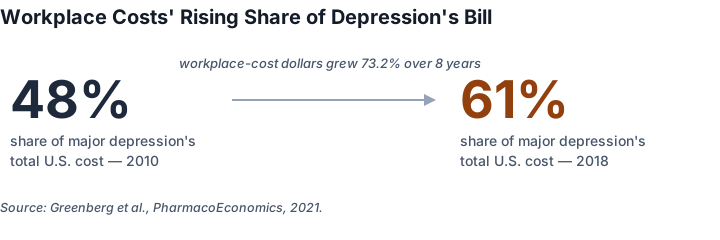
Start with the strongest US number. In 2021, Greenberg and colleagues published a peer-reviewed study in PharmacoEconomics, a medical economics journal. Using 2018 data, they priced major depression’s total US cost at $326.2 billion a year (Greenberg et al., PharmacoEconomics, 2021). Workplace costs made up 61% of that total. Back in 2010, the workplace share was 48%. Across those eight years, workplace costs grew 73.2%.
Say that more plainly. More than six of every ten dollars that depression costs this country now shows up at work, through missed days and slower, weaker output on the job. The workplace piece is the biggest piece. It is also the piece growing fastest.
The same research team ran a second study with a different counting method, published in Advances in Therapy in July 2023. Because the methods differ, don’t add its numbers to the ones above. That newer study priced presenteeism alone at $43.3 billion for 2019. It works out to $2,188 per adult with major depression, inside a $333.7 billion total, or $382.4 billion in 2023 dollars (Greenberg et al., Advances in Therapy, 2023).
Now zoom out past the US. The World Health Organization estimates that depression and anxiety cost the world 12 billion working days every year. The global price tag on that lost work is about $1 trillion a year (WHO, September 2024). That is a world number, so don’t stack it on the US figures. It tells the same story at a bigger scale.
One warning before we move on. You may have seen a claim that presenteeism costs the US economy “$150 billion or more.” That figure traces back to a magazine article from 2004, and websites have copied it from each other for twenty years. Skip it. The peer-reviewed numbers above are newer and stronger.
Why doesn’t your benefits plan cover this cost?
Because benefits plans pay claims, and presenteeism never files a claim.
Follow the money for a second. Your company pays premiums, the monthly price of the plan, to a commercial insurer. The insurer pays bills when someone actually gets care. Every therapy session it approves costs it money. Every session that never happens costs it nothing.
Presenteeism is what “never happens” looks like from inside your office. An employee can’t find a therapist who takes the plan. Or an approval stalls until they quit trying. Or the copay math stops making sense on their budget. No claim gets filed, so the insurer’s books look clean. The cost did not vanish, though. It moved into your payroll, where you now pay full salary for partial work.
I wrote about this business model in The Business of Being Unwell. The short version: the company that decides whether care happens does not carry the cost when care doesn’t happen. You do. That split is the whole reason your benefits plan and your presenteeism problem never appear on the same page.
Here is where presenteeism hides on a P&L, the profit and loss sheet:
- Missed deadlines and slower projects
- Mistakes, and the rework that follows them
- Meetings that stall because a key person is running on empty
- Managers spending hours covering for a struggling teammate
- Good people leaving after “pushing through” stops working
None of those lines says “mental health.” Every one of them is.
Does paying for mental health care pay off?
The most famous number here is old, so I will date it honestly. In April 2016, the World Health Organization published results from a modeling study in The Lancet Psychiatry. It covered 36 countries across 2016 to 2030. Scaling up treatment for depression and anxiety would cost about $147 billion. The projected return was $399 billion in restored ability to work, plus $310 billion in health gains (WHO, April 2016). That is where the famous line comes from: every $1 invested in treating depression and anxiety returns about $4.
The WHO still cites that figure today, and nothing newer has replaced it. Treat it as a model, because that is what it is, and models simplify. But the direction of the finding has held for a decade. Treating these conditions pays better than ignoring them.
Here is what bothers me more than any old stat. Most employers own an EAP, an employee assistance program, which is the benefit built to catch this exact problem. Very few ever measure what it returns. While researching this piece, I could not find one solid, recent US figure on how many employers track EAP ROI, the return on each dollar spent. That silence is the finding. Companies track the price of the benefit and skip the value.
Use follows the same sad curve. At many companies, EAP use sits in the low single digits, and I unpacked why in Why Your EAP Has a 3% Utilization Problem. A benefit nobody uses returns nothing, no matter what the brochure promised.
Why 2026 budgets make this worse
Benefits teams are heading into 2026 in cutting mode. The Business Group on Health surveyed 121 large employers in June and July of 2025. Those employers projected a median 9% rise in health care costs for 2026. Median means the middle answer in the group. Even after plan design changes, they still expected a 7.6% rise (Business Group on Health, via WorldatWork, August 2025). That is the steepest projected jump in years.
The same survey shows where some of the pressure sits. 73% of these employers said use of mental health and substance use services had gone up. Another 17% expect an increase ahead (Business Group on Health, August 2025).
Put those facts together and a trap appears. Mental health looks like a cost to contain, so the visible line gets trimmed. But the claims line was never the whole cost. Squeeze access, and the invisible line grows. You save on the ledger the insurer shows you. You lose more on the ledger only your CFO feels. I wrote about this backwards reading of the numbers in Mental Health Just Became an Employer Cost Driver.
None of this means employers are wrong to watch costs. A 9% jump is real money. My argument is about where the knife lands. Cutting mental health access is the one cut that lowers the number on the page while raising what you actually spend.
What can employers actually do about presenteeism?
Four moves, in order of how fast you can start:
- Measure it. You can’t manage a cost you refuse to see. Short, anonymous check-ins about focus, energy, and workload will tell you more than claims data ever will.
- Audit real access. Open your plan’s therapist directory and call ten names. Count how many are taking new patients this month. Your employees already know the answer.
- Ask your insurer harder questions. How many behavioral health claims were denied last year? How do therapist pay rates compare with medical pay rates inside the same plan? Get the answers in writing.
- Support the days between sessions. Even people in steady treatment usually get about 4 sessions a month. Work happens on the other 26 days. That gap is a big part of why my team built VibeCheck.luxury, and it is the right test for any tool a vendor pitches you: does it help on the days without a session?
A benefits plan and an accessible therapist are not the same thing. Your people can carry insurance cards all day while the real cost sits in payroll, unmeasured. The employers who come out ahead will treat mental health access as an operations question and demand proof that it is real. Your insurer will not volunteer that proof. Ask anyway.
FAQ
What is presenteeism in mental health? Presenteeism means an employee is at work but too unwell to work well. With depression, that looks like lost focus, slow decisions, and mistakes. One peer-reviewed study priced depression-related presenteeism at $43.3 billion in the US for 2019, about $2,188 per adult with major depression (Greenberg et al., Advances in Therapy, 2023).
How much does mental health presenteeism cost US employers? The strongest US estimate comes from a 2021 peer-reviewed study in PharmacoEconomics. Workplace costs, absenteeism plus presenteeism, made up 61% of major depression’s $326.2 billion yearly cost, up from 48% in 2010 (Greenberg et al., 2021). Worldwide, the WHO counts 12 billion working days lost to depression and anxiety each year (WHO, September 2024).
Is spending on employee mental health worth it? The WHO’s 2016 modeling study in The Lancet Psychiatry projected that every $1 invested in scaled-up treatment for depression and anxiety returns $4 in better health and ability to work (WHO, April 2016). The figure is a decade old, and the WHO still cites it. Nothing newer has replaced it.
Why doesn’t a health plan cover presenteeism? Health plans pay claims for care that happens. Presenteeism is the cost of care that never happens, so there is no claim to pay. The loss lands in payroll instead. The fix starts with benefits people actually use. Here is how to actually use your EAP, and why most employees never do.
Sources
- Greenberg, P.E., et al. The Economic Burden of Adults With Major Depressive Disorder in the United States (2010 and 2018). PharmacoEconomics, June 2021 (published online May 2021). pubmed.ncbi.nlm.nih.gov
- Greenberg, P.E., et al. The Economic Burden of Adults with Major Depressive Disorder in the United States (2019). Advances in Therapy, July 2023. pmc.ncbi.nlm.nih.gov
- World Health Organization. Mental Health at Work (fact sheet), September 2024. who.int
- World Health Organization. Investing in Treatment for Depression and Anxiety Leads to Fourfold Return (on Chisholm et al., The Lancet Psychiatry), April 13, 2016. who.int
- Business Group on Health. 2026 Employer Health Care Strategy Survey (121 large employers, surveyed June-July 2025), reported by WorldatWork Workspan Daily, August 2025. worldatwork.org
Figures current as of July 2026.
Disclaimer
This article is for educational and informational purposes only. It does not constitute medical, clinical, legal, or therapeutic advice, and reading it does not create a therapist-client relationship with Matthew Sexton, LCSW or Mental Wealth Solutions, Inc. Although the author is a licensed clinical social worker, the content in this article is not clinical assessment, diagnosis, or treatment.
The cost estimates, survey results, and return-on-investment figures described here reflect published research and employer surveys available at the time of writing, and they may change as new data is published. Benefit plan terms, EAP structures, and workplace mental health programs vary by employer, plan, and state. Individual mental health needs vary as well, and what is described here may not match your situation. For decisions about a specific benefits plan, consult your benefits advisor or qualified counsel; for personal mental health concerns, consult a licensed mental health professional.
If you are in immediate emotional crisis, you can reach the 988 Suicide & Crisis Lifeline by calling or texting 988 (US). If you are experiencing domestic violence or are in physical danger, contact the National Domestic Violence Hotline at 1-800-799-7233 or visit thehotline.org. In a life-threatening emergency, call 911.
Frequently asked questions.
- What is presenteeism in mental health?
- Presenteeism means an employee is at work but too unwell to work well. With depression, that looks like lost focus, slow decisions, and mistakes. One peer-reviewed study priced depression-related presenteeism at $43.3 billion in the US for 2019, about $2,188 per adult with major depression (Greenberg et al., Advances in Therapy, 2023).
- How much does mental health presenteeism cost US employers?
- The strongest US estimate comes from a 2021 peer-reviewed study in PharmacoEconomics. Workplace costs, absenteeism plus presenteeism, made up 61% of major depression's $326.2 billion yearly cost, up from 48% in 2010. Worldwide, the WHO counts 12 billion working days lost to depression and anxiety each year (September 2024).
- Is spending on employee mental health worth it?
- The WHO's 2016 modeling study in The Lancet Psychiatry projected that every $1 invested in scaled-up treatment for depression and anxiety returns $4 in better health and ability to work. The figure is a decade old, and the WHO still cites it. Nothing newer has replaced it.
- Why doesn't a health plan cover presenteeism?
- Health plans pay claims for care that happens. Presenteeism is the cost of care that never happens, so there is no claim to pay. The loss lands in payroll instead. The fix starts with benefits people actually use, real network access, and support between sessions.
Want to discuss this for your program?
Book a 30-min conversation. We'll walk you through deployment, the BAA, and what your rollout looks like in production.
Book a 30-min conversation