Colorado HB 26-1195 takes effect August 12, 2026. It’s not another law banning a chatbot app from pretending to be a therapist. It’s the first one that reaches past the apps and regulates what a licensed human clinician is allowed to do with AI inside their own session.
Quick answer: Colorado’s HB 26-1195, signed June 3, 2026 and effective August 12, 2026, bars a licensed mental health professional from letting AI engage in therapeutic communication with a client unless the clinician, the AI, and the client are interacting synchronously in real time, and requires written, informed consent before any AI recording begins. Every earlier state law in this wave targeted the chatbot. This one targets the clinician’s own tool use, which is a different, sharper line.
What does Colorado HB 26-1195 actually change?
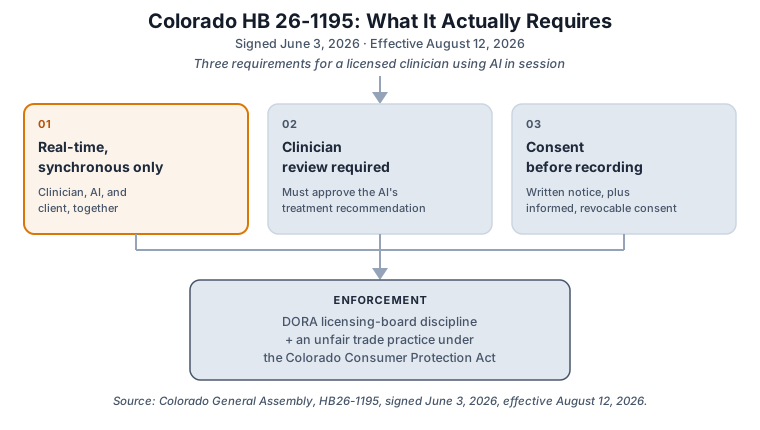
Gov. Jared Polis signed HB 26-1195, “Psychotherapy Artificial Intelligence Restrictions,” on June 3, 2026. The act prohibits a licensed, certified, or registered mental health professional from allowing an AI system to engage in therapeutic communication with a client unless the professional, the AI system, and the client are all interacting synchronously, in real time. If AI generates a treatment recommendation or plan, the clinician has to review and approve it before it counts as clinical judgment.
Separately, if a session is going to be recorded or transcribed by an AI system, the clinician has to give the client advance written notice of the AI’s use and purpose, and get written, informed, revocable consent before recording starts. Enforcement runs through DORA licensing-board discipline, and a violation also counts as an unfair trade practice under the Colorado Consumer Protection Act.
None of this bans AI from a Colorado therapy practice. It bans an AI system from operating on a client without the clinician physically, synchronously present, and it bans quietly recording without asking first.
Why is this different from the laws you’ve already heard about?
Illinois, Nevada, and Maine wrote laws aimed at the product: a chatbot app that markets itself as therapy, or lets a user believe they’re talking to a licensed provider. Those laws answer the question “can a bot call itself a therapist?” with a hard no.
Colorado is answering a different question: “what is a real, licensed clinician allowed to do with an AI tool while they’re the one running the session?” That’s not a chatbot-app question. It’s a scope-of-practice question, and it’s the first state law in this cycle to write it down. If your state’s earlier AI-therapy coverage was all about consumer apps, Colorado is the sequel that moves the line into the therapy room itself.
What’s the Tennessee comparison, and why does it matter?
Tennessee SB 1580 took a narrower approach. Signed April 1, 2026 and effective July 1, 2026, already live, it prohibits any person or company from advertising or representing an AI system as a “qualified mental health professional.” Violations are treated as violations of the Tennessee Consumer Protection Act of 1977, carrying a $5,000-per-violation penalty and a private right of action. The bill passed the Tennessee Senate 32-0 and the House 94-0.
Tennessee’s law polices the marketing claim. Colorado’s law polices the clinical act. Together, they define the 2026 practice floor from two different directions: don’t let a product lie about what it is, and don’t let a licensed human hand the room over to a tool without being there. Neither law is about whether AI belongs in behavioral health. Both are about who stays accountable when it’s in the room.
A platform helped write its own exemption. That’s worth knowing.
SonderMind, a venture-backed Colorado teletherapy platform, worked with HB 26-1195’s sponsors before the bill was even introduced. The company got an exemption carved out for its own “wellness tools,” journaling, mood monitoring, crisis-resource directories, and got a blanket prohibition on AI “detecting emotions” removed, arguing it would have blocked its own crisis-detection safety guardrails.
That’s a genuinely reasonable ask on its face. It’s also worth naming plainly: a platform helped shape the exemptions in a law that’s being framed as reining platforms in. That’s not a scandal. It’s how legislation actually gets written, with the industry in the room. But it’s the kind of detail that gets lost when a law gets summarized as “states are cracking down on AI therapy,” and it’s exactly the kind of detail commercial-insurer-and-platform-driven healthcare keeps producing: the rule gets written, and the rule’s authors have already made sure it fits around their own product.
What should a clinician using AI actually do before August 12?
If you’re licensed in Colorado, three things. First, if any AI tool you use ever operates on a client in real time, confirm you, the AI, and the client are synchronously present, not the AI running ahead of you or catching up after. Second, if anything gets recorded or transcribed by AI, build the written notice and consent into your intake paperwork now, not on August 11. Third, if AI drafts a treatment recommendation, make sure your workflow has an explicit review-and-approve step, not an auto-accept.
If you’re outside Colorado, the practice floor is still worth knowing, because it’s the direction every state is heading. The clinician stays the one who’s there, the one who signs off, the one who’s accountable. That’s not a compliance inconvenience. It’s the actual argument for why a licensed human belongs in the loop at all: not because AI can’t draft a note, but because someone has to be answerable for what the note says.
FAQ
What does Colorado HB 26-1195 actually require? Signed June 3, 2026 and effective August 12, 2026, it prohibits a licensed mental health professional from letting an AI system engage in therapeutic communication with a client unless the professional, the AI, and the client interact synchronously in real time. Any AI-generated treatment recommendation must be reviewed and approved by the clinician. If a session is recorded or transcribed by AI, the clinician must give advance written notice and get the client’s written, informed, revocable consent first.
Is this the same as the laws banning AI chatbot apps from acting as a therapist? No. Illinois, Nevada, and Maine’s laws target consumer-facing chatbot apps that claim to provide therapy. Colorado HB 26-1195 is different: it regulates what a licensed human clinician can do with AI inside their own practice, requiring real-time supervision and consent to record, not banning any app.
When does Tennessee’s AI therapy law take effect? Tennessee SB 1580 was signed April 1, 2026 and took effect July 1, 2026. It prohibits anyone from advertising or representing an AI system as a qualified mental health professional. Violations are treated as violations of the Tennessee Consumer Protection Act, carrying a $5,000-per-violation penalty.
What happens if a Colorado clinician violates HB 26-1195? Enforcement runs through DORA licensing-board discipline, and violations are also classified as an unfair trade practice under the Colorado Consumer Protection Act.
Sources
- Colorado General Assembly, HB26-1195, “Psychotherapy Artificial Intelligence Restrictions,” signed June 3, 2026, effective August 12, 2026. leg.colorado.gov
- Snell & Wilmer, “Preparing for the Convergence of SB 24-205, HB 26-1139, and HB 26-1195,” 2026. swlaw.com
- Healthcare Law Insights (Foley & Lardner), “Tennessee Draws a Line: New Law Bars AI from Posing as Mental Health Professionals,” April 2026. healthcarelawinsights.com
- Troutman Pepper, “Tennessee Enacts Health Care AI Bill With Private Right of Action,” April 2026. troutmanprivacy.com
- SonderMind testimony filed with the Colorado General Assembly on HB 26-1195. leg.colorado.gov
Figures current as of July 2026.
Disclaimer
This article is for educational and informational purposes only. It does not constitute medical, clinical, legal, or therapeutic advice, and reading it does not create a therapist-client relationship with Matthew Sexton, LCSW or Mental Wealth Solutions, Inc. Although the author is a licensed clinical social worker, the content in this article is not clinical assessment, diagnosis, or treatment.
State AI-in-therapy statutes are new, moving quickly, and their requirements may change or be clarified after this article is published. Nothing here is a substitute for reading the actual bill text, confirming current requirements with your state licensing board, or consulting qualified legal counsel before changing how you use AI in your practice.
If you are in immediate emotional crisis, you can reach the 988 Suicide & Crisis Lifeline by calling or texting 988 (US). If you are experiencing domestic violence or are in physical danger, contact the National Domestic Violence Hotline at 1-800-799-7233 or visit thehotline.org. In a life-threatening emergency, call 911.
Frequently asked questions.
- What does Colorado HB 26-1195 actually require?
- Signed June 3, 2026 and effective August 12, 2026, it prohibits a licensed mental health professional from letting an AI system engage in therapeutic communication with a client unless the professional, the AI, and the client interact synchronously in real time. Any AI-generated treatment recommendation must be reviewed and approved by the clinician. If a session is recorded or transcribed by AI, the clinician must give advance written notice and get the client's written, informed, revocable consent first.
- Is this the same as the laws banning AI chatbot apps from acting as a therapist?
- No. Illinois, Nevada, and Maine's laws target consumer-facing chatbot apps that claim to provide therapy. Colorado HB 26-1195 is different: it regulates what a licensed human clinician can do with AI inside their own practice, requiring real-time supervision and consent to record, not banning any app.
- When does Tennessee's AI therapy law take effect?
- Tennessee SB 1580 was signed April 1, 2026 and took effect July 1, 2026. It prohibits anyone from advertising or representing an AI system as a qualified mental health professional. Violations are treated as violations of the Tennessee Consumer Protection Act, carrying a $5,000-per-violation penalty.
- What happens if a Colorado clinician violates HB 26-1195?
- Enforcement runs through DORA licensing-board discipline, and violations are also classified as an unfair trade practice under the Colorado Consumer Protection Act.
If you're the therapist here.
Your clients get 4 sessions a month. The other 26 days they're on their own. VibeCheck.luxury is the between-session companion that carries those days back to you — clients check in daily, and you walk in already knowing what kind of week it was. Built by Matthew Sexton, LCSW, NATC.