
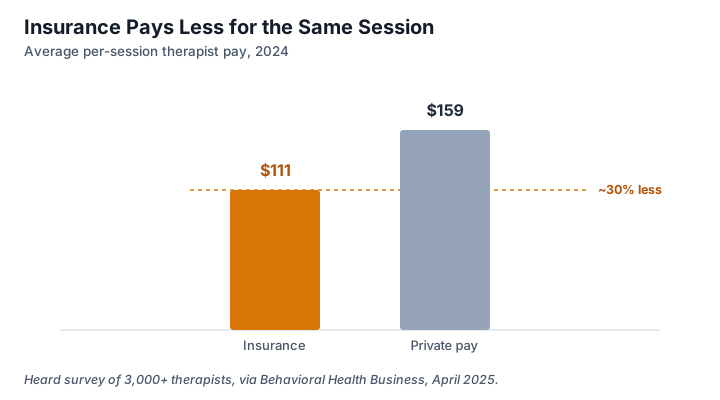
Insurance pays therapists about $111 for a therapy session. Private pay averages $159 for the same hour. Private pay means the client pays cash, with no insurance. So insurance pays roughly 30% less. The numbers come from a Heard survey of more than 3,000 therapists. Behavioral Health Business reported them in April 2025. At first, this looks like a pay story for therapists. But it decides something bigger. It decides whether your insurance card gets you a real appointment.
Quick answer: Therapists collect about $111 per session from insurance versus $159 from private pay, roughly 30% less (Heard survey of 3,000+ therapists, via Behavioral Health Business, April 2025). Low pay is the most-cited barrier pushing therapists off insurance panels. Every therapist who leaves a panel shrinks the in-network list you get to pick from.
Key Takeaways
- Insurance pays therapists about $111 per session versus $159 private pay, roughly 30% less (Heard survey via Behavioral Health Business, April 2025)
- 38% of psychologists now take no insurance at all, up from 34% a year earlier (APA, December 2025)
- 75% of psychologists call low reimbursement the top barrier to taking insurance
- Patients in commercial plans go out-of-network 3.5 times more often for mental health care than for medical care (RTI International, April 2024)
- In June 2026, Aetna moved to pay full therapy hours at shorter-session rates for clinicians who bill through Alma
How big is the insurance reimbursement gap for therapists?
Therapists of every kind collected about $111 per session from insurance in 2024. The private-pay rate was $159. That is about 30% less, or nearly a third. The numbers come from Heard’s survey of more than 3,000 therapists. Behavioral Health Business covered it in April 2025.
Here’s a quick definition. The word matters. Reimbursement is the money the insurance company pays a therapist for a session. The rate is set by contract. A solo therapist has almost no say in it.
Heard runs this survey every year. The newest one asked 1,950 therapists about 2025. They came from all 50 states and D.C. The gap held. Insurance paid 25% to 35% below private-pay rates. A $150 cash session paid about $105 through insurance (Heard 2026 Financial State of Private Practice Report, April 2026).
One honest note. These dollar figures come from one company’s yearly survey. So the trend needs an outside check. A peer-reviewed study backs it up. Peer-reviewed means other experts checked the work. Two national surveys of psychologists back it up too. They’re coming up next.
Why do therapists stop taking insurance?
Pay is the number one reason. And it’s not close. The American Psychological Association ran a survey in 2025, the Practitioner Pulse Survey. In it, 75% of psychologists said low reimbursement was the top barrier to taking insurance. Low reimbursement just means the checks are too small. And 38% of licensed psychologists now take no insurance at all. That’s up from 34% in 2024 (APA, December 2025).
One caution before you read on. The APA surveys count only psychologists, who hold doctorates. Social workers, counselors, and family therapists weren’t counted here. So keep the groups separate.
The rest of the field shows the same thing. A study in Health Affairs Scholar looked at 175,083 private-practice therapists of every kind (September 2024). About one-third took no insurance. Therapists who skipped insurance charged more per session too. They charged $155.90 on average, versus $141.06 for those who took it. Among therapists with a doctorate, it was $195.91 versus $167.69. Read those pairs slowly. Taking insurance lowers what a therapist earns per hour. Leaving it raises the pay.
The leaving is happening right now. Among psychologists who still take insurance, 10% dropped at least one commercial panel in the past year (APA, December 2025). A panel is the insurer’s list of approved therapists. Dropping a panel means coming off that list.
A year earlier, APA asked psychologists what got in the way. Some had left panels. Others never joined. 82% said the pay was too low. Paperwork came in at 62%. That’s the admin work, the billing and forms. Doubt about ever getting paid came in at 52% (APA 2024 Practitioner Pulse Survey, 2024).
In my corner of the field, the panel conversation is never about wanting to drop clients. It’s a spreadsheet. Rent, billing time, unpaid phone calls with the plan, self-employment tax. At $111 a session, the spreadsheet fails. At $159, it works. The clinicians stayed the same. The math moved under them, one contract at a time.
The patient side: an emptier list and a bigger bill
The gap hits patients as an empty search screen. Commercial insurance plans are the kind you get through a job or buy on your own. In those plans, patients often went out-of-network for mental health clinicians. It happened 3.5 times more often than for medical or surgical care. For psychologists alone, it was 10.6 times. That comes from an RTI International study of 2019 to 2021 claims. It covered more than 22 million members a year (RTI International, April 2024).
Out-of-network means the clinician has no contract with your plan. You pay a bigger share of the bill. Sometimes you pay all of it.
The same study found the reason underneath. In-network means the clinician does have a contract with your plan. In those same plans, in-network office visits paid medical and surgical clinicians 22% more on average. Mental health clinicians got less. Same plan, same insurer, different math for your mind.
From the patient side, the gap works like this:
- The in-network list gets shorter, because low pay pushed therapists off it.
- The therapists who stay fill up fast, so waits stretch.
- More people pay cash for care their plan says it covers.
- People who can’t pay cash often go without.
That last line is the point. A covered benefit and an available appointment are not the same thing. I’ve made that case before, in “Just Go to Therapy” Is Broken and in The Business of Being Unwell. The reimbursement gap is the engine under both.
Aetna, June 2026: the cuts are still coming
On June 4, 2026, the American Psychiatric Association and APA Services sent a joint letter to Aetna-CVS Health. They asked it to pause a new round of rate cuts (June 2026). The cuts target clinicians who bill through Alma. Alma is a platform many therapists use to work with insurance.
The letter lists three changes. First, Aetna would pay the full therapy hour at the rate of a shorter one. The full hour is billing code 90837, for sessions of 53 minutes or more. The shorter one is code 90834, for 45 minutes. Second, it would pay psychologists at master’s-level rates. That erases the extra pay for a doctorate. Third, it would pay a longer, more complex medical visit, code 99215, at the lower 99214 rate.
In plain terms: bill a full therapy hour, get paid as if it were the short version.
The two groups warned the cuts may break the federal parity law. That law is the Mental Health Parity and Addiction Equity Act. Parity means plans can’t treat mental health care worse than medical care. States have already started fining commercial insurers over parity. I covered that wave in The Parity Fines Are Real Now.
A denial letter can be appealed. An empty network cannot. When rates drop low enough, a plan never has to say no in writing. The no happens quietly. The search tool returns therapists who stopped taking the plan two years ago. The RTI numbers above are that quiet no, measured at scale. And 38% of psychologists already take no insurance. Cutting rates further is a choice about how empty the list gets.
For the therapist’s side of these same numbers, there’s a companion piece on our VibeCheck.luxury blog: Why Commercial Insurers Pay Therapists So Little.
What would actually close the gap?
Two things. First, pay that clears the therapist’s bills. Second, parity rules with teeth. The evidence says pay is the lever. Among psychologists who left panels or never joined, 82% named low pay as a barrier. That was well ahead of paperwork at 62% (APA, 2024). Fix the check, and the other complaints shrink.
You don’t need new laws to push on this. Employers pick the plans most working people carry. They can ask the insurer one useful question. How many in-network therapists took a new client last month? Regulators can ask for the same number, plan by plan. Patients can file parity complaints when a network exists only on paper. None of that is dramatic. All of it raises the cost of keeping the list empty.
The hopeful part is that nobody has to invent anything. The therapists are still here. Many trained on purpose to serve people who can’t pay $159 in cash. Pay mental health clinicians the way the same plan pays medical ones, and the list refills. The gap is a choice. And choices can be unmade.
FAQ
How much less does insurance pay therapists than private pay? About 30% less. Therapists collected an average of $111 per session from insurance versus $159 from private pay, per a Heard survey of more than 3,000 therapists reported by Behavioral Health Business (April 2025). Heard’s newer report puts the 2025 gap at 25% to 35% below private-pay rates (Heard, April 2026).
Why do so many therapists not take insurance? Low pay is the most-cited barrier. In the APA’s 2025 Practitioner Pulse Survey, 75% of psychologists named insufficient reimbursement as the top barrier, and 38% accepted no insurance at all (APA, December 2025). Across all license types, a peer-reviewed study found about one-third of 175,083 private-practice psychotherapists accept none (Health Affairs Scholar, September 2024).
What does the insurance reimbursement gap mean for patients? Fewer in-network choices and bigger bills. In commercial plans, patients went out-of-network 3.5 times more often for mental health clinicians than for medical clinicians, and in-network visits paid medical clinicians 22% more than mental health clinicians (RTI International, April 2024). More of the cost shifts to you, or care gets skipped.
Is the therapist reimbursement gap getting better or worse? The signals point worse. Psychologists taking no insurance rose from 34% to 38% in one year (APA, December 2025). 10% dropped a commercial panel in the past year. And in June 2026, Aetna moved to pay full therapy hours at shorter-session rates for clinicians who bill through Alma (APA and APA Services joint letter, June 2026).
Sources
-
Behavioral Health Business, Despite the Rise in Therapist Income, Reimbursement Woes Continue, coverage of Heard’s survey of 3,000+ therapists ($111 insurance vs $159 private pay), April 7, 2025.
-
Heard, The Heard 2026 Financial State of Private Practice Report, survey of 1,950 therapists across all 50 states and D.C., insurance 25% to 35% below private-pay rates, April 2026.
-
American Psychological Association, 2025 Practitioner Pulse Survey, 38% accept no insurance, 75% cite insufficient reimbursement, 10% left a commercial panel in the past year, December 2025.
-
American Psychological Association, 2024 Practitioner Pulse Survey, 82% of psychologists who left or never joined panels cited insufficient reimbursement, versus 62% administrative burden and 52% payment reliability, 2024.
-
Zhu et al., Health Affairs Scholar, peer-reviewed analysis of 175,083 US private-practice psychotherapists, about one-third accept no insurance, $155.90 versus $141.06 average session rates, September 2024.
-
American Psychiatric Association and APA Services, joint letter to Aetna-CVS Health, request to pause Alma-affiliated rate cuts, parity concerns, June 4, 2026.
-
RTI International, Study: Disparities in Network Use and Reimbursement for Mental Health and Substance Use Treatment, 3.5x out-of-network use for behavioral health, 22% higher in-network pay for medical/surgical clinicians, April 2024.
Figures current as of July 2026.
Disclaimer
This article is for educational and informational purposes only. It does not constitute medical, clinical, legal, or therapeutic advice, and reading it does not create a therapist-client relationship with Matthew Sexton, LCSW or Mental Wealth Solutions, Inc. Although the author is a licensed clinical social worker, the content in this article is not clinical assessment, diagnosis, or treatment.
Reimbursement rates, panel contracts, and plan networks vary by insurer, by state, by license type, and over time, and the figures cited here reflect the named surveys and sources as of their publication dates. Your plan or practice may not match the averages described. If you are a clinician weighing insurance participation, or a patient sorting out coverage for therapy, please confirm current terms with the payer, your plan documents, or a qualified billing or benefits professional before acting on anything here.
If you are in immediate emotional crisis, you can reach the 988 Suicide & Crisis Lifeline by calling or texting 988 (US). If you are experiencing domestic violence or are in physical danger, contact the National Domestic Violence Hotline at 1-800-799-7233 or visit thehotline.org. In a life-threatening emergency, call 911.
Frequently asked questions.
- How much less does insurance pay therapists than private pay?
- About 30% less. Therapists collected an average of $111 per session from insurance versus $159 from private pay, according to a Heard survey of more than 3,000 therapists reported by Behavioral Health Business in April 2025. Heard's 2026 report put the 2025 gap at 25% to 35% below private-pay rates.
- Why do so many therapists not take insurance?
- Low pay is the most-cited barrier. In the American Psychological Association's 2025 Practitioner Pulse Survey, 75% of psychologists named insufficient reimbursement as the top barrier to accepting insurance, and 38% accepted no insurance at all. Across all license types, a peer-reviewed Health Affairs Scholar study found about one-third of 175,083 private-practice psychotherapists accept no insurance.
- What does the insurance reimbursement gap mean for patients?
- Fewer in-network choices and bigger bills. In commercial plans, patients went out-of-network 3.5 times more often for mental health clinicians than for medical clinicians, and in-network office visits paid medical clinicians 22% more than mental health clinicians (RTI International, April 2024). More of the cost shifts to the patient, or care gets skipped.
- Is the therapist reimbursement gap getting better or worse?
- The signals point worse. Psychologists taking no insurance rose from 34% to 38% in one year (APA, December 2025), 10% dropped a commercial panel within the past year, and in June 2026 Aetna moved to pay full therapy hours at shorter-session rates for clinicians who bill through Alma.
If you're the therapist here.
Your clients get 4 sessions a month. The other 26 days they're on their own. VibeCheck.luxury is the between-session companion that carries those days back to you — clients check in daily, and you walk in already knowing what kind of week it was. Built by Matthew Sexton, LCSW, NATC.