Universal Health Services reported $17.365 billion in total net revenue for 2025 (UHS FY2025 results, early 2026). In July 2026, Utah revoked the operating license of one campus run by a UHS subsidiary. One campus lost its license. The company runs 345 others.
Put those two facts next to each other and the shape of the problem is hard to miss. I have spent my career inside behavioral-health systems, watching how oversight reaches, or fails to reach, the building where care actually happens. This is not a story about what happened inside one campus. It is a story about the two systems we built to answer for it, one federal and one state, and what each one can actually do.
Quick answer: Utah’s licensing division revoked one campus’s authority to operate, after an outside advocacy complaint escalated years of regulatory back-and-forth. The federal law written in response to a decade of survivor advocacy, the Stop Institutional Child Abuse Act, does not produce its first report until December 2027, and it excludes state-licensed hospitals from its own study. A state licensor can reach one building. Nothing yet reaches the company that owns 346 of them.
What Utah actually did
Utah’s Department of Health and Human Services, through its Division of Licensing and Background Checks, revoked the license of UHS of Provo Canyon, doing business as the Springville Campus. Effective date: July 6, 2026. The regulatory category, in the agency’s own language and nowhere expanded here: “failure to provide applicable health and safety services for clients” (Axios Salt Lake City, July 7, 2026; CBS News, July 7, 2026).
That wording is enough. This is a story about authority, ownership, and reach.
The provider has 15 days to request a hearing. If the order stands, services stop and clients are discharged by August 6, 2026, and the current owners are barred from reapplying for a Utah license for five years (KSL.com, July 7, 2026; Fox13 Now, July 7, 2026).
UHS and Provo Canyon CEO Tim Marshall told Axios the company disagrees with the state’s decision and is “evaluating all available legal and administrative options, including an appeal” (Axios Salt Lake City, July 7, 2026). That is a legitimate corporate response inside the rules we wrote. The rules are the point.
So the process may continue. As of publication, the narrower point holds: a state regulator used a power it actually has. There is an effective date, an appeal window, a closure deadline, and a consequence for reapplication.
Something worked.
What did Congress build instead of an enforcement machine?
In December 2024, Congress passed and the President signed the Stop Institutional Child Abuse Act. It is real law: Public Law 118-194, approved December 23, 2024, citation 138 STAT. 2664-2668 (PL 118-194, GPO-authenticated text).
Read the statute. The entire operative content is Section 2: a study. HHS is directed, within 45 days of enactment, to seek a contract with the National Academies of Sciences, Engineering, and Medicine to examine the state of youth in youth residential programs and make recommendations.
What the statute does not create:
- No federal licensing authority
- No inspection regime
- No penalties
- No enforcement mechanism
First report due no later than December 23, 2027, and every two years after that for a decade.
So when Utah revoked the Springville license in July 2026, the federal law’s first deliverable did not yet exist. Whatever the National Academies eventually recommends arrives after this campus has already closed.
The study itself is not worthless. Its 16 mandated components include prevalence and scope, federal and state funding sources, existing regulation including alternative licensing standards and exemptions, and recommendations to improve oversight of programs receiving federal funding. That work may matter. It still cannot revoke a license.
Utah could.
Sen. Jeff Merkley (D-OR), who sponsored the bill with Sen. John Cornyn (R-TX) and Sen. Tommy Tuberville (R-AL), framed it this way: “Without oversight, residential treatment for troubled teens can turn into abuse. This bipartisan bill shines a light on the ‘troubled teen’ industry” (Merkley Senate, January 7, 2025). Light is useful. Light is not a license clerk.
The gap Congress wrote into its own statute
Section 2(e)(7)(B) of Public Law 118-194 excludes “a hospital licensed by a State” from the definition of “youth residential program” the study covers (PL 118-194).
Corporate behavioral-health chains operate across both licensure categories. A facility licensed as a hospital answers to different rules than one licensed as a residential program, even when the same parent company runs both. So Congress commissioned a study around one statutory definition while diversified operators own facilities on either side of it.
That does not make the boundary an accident. It makes it visible. We built a federal instrument that maps this industry after the fact, and maps only part of it by design. State tools still close buildings one at a time. The ownership layer sits above both.
Who owns Provo Canyon School?
Universal Health Services trades on the New York Stock Exchange under the ticker UHS and has been public since 1981. It is not a private-equity roll-up. That distinction matters, because a separate wave of consolidation driven by private equity has reshaped much of the rest of the sector, and those behavioral-health acquisitions deserve their own scrutiny. UHS is the cleaner example of the public-markets version of the same structural problem: ownership answers to shareholders across decades, and the state still licenses one address at a time.
From the company’s own FY2025 results (UHS financial release, early 2026):
- $17.365 billion in total net revenues, up 9.7% year over year
- Behavioral-health segment: $7.185 billion, about 43% of consolidated net revenue
- 346 inpatient behavioral-health facilities
- 29 acute care hospitals and 168 outpatient or ambulatory facilities
- A footprint across 40 states, plus DC, the UK, and Puerto Rico
- About 101,500 employees
Provo Canyon School is operated by a UHS subsidiary. That is not a reporter’s inference. It is on the company’s own careers site (UHS Careers).
The corporate regulatory history is also public record. In 2020, UHS and related entities agreed to pay $122 million to settle False Claims Act allegations involving medically unnecessary inpatient behavioral-health services and illegal kickbacks, and entered a five-year Corporate Integrity Agreement with the HHS Office of Inspector General, without admitting liability (HHS OIG, July 10, 2020).
None of those numbers make any single clinician the villain. We have written before about the personal cost of corporate care and about debt-driven behavioral-health consolidation. Different ownership forms, same direction of travel. Capital can reorganize a sector faster than a licensing desk can walk a hallway.
What actually forced Utah to act?
A complaint filed June 16, 2026 by the Disability Law Center, Utah’s federally designated protection and advocacy agency, escalated years of regulatory back-and-forth into a full revocation (APM Reports / Salt Lake Tribune, July 8, 2026). That is the piece that moved. Not the federal statute.
This was not the state’s first look at the campus in 2026. A January 2026 matter drew a compliance-focused response rather than immediate revocation. State timelines show an emergency action on May 29, 2026 and additional licensing conditions on June 18, 2026, before the complaint tipped the file to revocation on July 6 (KUTV, July 7, 2026). APM Reports and the Salt Lake Tribune describe Utah as having “historically exercised relatively light regulation” of these facilities while “adopting a firmer stance in recent years,” a journalist’s characterization of posture rather than a national dataset (APM Reports / Salt Lake Tribune, July 8, 2026).
That sequence matters. Public systems often need information from outside themselves before their enforceable machinery moves. An outside advocacy body filed. A state division then used its licensing authority.
The legislative record behind all of it was built by a decade of public advocacy. Paris Hilton is one of the people who chose that public role, by name and on the record. She testified before the Utah Senate Judiciary, Law Enforcement and Criminal Justice Committee on February 8, 2021, supporting SB127, a bill requiring treatment centers to document restraints and involuntary confinement and file monthly reports with state licensors. Her regulatory ask to the legislature: the state must monitor the companies taking large sums from families and taxpayers (Deseret News, February 8, 2021). She testified again before the House Ways and Means Committee on June 26, 2024, with policy asks that included passing the Stop Institutional Child Abuse Act and tightening oversight of youth residential treatment facilities (CNN, June 26, 2024). After the revocation took effect, in a social media post, she said: “No institution is too powerful to be held accountable. When survivors refuse to stay silent, change is possible” (Deseret News, July 7, 2026).
That advocacy is why the legislative record exists. The federal law carrying it still produces, as its first deliverable, a study due in 2027. The campus that is actually closing was closed by a state agency acting on a protection-and-advocacy complaint. Both things are true. Holding them together is the job.
Corporate behavioral health chain accountability, one license at a time
Here is the structural argument, without adjectives and without inventing a frequency claim about how often this happens.
The retail side. A state licensing division reviews a complaint file. It can impose conditions, take emergency action, revoke a license, bar reapplication for a term of years. Its unit of action is a campus.
The wholesale side. One NYSE-listed parent operates hundreds of inpatient behavioral-health facilities across dozens of states and both hospital and non-hospital licensure categories. Behavioral health is nearly half of consolidated revenue. Capital markets reward scale. Licensing law still thinks in street addresses.
Ownership answers at corporate scale. Licensing answers at campus scale. Utah’s action is real, but its jurisdiction does not expand because the owner happens to run 346 inpatient facilities. The oversight is retail. The ownership is wholesale.
I have worked inside systems where the license on the wall and the capital stack above it never quite meet in the same meeting. The people doing the daily clinical work usually have the least control over ownership strategy, capital allocation, and regulatory design. Blaming them would miss the machinery entirely.
What should we take from this?
First, state licensing is not ceremonial. A license can be revoked. Deadlines can be imposed. Reapplication can be barred. That authority is worth defending, and licensing bodies are worth funding well enough to use it.
Second, complaint pathways matter. This action followed a complaint from an outside protection and advocacy organization. Accountability needs people and institutions able to carry information into a process that can act on it.
Third, we should stop confusing documentation with enforcement. A federal report can build shared evidence and better recommendations. It cannot substitute for inspection authority, penalties, or licensing power when Congress did not put those tools in the law.
Fourth, appeal rights are part of the process, not a loophole. Fifteen days to request a hearing is how administrative law works. Accountability that cannot survive a hearing is theater. Accountability that only ever reaches one address is incomplete.
One campus closing also does not solve an access problem. Families who need residential behavioral-health care for a minor still have to find it somewhere, often in regions where provider shortages already limit the options. Facility closures, whatever the reason behind any single one, tend to land hardest on communities that already have the fewest choices, something we have tracked in how closures track with existing access gaps.
So we do not get a victory lap or a failure dirge. We get the ratio: one campus, 346 facilities, a federal study due in 2027.
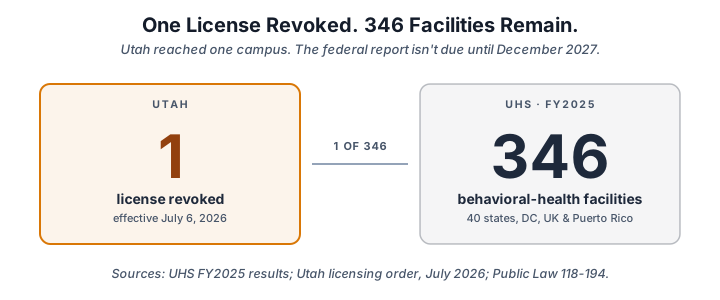
Utah found one lever and pulled it. Good. Now we have to be honest about what the lever reaches. The enemy here is not a nurse on a night shift, and it is not a teenager in a residential program. The enemy is a structure that lets capital operate at portfolio scale while accountability arrives as a single-state PDF.
Something worked in Utah in July 2026. The task now is to stop mistaking one campus for a system, and one study for a regulator.
FAQ
What happened to Provo Canyon School’s license in 2026? Utah’s Division of Licensing and Background Checks revoked the operating license of UHS of Provo Canyon’s Springville campus, effective July 6, 2026, citing failure to provide applicable health and safety services for clients. The provider has 15 days to request a hearing. If the order stands, the campus must discharge clients by August 6, 2026, and the current owners are barred from reapplying for a Utah license for five years (CBS News; Axios Salt Lake City, July 7, 2026).
Why did a state agency revoke the license instead of the federal government? Because no federal agency has that authority. The Stop Institutional Child Abuse Act, signed December 23, 2024, created a National Academies study due December 23, 2027, not a licensing system. Utah’s Division of Licensing and Background Checks acted on a June 16, 2026 complaint from the Disability Law Center, the state’s federally designated protection and advocacy agency (Public Law 118-194; APM Reports, July 8, 2026).
What does the Stop Institutional Child Abuse Act actually require? Public Law 118-194 directs HHS to contract with the National Academies of Sciences, Engineering, and Medicine for a study of youth residential programs, with a first report due by December 23, 2027 and further reports every two years for a decade. It creates no federal licensing authority, no inspection regime, no penalties, and no enforcement mechanism. Section 2(e)(7)(B) also excludes any hospital licensed by a state from the definition it studies (Public Law 118-194).
Is Universal Health Services a private equity company? No. UHS has traded on the New York Stock Exchange since 1981. It reported $17.365 billion in total net revenue for FY2025, with its behavioral-health segment generating $7.185 billion, about 43% of that total, across 346 inpatient behavioral-health facilities in 40 states plus DC, the UK, and Puerto Rico (UHS FY2025 results). It is a public-markets company, a different ownership structure than a private-equity fund.
What is Paris Hilton’s role in the Provo Canyon story? She is a public advocate, not a party to the revocation. She testified before the Utah Legislature in 2021 in support of oversight legislation and before the House Ways and Means Committee in 2024. On the 2026 revocation she said: “No institution is too powerful to be held accountable. When survivors refuse to stay silent, change is possible” (Deseret News, July 7, 2026).
Sources
- CBS News (CBS/AP), “License of Utah boarding school where Paris Hilton alleged she was abused is revoked” (July 7, 2026). Effective date, appeal window, closure deadline, five-year reapplication ban.
- Axios Salt Lake City, “Utah revokes license for Provo Canyon School” (July 7, 2026). CEO Tim Marshall statement, regulatory category, appeal terms.
- KSL.com, “Utah revokes Springville’s Provo Canyon School license” (July 7, 2026). Facility identification, ownership, deadlines.
- Fox13 Now, “License of Provo Canyon School’s Springville campus revoked by state” (July 7, 2026). UHS ownership and appeal terms.
- APM Reports / Salt Lake Tribune (Jessica Schreifels, Samantha Moilanen), “Utah officials order Provo Canyon School’s girls program to close by August” (July 8, 2026). Prior compliance history, regulatory-posture characterization.
- Universal Health Services, Q4/FY2025 financial results release (early 2026). Revenue, segment mix, facility counts, geography, employee count, public-company status.
- HHS Office of Inspector General, Universal Health Services $122 million False Claims Act settlement (July 10, 2020). Prior corporate regulatory history, Corporate Integrity Agreement.
- UHS Careers, Provo Canyon School. Primary confirmation of UHS subsidiary operation.
- GPO-authenticated statute text, Public Law 118-194, Stop Institutional Child Abuse Act (signed December 23, 2024). Study-only operative content, 2027 report deadline, hospital exclusion in Sec. 2(e)(7)(B).
- Sen. Jeff Merkley, statement on the Stop Institutional Child Abuse Act becoming law (January 7, 2025). Sponsor framing of the enacted law.
- Deseret News (Katie McKellar), coverage of Paris Hilton’s testimony to the Utah Legislature (February 8, 2021). SB127 testimony and bill content.
- CNN, coverage of Paris Hilton’s testimony before the House Ways and Means Committee (June 26, 2024). Federal testimony and policy asks.
- Deseret News (Mallory Mailloux), Paris Hilton’s statement on the license revocation (July 7, 2026). On-record accountability statement.
- KUTV (Jared Turner), advocacy and investigation timeline (July 7, 2026). 2026 regulatory timeline, emergency action and licensing conditions dates.
Disclaimer
This article is for educational and informational purposes only. It does not constitute medical, clinical, legal, or therapeutic advice, and reading it does not create a therapist-client relationship with Matthew Sexton, LCSW, or Mental Wealth Solutions, Inc. Although the author is a licensed clinical social worker, nothing here is legal analysis of the cited statute, regulatory filing, or licensing action.
Regulatory actions described here, including the license revocation and the appeal process, may change after publication. Universal Health Services has 15 days from the effective date to request a hearing, and the outcome of that appeal, along with the National Academies study required under Public Law 118-194, may alter facts described above. Confirm current status directly with the Utah Division of Licensing and Background Checks or the cited outlets before relying on any date or figure in this article.
If you are in immediate emotional crisis, you can reach the 988 Suicide & Crisis Lifeline by calling or texting 988 (US). In a life-threatening emergency, call 911.
Frequently asked questions.
- What happened to Provo Canyon School's license in 2026?
- Utah's Division of Licensing and Background Checks revoked the operating license of UHS of Provo Canyon's Springville campus, effective July 6, 2026, citing failure to provide applicable health and safety services for clients. The provider has 15 days to request a hearing. If the order stands, the campus must discharge clients by August 6, 2026, and the current owners are barred from reapplying for a Utah license for five years (CBS News and Axios Salt Lake City, July 7, 2026).
- Why did a state agency revoke the license instead of the federal government?
- Because no federal agency has that authority. The Stop Institutional Child Abuse Act, signed December 23, 2024, created a National Academies study due December 23, 2027, not a licensing system. Utah's Division of Licensing and Background Checks acted on a June 16, 2026 complaint from the Disability Law Center, the state's federally designated protection and advocacy agency (Public Law 118-194; APM Reports, July 8, 2026).
- What does the Stop Institutional Child Abuse Act actually require?
- Public Law 118-194 directs HHS to contract with the National Academies of Sciences, Engineering, and Medicine for a study of youth residential programs, with a first report due by December 23, 2027 and further reports every two years for a decade. It creates no federal licensing authority, no inspection regime, no penalties, and no enforcement mechanism. Section 2(e)(7)(B) also excludes any hospital licensed by a state from the definition it studies (Public Law 118-194, GPO-authenticated statute).
- Is Universal Health Services a private equity company?
- No. UHS has traded on the New York Stock Exchange since 1981. It reported $17.365 billion in total net revenue for FY2025, with its behavioral-health segment generating $7.185 billion, about 43% of that total, across 346 inpatient behavioral-health facilities in 40 states plus DC, the UK, and Puerto Rico (UHS FY2025 financial results). It is a public-markets company, a different ownership structure than a private-equity fund.
- What is Paris Hilton's role in the Provo Canyon story?
- She is a public advocate, not a party to the revocation. She testified before the Utah Legislature in 2021 in support of oversight legislation and before the House Ways and Means Committee in 2024. On the 2026 revocation she said: 'No institution is too powerful to be held accountable. When survivors refuse to stay silent, change is possible' (Deseret News, July 7, 2026).
If you're the therapist here.
Your clients get 4 sessions a month. The other 26 days they're on their own. VibeCheck.luxury is the between-session companion that carries those days back to you — clients check in daily, and you walk in already knowing what kind of week it was. Built by Matthew Sexton, LCSW, NATC.