
Summit BHC, a private equity-backed inpatient behavioral health chain with roughly 39 facilities across 20 states, completed a distressed debt exchange in September 2025 to avoid bankruptcy — and as of June 2026, S&P Global Ratings has revised the company’s credit outlook to negative, projecting a substantial free cash flow deficit through 2026 and into 2027. The company carries approximately $1.1 billion in total debt.
Quick answer: Summit BHC is the clearest recent example of a structural problem in private equity-owned behavioral health. The PE model — borrow heavily, acquire fast, harvest returns — runs directly into the economics of mental health care, where reimbursement rates are low, labor costs are high, and patients cannot simply go elsewhere when the money runs out. Summit’s debt crisis is a case study in what that collision looks like up close.
What Summit BHC Is
Summit BHC is a Franklin, Tennessee-based chain specializing in acute psychiatric care and substance use disorder treatment. Patient Square Capital, a healthcare-focused private equity firm, acquired it from two earlier PE owners — FFL Partners and Lee Equity Partners — in November 2021 for approximately $1.3 billion.
At the time of that acquisition, Summit operated 24 facilities across 16 states. It kept growing. In early 2022, it acquired seven psychiatric hospitals from Strategic Behavioral Health, adding facilities in Iowa, New Mexico, North Carolina, Tennessee, Texas, and Wisconsin, and expanding to 31 inpatient facilities across 19 states. By 2025, the company had grown to around 39 facilities in 20 states.
This is the PE playbook in its standard form: acquire a platform, add facilities through bolt-on acquisitions, expand the geographic footprint, and build the scale that commands a premium at exit. The problem is that the debt taken on to execute that strategy has to be serviced. And in behavioral health, servicing $1.1 billion in debt is harder than it looks in a pitch deck.
What Happened
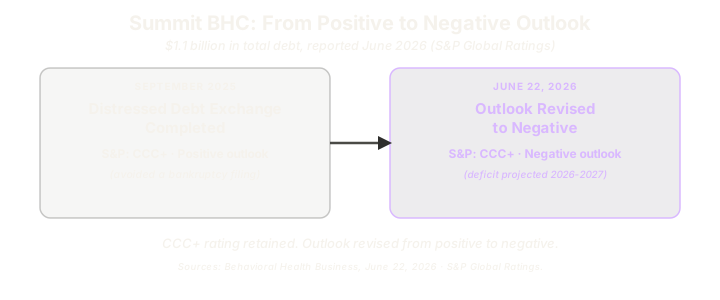
Summit BHC announced what it called a “pro rata liability management exercise” in August 2025. In plain terms, this was a debt restructuring. By September 2025, the company completed a distressed exchange transaction — one of the mechanisms companies use to avoid a formal bankruptcy filing by renegotiating the terms of outstanding debt with existing creditors. S&P Global Ratings assigned the company a CCC+ credit rating at that point, with a positive outlook.
That positive outlook did not last. By June 22, 2026, Behavioral Health Business reported that S&P had revised Summit BHC’s credit outlook from positive to negative. The rating agency projected that Summit would carry a substantial free cash flow deficit in 2026 and a more modest shortfall in 2027.
The pressures behind those projections were consistent with what the broader industry has been experiencing: declining patient volume from specific payer segments, including Veterans Affairs patients; increased labor costs; and the persistent challenge of running a debt-heavy company in a field with narrow operating margins. As of early 2025, the company had been running cash flow deficits in the range of $30 million to $40 million.
A CCC+ rating, for context, means S&P considers the issuer vulnerable to nonpayment, and that the company’s capacity to meet financial commitments depends on favorable business, financial, and economic conditions. A negative outlook means the rating agency believes conditions may deteriorate further.
Why the Private Equity Model and Behavioral Health Don’t Fit
The mismatch is not complicated, but it is structural, and it keeps producing the same outcome.
Private equity acquires companies using leveraged buyouts — a significant portion of the purchase price is borrowed, and that debt lands on the acquired company’s balance sheet, not the PE firm’s. The firm then needs the company to grow earnings fast enough to service the debt, pay management fees, and deliver the returns that make the fund viable for its own investors.
Behavioral health, especially inpatient psychiatric care, does not accommodate that model well.
Reimbursement rates are the first problem. Commercial insurers pay mental health providers less than they pay medical and surgical providers in the same health plans — the parity violation that advocacy groups and state regulators have spent years documenting. The Kennedy Forum’s Mental Health Parity Index, published in April 2026, found that the four largest commercial insurers — Aetna, BlueCross BlueShield, Cigna, and UnitedHealthcare — paid clinicians less for outpatient mental health care than for physical health care in every one of the 43 states examined. That disparity, compounded across thousands of patient encounters, means thinner margins from the revenue side before labor costs are even factored in.
Labor is the second problem. Behavioral health is staffing-intensive. Psychiatric nurses, licensed clinicians, and support staff are expensive to hire and retain. After COVID-19 accelerated burnout and attrition across the clinical workforce, wage pressures have stayed elevated. A company servicing $1.1 billion in debt while facing both reimbursement suppression and wage inflation is getting squeezed from both directions at once.
The third problem is fixed-cost structure. Inpatient psychiatric facilities have high overhead whether the beds are full or not. Maintaining viable occupancy rates while managing census fluctuations is one of the foundational operational challenges of running a psychiatric hospital. When patient volume from a significant payer — in Summit’s case, VA patients — starts declining, the margins that were already thin get thinner.
None of this is secret information. The people who built these deals knew the economics. The bet was that scale would solve it: a large enough chain could negotiate better reimbursement rates, centralize administrative functions, and spread fixed costs across more facilities. For some chains, in some periods, that has worked. For Summit, carrying $1.1 billion in debt into a rising-cost environment, it has not.
Who Pays When the Model Breaks
The PE investors absorb losses when a deal underperforms. That part is straightforward. The part that matters more is what happens to the people receiving care when the financial model fails.
Summit BHC operated Johnstown Heights Behavioral Health in Johnstown, Colorado. The facility opened in 2021, the same year Patient Square Capital completed its acquisition of Summit’s parent company. By the time Johnstown Heights closed in March 2025, laying off 158 employees, it had accumulated a record that included multiple citations from Colorado’s Department of Public Health and Environment and was placed in Immediate Jeopardy status — the most severe designation the state can assign — on more than one occasion, including after a patient death in late 2022. Former employees described understaffing, poorly maintained facilities, and documentation irregularities.
That closure was not an isolated event. Becker’s Behavioral Health tracked at least 18 behavioral health facility closures in 2025, following 20 closures in 2024. The Private Equity Stakeholder Project has documented a pattern in which PE-owned behavioral health companies initiate closures and layoffs, often citing funding shortfalls, that leave communities with fewer options.
The conditions that produce those patterns — cost-cutting to service debt, lean staffing to protect margins, under-investment in physical infrastructure — are the predictable outputs of a model that was never designed with clinical outcomes as its primary operating constraint. The difference between a behavioral health patient and a consumer whose retail chain closes is that the patient cannot simply go to another store. Inpatient psychiatric care requires immediate placement, and there is rarely a backup.
That is the moral core of the problem. The PE model socializes the risk onto the people least able to absorb it.
What This Means Going Forward
Summit BHC is not the only chain with exposure. Acadia Healthcare, one of the largest publicly traded behavioral health companies in the country, saw its stock fall sharply through 2024 after disclosing a Department of Justice investigation, a grand jury subpoena, and expected SEC inquiries related to patient admissions, length-of-stay, and billing practices. Separate reporting from the New York Times found that the company had held patients against their will when it was not medically necessary. Acadia subsequently announced plans to reduce capital expenditures by at least $300 million in 2026 and pause several growth projects.
The pattern here is not one bad actor having a bad year. It is a structural problem with a model being applied to a sector it was not designed for.
I have spent my career as a clinician watching what happens when financial logic gets applied to behavioral health without clinical logic to check it. The result is usually some version of the same thing: facilities that look viable on a spreadsheet until they don’t, and patients who get caught in the gap. The people who built these deals exit with some version of a return. The communities that depended on those facilities are left figuring out where to go next.
The Summit BHC situation may resolve without further deterioration. The company may find a path to refinancing, improve its census, or reduce costs enough to stabilize. But the S&P negative outlook and the $1.1 billion debt load sitting under an already-distressed rating are not conditions that resolve easily. The structural pressures — reimbursement suppression, labor costs, high fixed overhead — have not gone anywhere.
The question worth asking is not whether this particular company makes it. It is whether a system that keeps loading behavioral health capacity onto PE debt structures, then watching those structures crack, is building anything durable at all.
FAQ
What happened to Summit BHC’s finances in 2025 and 2026?
Summit BHC completed a distressed debt exchange in September 2025, restructuring its obligations to avoid a formal bankruptcy filing. S&P Global Ratings assigned a CCC+ rating at that time. By June 2026, S&P revised the company’s credit outlook from positive to negative, projecting a substantial free cash flow deficit in 2026 and further shortfalls into 2027. The company carries approximately $1.1 billion in total debt obligations.
Who owns Summit BHC and how big is it?
Patient Square Capital, a healthcare-focused private equity firm, owns Summit BHC. Patient Square acquired it in November 2021 for approximately $1.3 billion. The company is headquartered in Franklin, Tennessee, and operates around 39 inpatient facilities across 20 states, offering acute psychiatric care and substance use disorder treatment.
Why do private equity-backed behavioral health companies struggle financially?
The core problem is structural: PE firms finance acquisitions with debt that lands on the acquired company’s balance sheet, requiring rapid margin growth to service it. Behavioral health generates thin margins because commercial insurers pay mental health clinicians less than medical providers in the same plan, labor costs are high and rising, and inpatient facilities require consistent occupancy. When those conditions don’t line up with the debt load, the math stops working.
What happens to patients when a PE-backed behavioral health chain faces financial distress?
Summit BHC’s own Johnstown Heights Behavioral Health in Colorado closed in March 2025 after accumulating state regulatory violations, including multiple Immediate Jeopardy designations and one patient death in 2022. Becker’s Behavioral Health tracked 18 behavioral health facility closures in 2025 and 20 in 2024. When a facility closes, patients lose access to care in communities that often have limited alternatives. Unlike most consumer services, inpatient psychiatric care cannot be deferred while you look for another option.
Sources
- Behavioral Health Business, “Summit BHC Faces Downgraded Credit Outlook as It Works Past Debt Exchange” (June 22, 2026)
- PR Newswire / Patient Square Capital, “Patient Square Capital to Acquire Summit BHC from FFL Partners and Lee Equity Partners” (September 2021)
- Behavioral Health Business, “Patient Square Capital to Purchase Summit BHC for Over $1 Billion” (September 9, 2021)
- Behavioral Health Business, “Summit BHC Acquires 7 Psychiatric Hospitals From Strategic Behavioral Health, Moves Into New States” (January 6, 2022)
- Private Equity Stakeholder Project, “PE-owned behavioral health hospital closes” (2025) — Johnstown Heights closure, 158 layoffs, Immediate Jeopardy designations
- Becker’s Behavioral Health, “18 behavioral health closures in 2025” (2025)
- Becker’s Behavioral Health, “20 behavioral health closings in 2024” (2024)
- AHA News / The Kennedy Forum Mental Health Parity Index, “Data Highlights Gaps in Finding Network Mental Health Coverage” (April 16, 2026)
- Behavioral Health Business, “Acadia Healthcare Leadership Focuses on 2026 Growth Strategy Despite 2024 Financial Challenge” (February 28, 2025)
- GlobeNewswire / Hagens Berman, “Acadia Healthcare (ACHC) Shares Tumble After Disclosing DOJ Probe, Grand Jury Subpoena” (October 10, 2024)
Disclaimer
This article is for educational and informational purposes only. It does not constitute medical, clinical, legal, or therapeutic advice, and reading it does not create a therapist-client relationship with Matthew Sexton, LCSW or Mental Wealth Solutions, Inc. Although the author is a licensed clinical social worker, the content in this article is not clinical assessment, diagnosis, or treatment.
Financial situations, ownership structures, and service availability at specific behavioral health providers change rapidly and may differ from what is described here. Credit ratings, debt figures, and corporate ownership information reflect what was publicly reported at the time of writing and may have changed. Nothing in this article is investment, financial, or legal advice. Patients or families seeking behavioral health services should verify provider availability, insurance acceptance, and facility status directly before making any care decisions.
If you are in immediate emotional crisis, you can reach the 988 Suicide & Crisis Lifeline by calling or texting 988 (US). If you are experiencing domestic violence or are in physical danger, contact the National Domestic Violence Hotline at 1-800-799-7233 or visit thehotline.org. In a life-threatening emergency, call 911.
Frequently asked questions.
- What happened to Summit BHC's finances in 2025 and 2026?
- Summit BHC completed a distressed debt exchange transaction in September 2025, restructuring debt to avoid bankruptcy. S&P Global Ratings assigned the company a CCC+ rating at that time. By June 2026, S&P revised its credit outlook from positive to negative, citing a substantial free cash flow deficit in 2026 and expected shortfalls into 2027. The company carries approximately $1.1 billion in total debt obligations.
- Who owns Summit BHC and how big is it?
- Summit BHC is owned by Patient Square Capital, a private equity firm that acquired it in November 2021 in a deal valued at approximately $1.3 billion. The company is headquartered in Franklin, Tennessee, and operates around 39 inpatient facilities across 20 states, offering acute psychiatric care and substance use disorder treatment.
- Why do private equity-backed behavioral health companies struggle financially?
- The core problem is a mismatch between the PE model and the economics of behavioral health. PE firms typically load acquired companies with debt to finance the buyout, then need rapid margin expansion to service it. But behavioral health runs on thin margins — commercial insurers pay mental health clinicians less than medical providers in the same plan, labor costs are high and rising, and inpatient facilities require consistent occupancy to cover fixed overhead. When those conditions don't line up, the debt load becomes unsustainable.
- What happens to patients when a PE-backed behavioral health chain faces financial distress?
- The track record is not encouraging. Summit BHC's own facility Johnstown Heights Behavioral Health in Colorado closed in March 2025, having been cited multiple times by state regulators for conditions serious enough to earn Immediate Jeopardy status — the most severe designation available. Becker's Behavioral Health tracked 18 behavioral health facility closures in 2025 and 20 in 2024. When facilities close, patients lose access to care and staff lose jobs. In communities with limited alternatives, there is nowhere else to go.
Want to discuss this for your program?
Book a 30-min conversation. We'll walk you through deployment, the BAA, and what your rollout looks like in production.
Book a 30-min conversation