Quick answer: About 137 million Americans, roughly 40% of the country, live in a federally designated mental health shortage area, and only 27% of the need for providers there is met (KFF State Health Facts, HRSA data as of December 31, 2025). The therapists who could close that gap are burning out, and many have thought about leaving. Low pay from commercial insurers sits near the center of both problems.
You may have seen a claim going around: 40% of therapists are thinking about quitting. I went looking for where that exact number comes from. I could not find a source that holds up, so I won’t use it. The verified numbers are heavy enough on their own. In a National Council for Mental Wellbeing survey fielded in February 2023, 48% of behavioral health workers said the shortage had them considering other jobs. Nearly half. And 137 million Americans are living with the results.
I’ve spent 13 years in behavioral health. I’ve watched skilled clinicians walk away from work they were built for. The reasons rarely had anything to do with clients. The paperwork, the pay, and the phone calls with insurers did the damage. This post walks through the checked numbers on therapist burnout and the workforce shortage, and what they mean if you ever need care. Which, sooner or later, is most of us.
The Therapist Shortage, in Plain Numbers
The federal government keeps a map of places that don’t have enough mental health providers. Each one is called a Mental Health Professional Shortage Area. In plain words, the government checked and found too few therapists, counselors, psychologists, and psychiatrists in that spot.
As of December 31, 2025, there were 6,807 of these shortage areas. More than 137 million people live inside them, according to KFF State Health Facts, which tracks the federal HRSA data (December 2025). That’s roughly 2 in 5 Americans. This is not a problem for “somewhere else.” It is probably a problem for your county, or the one next to it.
Here’s the number that stays with me. Inside those areas, only 27.3% of the need for mental health practitioners is met (KFF, December 2025). Meaning: for every 100 providers those communities need, about 27 exist. The other 73 are missing. People still get sick in the gap. They just don’t get care.
And the size of the fix is smaller than you’d guess. About 6,800 more practitioners would clear the entire federal shortage list (KFF, December 2025). For a country this size, that’s a tiny number. The gap is fixable. It just keeps not getting fixed.
I’ve written before about why “just go to therapy” is broken advice. This map is a big part of the reason. You can’t go to a therapist who isn’t there.
Is It True That 40% of Therapists Want to Quit?
Not exactly, and I think you deserve the honest version.
First, a plain definition. Burnout is deep exhaustion from work stress that rest doesn’t fix, plus a growing sense of distance from the job. It isn’t a character flaw. It’s a predictable response to bad working conditions.
In early 2023, the National Council for Mental Wellbeing and The Harris Poll surveyed 750 behavioral health workers. The survey ran from February 3 to 19, 2023. In it, 93% said they had experienced burnout (National Council / The Harris Poll, April 2023). About 62% rated that burnout as moderate to severe, an 8 or higher on a 10-point scale. And 48% said the impact of the shortage pushed them to consider other employment options.
Two caveats, because I promised honest numbers. That survey is from 2023, so it isn’t fresh. And it covered behavioral health workers broadly, not therapists alone. So no, I can’t tell you that 40% of therapists are quitting today. I can tell you that nearly half the workforce was already eyeing the door three years ago, and nothing about the system has gotten kinder since.
The newer data doesn’t offer much comfort. In December 2025, the American Psychological Association surveyed 1,742 licensed practicing psychologists. Overall, 34% reported burnout (APA 2025 Practitioner Pulse Survey, December 2025). Among early-career psychologists, meaning those within ten years of their doctorate, it was 51%. Among the most senior group, it was 16%.
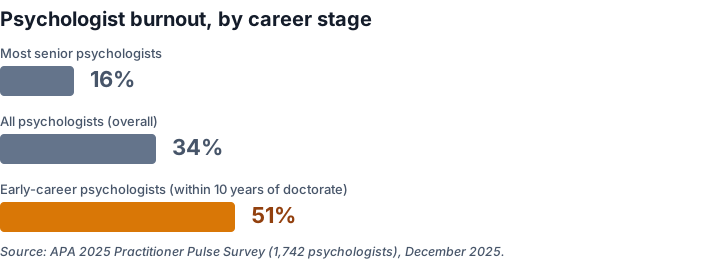
Sit with that spread for a second. The newest psychologists are burning out at about three times the rate of the most senior ones. Those early-career clinicians are the ones the field needs for the next 30 years. When your newest workers burn out first, the pipeline itself is failing. I walked through that math in The Attrition Death Spiral: recruiting new clinicians can’t outrun losing the ones we already have.
Why Therapist Burnout Happens
Burnout gets framed as a personal failing. As if therapists just need a bubble bath and a better morning routine. That framing is convenient for the system causing the damage, and it’s wrong.
The APA’s December 2025 survey asked psychologists who take no insurance, or who dropped an insurance panel in the past year, what pushed them out. A panel is just the list of providers an insurance plan agrees to pay. Their top answers (APA, December 2025):
- 75% said the pay was too low. The plan’s rates didn’t cover the real cost of doing the work.
- 57% pointed to administrative problems with insurance payers. The forms, the portals, the phone calls, the appeals.
- 43% said they couldn’t count on being paid reliably. Imagine doing your job all month and treating your paycheck as a maybe.
The exits are not hypothetical. In the past year alone, 10% of insurance-accepting psychologists stopped participating in a private or commercial insurance panel, and 38% of psychologists now accept no insurance at all (APA, December 2025).
Look at what’s missing from that list: the clients. Therapists aren’t running from the people they help. They’re running from the machine wrapped around that help. Your insurance card says you’re covered. But that word has never promised you’ll find someone who can see you. I broke down how that business model works in The Business of Being Unwell.
For the therapists reading this, I’ve also written about building a sustainable caseload over on the VibeCheck.luxury blog.
What Does the Shortage Mean for You?
Longer waits, and worse shape when you finally get in. Providers are reporting exactly that.
In the same December 2025 APA survey, 46% of psychologists said they had no openings for new patients. Another 40% keep a waitlist. And 45% reported rising symptom severity among the clients they do see (APA, December 2025). Put those together and the picture is plain. People wait longer for care, and they get sicker while they wait.
Waitlists aren’t neutral, either. A person who finally works up the nerve to call, then hears “three months,” often doesn’t call the next place. The window closes.
The forecast is rough too. The National Council for Mental Wellbeing, citing federal HRSA workforce projections, expects the U.S. to be short about 88,000 mental health counselors and 114,000 addiction counselors by 2037 (National Council, December 2025). That’s on top of the psychiatrist cliff already rolling toward us.
If you’re trying to find care right now, a few moves improve your odds:
- Get on more than one waitlist. About 40% of psychologists keep one, so ask to be added.
- Ask about telehealth. A licensed provider anywhere in your state can usually see you by video.
- When a full practice says no, ask for two or three names. Clinicians usually know who has openings.
- If cost is the wall, ask about a sliding scale. That means the fee drops based on your income.
None of this fixes the system. It just helps you get through it while the real fixes crawl along.
A Note for Employers
Most employers now offer a mental health benefit and consider the job done. The workforce data says the job is not done. A benefit only counts if your people can actually book a session with it. In a country where 46% of psychologists have no openings (APA, December 2025), a lot of them can’t.
So ask your plan harder questions. How many in-network therapists near your people are taking new patients this month? What’s the real average wait for a first appointment? If the answer is a shrug, you’re paying for coverage your people can’t use. And remember what pushed clinicians off those networks in the first place: 75% of psychologists who stepped away from insurance said the pay was too low (APA, December 2025). The network looks full on paper and empty in real life for a reason.
What Would Actually Fix the Workforce Drain?
The fixes match the causes. None of them are mysterious.
Pay clinicians enough to stay. When 75% of psychologists stepping away from insurance name low pay as the reason (APA, December 2025), the rate-setters have their answer. Commercial insurers set those rates. They can change them.
Cut the busywork. 57% named administrative problems with payers. Every unpaid hour spent on forms and appeals is an hour of care lost, and one more shove toward the exit.
Protect the newest clinicians. With 51% of early-career psychologists reporting burnout, the field is leaking at the entrance. Real supervision, sane caseloads, and loan support keep people, and keeping people is cheaper than replacing them.
Make care fit real life. Therapy, when you can get it, is about 4 sessions a month. The other 26 days belong to jobs, kids, and 2 a.m. worries. People need support that reaches them there too.
I refuse to end this in the ditch, so here’s the hopeful part. This shortage was built by decisions, mostly decisions about money. Decisions can be reversed. Roughly 6,800 practitioners would clear the entire federal shortage list. That’s a policy choice, and 137 million people are waiting on it.
FAQ
Is it true that 40% of therapists are thinking about quitting?
That exact figure doesn’t hold up in any strong source. The closest verified number: 48% of behavioral health workers said shortage strain made them consider other employment, in a National Council for Mental Wellbeing / Harris Poll survey of 750 workers fielded in February 2023. In newer data, 34% of psychologists reported burnout in 2025, rising to 51% for early-career psychologists (APA, December 2025).
How many Americans live in a mental health shortage area?
About 137 million people, roughly 40% of the U.S. population, live in one of 6,807 federally designated Mental Health Professional Shortage Areas, per KFF State Health Facts tracking HRSA data as of December 31, 2025. Only 27.3% of the need for practitioners in those areas is currently met.
Why is it so hard to find a therapist who takes my insurance?
Because many have stepped away from insurance networks. Per the APA’s December 2025 Practitioner Pulse Survey, 38% of psychologists accept no insurance, and 10% of those who do dropped a private or commercial panel in the past year. Among psychologists who stepped back, 75% cited pay that was too low.
Will the therapist shortage get better on its own?
The projections say no. The National Council for Mental Wellbeing, citing HRSA workforce projections, expects a shortfall of about 88,000 mental health counselors and 114,000 addiction counselors by 2037 (December 2025). Closing the gap takes better pay from commercial insurers, less administrative burden, and real support for early-career clinicians.
Sources
- Mental Health Care Health Professional Shortage Areas (HPSAs). KFF State Health Facts, based on HRSA data as of December 31, 2025. 137,133,953 people across 6,807 designations; 27.3% of need met; about 6,800 additional practitioners needed.
- 2025 Practitioner Pulse Survey, Full Report. American Psychological Association, December 2025. Survey of 1,742 licensed practicing psychologists; burnout, capacity, waitlist, and insurance-participation findings.
- Help Wanted. National Council for Mental Wellbeing / The Harris Poll, April 2023. Survey of 750 behavioral health workers, fielded February 3 to 19, 2023; 93% experienced burnout; 48% considered other employment options.
- Behavioral Health Workforce Under Pressure: Preparing Today, Tomorrow. National Council for Mental Wellbeing, updated December 19, 2025 (original September 25, 2025). HRSA-based projections: about 88,000 mental health counselors and 114,000 addiction counselors short by 2037.
Disclaimer
This article is for educational and informational purposes only. It does not constitute medical, clinical, legal, or therapeutic advice, and reading it does not create a therapist-client relationship with Matthew Sexton, LCSW or Mental Wealth Solutions, Inc. Although the author is a licensed clinical social worker, the content in this article is not clinical assessment, diagnosis, or treatment.
The workforce statistics, survey findings, and projections described here reflect publicly available federal data and professional surveys as of the publication date. Shortage-area designations, insurance participation, and workforce conditions vary by state and region and change over time, and what is described here may not match your local situation. If burnout, or anything else, is weighing on your health or your work, please consult a licensed mental health professional who can assess your specific circumstances.
If you are in immediate emotional crisis, you can reach the 988 Suicide & Crisis Lifeline by calling or texting 988 (US). If you are experiencing domestic violence or are in physical danger, contact the National Domestic Violence Hotline at 1-800-799-7233 or visit thehotline.org. In a life-threatening emergency, call 911.
Frequently asked questions.
- Is it true that 40% of therapists are thinking about quitting?
- That exact figure doesn't hold up in any strong source. The closest verified number: 48% of behavioral health workers said shortage strain made them consider other employment, in a National Council for Mental Wellbeing / Harris Poll survey of 750 workers fielded in February 2023. In newer data, 34% of psychologists reported burnout in 2025, rising to 51% for early-career psychologists (APA, December 2025).
- How many Americans live in a mental health shortage area?
- About 137 million people, roughly 40% of the U.S. population, live in one of 6,807 federally designated Mental Health Professional Shortage Areas, per KFF State Health Facts tracking HRSA data as of December 31, 2025. Only 27.3% of the need for practitioners in those areas is currently met.
- Why is it so hard to find a therapist who takes my insurance?
- Because many have stepped away from insurance networks. Per the APA's December 2025 Practitioner Pulse Survey, 38% of psychologists accept no insurance, and 10% of those who do dropped a private or commercial panel in the past year. Among psychologists who stepped back, 75% cited pay that was too low.
- Will the therapist shortage get better on its own?
- The projections say no. The National Council for Mental Wellbeing, citing HRSA workforce projections, expects a shortfall of about 88,000 mental health counselors and 114,000 addiction counselors by 2037 (December 2025). Closing the gap takes better pay from commercial insurers, less administrative burden, and real support for early-career clinicians.
Want to discuss this for your program?
Book a 30-min conversation. We'll walk you through deployment, the BAA, and what your rollout looks like in production.
Book a 30-min conversation