
AI monthly use among therapists nearly tripled in one year. The APA’s 2025 Practitioner and Technology Pulse Survey found 29% of therapists now use AI tools at least monthly — up from 10% the year before. (APA Practitioner and Technology Pulse Survey, 2025) The 71% who haven’t adopted yet are waiting for different things: clearer compliance standards, better tools, lower risk, or just more time to evaluate. This post is for both groups.
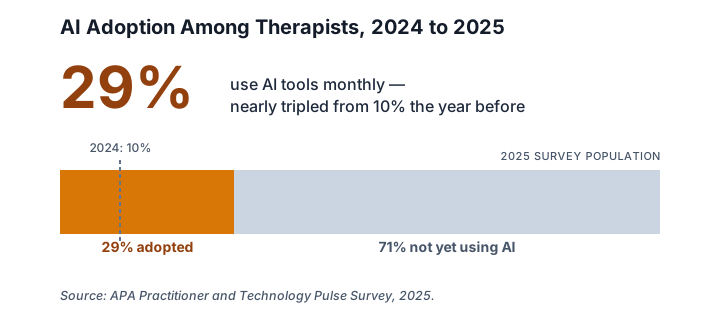
Quick answer: The 29% are mainly adopting ambient clinical intelligence (automated notes) and administrative automation. The core compliance gap is BAA coverage and data isolation — 67% of therapists cite data security as their primary concern, and it’s the right one to start with. The tools that are worth adopting in 2026 handle one thing well, sign a BAA, and don’t train on your client data.
Key Takeaways
- APA 2025: 29% of therapists use AI monthly — nearly tripled from 10% the prior year
- Four adoption categories: ambient clinical intelligence, practice management, outcome measurement, multi-modal operating systems
- 67% of therapists cite data security and privacy as primary concern with AI adoption
- No AI tool is HIPAA “compliant” — it’s HIPAA-eligible with BAA coverage; no BAA = liability on the clinician
- Documentation automation has clearest ROI and lowest clinical risk; start there
The Four Categories of AI Tools Private Practice Therapists Are Actually Adopting
The APA’s 2025 data and adoption patterns from platforms like Alma and AutoNotes point to four distinct categories where private practice AI adoption is actually happening. They’re not equally mature, and the risk profiles differ meaningfully.
1. Ambient Clinical Intelligence
This is the fastest-growing category. AI listens to sessions (with documented client consent) and generates clinical notes, progress notes, session summaries, and treatment plan updates automatically. Documentation that used to take 30-45 minutes per session comes back as a draft in under 10 minutes.
Tools in this space: AutoNotes (mental health-specific, BAA-ready), Opus AI, and several EHR-integrated versions emerging in 2025-2026. The value proposition is clear: documentation load is the leading driver of therapist burnout, and ambient AI is the most direct tool we have for reducing it.
Compliance note: ambient documentation requires explicit client informed consent covering what is recorded, who processes it, and how long data is retained. A BAA is required. Any tool in this category that cannot produce a BAA should not be used with PHI.
2. Practice Management AI
Billing automation, insurance verification, scheduling optimization, intake documentation, and prior authorization drafting. This category has lower clinical risk than ambient documentation (it doesn’t touch session content directly) but high operational leverage.
Platforms like Alma have integrated AI-powered billing and insurance coordination for clinicians in their network. For solo practitioners not on a platform, stand-alone tools in this category include Sana Benefits integrations and AI-assisted ERA processing from major clearinghouses.
The compliance standard here is simpler: does the tool access or store PHI? If yes, BAA required. If it only handles payment data, it may fall under different compliance frameworks.
3. Outcome Measurement
AI that tracks and analyzes client outcome data across a caseload — PHQ-9 trends, GAD-7 scores, session attendance patterns, treatment adherence. This category is less adopted but growing, driven by value-based care contracts that require outcome reporting.
The practical use case: a clinician with 30 active clients gets a weekly AI summary of caseload-level outcome trends, flagging clients whose scores haven’t moved or have worsened over a specified period. That’s not clinical judgment — it’s information organization that enables clinical judgment.
4. Multi-Modal Operating Systems
All-in-one platforms that combine documentation, scheduling, billing, outcome tracking, and clinical support. The value here is data integration — a single system that sees the full picture of a clinical practice rather than siloed tools that don’t talk to each other.
Simple Practice has been adding AI features to its platform. Alma provides network clinicians with an integrated set of services. VibeCheck.luxury is the between-session companion for therapists and their clients, with AI assisting documentation and outcomes while the licensed clinician retains oversight of all clinical functions.
The risk in this category: platform dependency. What you gain in integration, you cede in portability. Understand your data export rights before committing a full practice to any single platform.
The Compliance Question That Actually Matters
Sixty-seven percent of therapists cite data security and privacy as their primary concern about AI adoption (APA, 2025). That’s the right concern. Here’s how to evaluate it concisely.
The BAA question. No AI tool is HIPAA “compliant” in isolation. HIPAA establishes obligations for covered entities (you, as a clinician) and their business associates (tools that handle PHI on your behalf). A Business Associate Agreement is the legal instrument that extends your HIPAA obligations to your tool vendor. If a tool processes your clients’ session data and cannot produce a BAA, the liability for any breach sits with you, not the vendor.
The script: ask any AI vendor “Can you provide a signed BAA for use with client PHI?” If the answer is no, or is hedged into “we’re HIPAA-ready” or “HIPAA-compatible,” that’s a no.
The training data question. Some AI tools improve by training on user data. In a mental health context, that means your clients’ PHI could be used to train a model that other users benefit from. This is a separate question from BAA coverage — some tools are BAA-eligible but still train on your data unless you opt out. Ask explicitly: “Does this tool train its models on my clients’ session data, and how do I opt out?”
The data isolation question. Where is data stored, who has access, and what happens if the company is acquired? These questions matter more for mental health data than for most professional tools because the sensitivity of the content and the clinical liability attached to it are both unusually high.
The 71%: What’s Actually Worth Waiting For
If you’re in the 71% and haven’t adopted AI tools yet, the question isn’t whether to adopt — the adoption curve is clear. The question is what to adopt first and in what order.
The safest starting point: documentation automation with a BAA-covered tool that explicitly does not train on client data. Start with one tool, one use case, and evaluate whether it actually reduces your documentation load before adding anything else to the stack.
The question to ask before adding any second tool: does this improve care or just add complexity? AI tools have a well-documented tendency to expand — each one seems useful in isolation, but collectively they can create a more fragmented practice rather than a more efficient one.
The multi-modal platform play makes sense when you have enough volume and enough pain points that integration value outweighs the portability risk. Solo practitioners in their first two years of practice should probably not start there.
FAQ
What percentage of therapists use AI tools in their practice?
The APA’s 2025 Practitioner and Technology Pulse Survey found 29% of therapists now use AI tools at least monthly — nearly triple the 10% rate from the prior year. The fastest-growing category is ambient clinical intelligence (automated documentation), followed by administrative automation.
What are the four main categories of AI tools private practice therapists are adopting?
(1) Ambient clinical intelligence — AI generates notes from session audio; (2) Practice management AI — billing, scheduling, intake automation; (3) Outcome measurement — AI tracks and analyzes caseload outcome data; (4) Multi-modal operating systems — integrated platforms combining documentation, scheduling, billing, and clinical support.
What are the HIPAA compliance risks of AI tools for therapists?
The APA 2025 survey found 67% of therapists cite data security and privacy as primary concerns. Core compliance questions: Does it sign a BAA? Where is data stored? Does it train on client data? Tools claiming HIPAA compliance without a BAA shift liability to the clinician.
What is ambient clinical intelligence for therapists?
AI tools that listen to therapy sessions (with client consent) and generate clinical notes, session summaries, and treatment plan drafts automatically. Tools like AutoNotes and Opus AI reduce documentation from 30-45 minutes to 5-10 minutes per session. Require explicit informed consent and BAA coverage.
Should I use AI tools in my private practice in 2026?
The 29% adoption rate suggests early movers are finding value. Start with a tool that signs a BAA, has clear data isolation, and handles one specific pain point. Documentation automation has the clearest ROI and the lowest clinical risk when the clinician reviews all output.
Sources
- APA — Practitioner and Technology Pulse Survey, 2025. apa.org
- Alma — AI-integrated practice management for therapists, 2025-2026. helloalma.com
- AutoNotes — HIPAA-eligible ambient documentation for therapists. autonotes.ai
- APA — Health Advisory on Generative AI Chatbots in Mental Health, November 2025. apa.org
Sources current as of July 2026.
Disclaimer
This article is for educational and informational purposes only. It does not constitute medical, clinical, legal, or therapeutic advice, and reading it does not create a therapist-client relationship with Matthew Sexton, LCSW or Mental Wealth Solutions, Inc. Although the author is a licensed clinical social worker, the content in this article is not clinical assessment, diagnosis, or treatment.
HIPAA compliance is a legal and regulatory matter that depends on the specific facts of your practice, tools, and contracts. Nothing here constitutes legal or compliance advice. Tool vendor claims about HIPAA eligibility or compliance should be verified directly with the vendor’s legal documentation and with a qualified healthcare attorney or compliance consultant familiar with your specific practice. Regulatory requirements and tool capabilities change frequently and may differ from what is described here after publication.
If you are in immediate emotional crisis, you can reach the 988 Suicide & Crisis Lifeline by calling or texting 988 (US). If you are experiencing domestic violence or are in physical danger, contact the National Domestic Violence Hotline at 1-800-799-7233 or visit thehotline.org. In a life-threatening emergency, call 911.
Frequently asked questions.
- What percentage of therapists use AI tools in their practice?
- According to the APA's 2025 Practitioner and Technology Pulse Survey, 29% of therapists now use AI tools at least monthly — nearly triple the 10% rate from the year before. Roughly 71% still do not use AI tools regularly. The fastest-growing category is ambient clinical intelligence (automated session documentation), followed by administrative automation.
- What are the four main categories of AI tools private practice therapists are adopting?
- The four categories are: (1) Ambient clinical intelligence — AI that listens to sessions and generates notes automatically (AutoNotes, Opus AI); (2) Practice management AI — billing automation, scheduling, and intake documentation; (3) Outcome measurement tools — AI that tracks and analyzes client outcome data across caseloads; (4) Multi-modal operating systems — all-in-one platforms combining documentation, scheduling, billing, and clinical support (Alma, Simple Practice AI features, VibeCheck.luxury).
- What are the HIPAA compliance risks of AI tools for therapists?
- The APA's 2025 survey found 67% of therapists cite data security and privacy as their primary concern about AI adoption. Core compliance questions for any AI tool: Does it sign a BAA (Business Associate Agreement)? Where is data stored and processed? Does it train on client data? Who else has access? Tools that claim HIPAA compliance without a BAA are not covered entities and shift liability to the clinician.
- What is ambient clinical intelligence for therapists?
- Ambient clinical intelligence refers to AI tools that listen to therapy sessions (with client consent) and automatically generate clinical notes, session summaries, and treatment plan updates. Tools in this category include AutoNotes and Opus AI. They reduce documentation time significantly — some practices report cutting note-writing from 30-45 minutes to 5-10 minutes per session — but require careful informed consent and BAA coverage.
- Should I use AI tools in my private practice in 2026?
- The 29% adoption rate suggests early movers are finding value. The 67% data security concern is real and should inform tool selection. The most defensible path: start with a tool that signs a BAA, has clear data isolation (doesn't train on your clients' data), and handles one specific pain point rather than trying to replace your entire practice management system at once. Documentation automation has the clearest ROI and the lowest clinical risk when the clinician reviews all output.
If you're the therapist here.
Your clients get 4 sessions a month. The other 26 days they're on their own. VibeCheck.luxury is the between-session companion that carries those days back to you — clients check in daily, and you walk in already knowing what kind of week it was. Built by Matthew Sexton, LCSW, NATC.