
Quick answer: Insurance credentialing takes 90 to 120 days even when nothing goes wrong, according to the American Medical Association. During that whole wait, a fully licensed therapist cannot bill your insurance plan. The delays are so routine that California passed a law in October 2025, AB 1041, forcing commercial insurers to decide within 90 days or grant a temporary approval.
You did the hard part. You found a therapist you like. They are licensed. They have open times. Then they say the strange sentence: “I can’t take your insurance yet.”
The holdup is a process called credentialing. Credentialing means the insurance company checks a therapist’s license, degree, and history before it lets them bill. The American Medical Association’s credentialing guide says the full process can take 90 to 120 days after the application goes in, even when nothing goes wrong (AMA, October 2020). That is three to four months. And that is the good version. When paperwork stalls, the wait can stretch past six months.
I’m Matthew Sexton, a licensed clinical social worker. I want to walk you through this wait. It quietly breaks new therapy practices before they ever open. And it explains a lot about why care is so hard to find.
What is credentialing, and why does it take so long?
On paper, credentialing sounds simple. The insurer checks that the therapist is real: license, degree, malpractice insurance, work history. Malpractice insurance is the coverage a therapist must carry in case they get sued. Fair enough. Nobody wants fake therapists on the list.
But checking is only step one. After credentialing comes payer enrollment. That is the contract that lets a therapist actually bill the plan. The AMA’s guide says the whole chain, credentialing plus enrollment, can take an institution 90 to 120 days after the application is submitted (AMA, October 2020). And that is at big hospitals with whole departments for this work. A solo therapist does it alone, at night, between sessions.
The timing is the part that lands on you. The AMA notes that a delay at any point also delays when a clinician can start seeing patients and billing. The clock does not care that the therapist is licensed. Until the insurer says yes, your plan treats that therapist like they do not exist.
The gap that breaks new practices
A new practice starts paying bills on day one. Rent, liability insurance, software, a website, a phone line. Every one of those bills shows up whether or not the insurer has finished its paperwork.
The insurance money starts at day 90 to 120, at the earliest. So a new therapist spends three to four months paying full costs while that plan pays them nothing.
Here is what a new therapist carries during the wait:
- Office rent, due from the first month
- Malpractice insurance, required before the first session
- Practice software and a secure phone line
- A website and basic marketing
- Their own student loans and living costs
Behavioral science has a simple lesson here. Make a process slow enough, and a predictable share of people quit before the end. Nobody has to say no. The calendar says it for them. That trick works on patients waiting for approvals. It works just as well on therapists waiting to get paid.
Some therapists bridge the gap with cash-pay clients. Some burn savings. Some look at the wait and skip insurance panels for good. I wrote about that bigger pattern in The Business of Being Unwell. Every therapist who walks away makes the network thinner. The wait helped push them out.
Why can’t your new therapist take your insurance yet?
Because “licensed” and “in-network” are two different approvals, and the insurance company controls the second one.
Your therapist may have a state license, years of training, and an open Tuesday slot. None of that matters to your plan until credentialing is done. See them before that day, and the plan calls it out-of-network care. That usually means you pay much more. Sometimes you pay all of it.
This is one of the quiet gaps I keep pointing at. We tell people to “just go to therapy” as if the door is wide open. Then the system puts a three-to-four-month lock on the door and blames nobody.
It took a law to make insurers hurry up
How do we know these delays are routine, and not rare bad luck? Because a state had to pass a law about them.
California’s governor signed AB 1041 on October 11, 2025 (California Legislature, October 2025). The law tells commercial health plans and insurers to do three things:
- Confirm they received the application within 10 business days.
- Decide within 90 days of a complete application.
- If they miss the 90 days, the provider gets provisional approval for 120 days. Provisional means a temporary yes. The therapist can see patients and bill while the plan finishes checking.
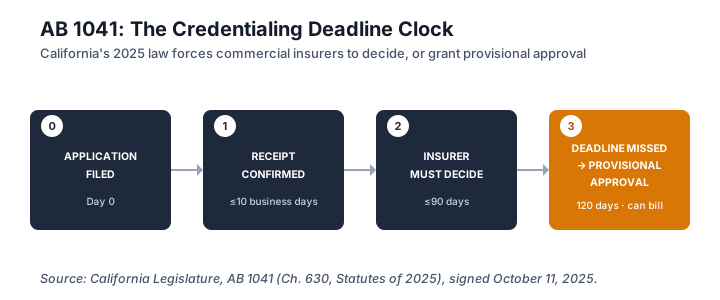
Read that law backwards and the problem shows itself. Nobody writes a deadline for a process that is already fast. Lawmakers set a 90-day cap because the waits kept blowing past it.
Notice what the law does not do, though. It cannot pay a therapist back for months already lost, and it only covers one state. What it does is stop the clock from running forever.
One more detail from the bill’s own text. California law already required plans that cover mental health to verify a mental health or substance use provider’s credentials within 60 days (AB 1041 text, October 2025). Mental health got its own faster rule before everyone else. Why? Because slow credentialing in behavioral health was already a known access problem.
Ghost networks: the other half of the trick
Now the part that makes the slow yes sting. Insurers take months to add a real, available therapist. Meanwhile, names that should come off the list stay on it. Those stale listings have a name: ghost networks. A ghost network is a directory full of providers you cannot actually see.
In December 2023, the New York Attorney General’s office called 396 mental health providers listed as in-network by 13 plans, including Aetna, Cigna, UnitedHealthcare, and Empire BlueCross BlueShield (New York Attorney General, December 2023). The finding: 86% were ghosts. They were unreachable, not in network, or not taking new patients. Only 14% offered an appointment.
It did not stop there. In February 2026, the same office settled with EmblemHealth after finding more than 80% of the behavioral health providers it listed as taking new patients were effectively unavailable (New York Attorney General, February 2026). In plain words, you could not actually book them. Emblem will pay $2.5 million. It must fix directory errors within 2 business days, run secret-shopper checks, and guarantee routine mental health appointments within 10 business days.
Hold both facts at once. Real therapists wait at the front door for months. Ghosts keep their seats inside. From the outside, the directory looks full. You cannot tell the difference until you start calling.
Where does the wait push therapists?
Out of the insurance system. The numbers show it clearly.
RTI International studied commercial insurance claims for more than 22 million people, covering 2019 to 2021 (RTI International, April 2024). Patients went out of network 3.5 times more often for behavioral health clinicians than for medical or surgical ones. For psychologists, it was 10.6 times more often. And the same commercial plans paid medical and surgical clinicians about 22% more for in-network office visits than they paid behavioral clinicians.
Put the pieces in a row. Getting on the panel costs a therapist three to four months of unpaid waiting. Staying on it pays about 22% less than the plan pays their medical colleagues. Many therapists do that math and skip the panel. There is a clinician-side breakdown of the same math on our VibeCheck.luxury blog: Cash-Pay vs Insurance: The Real Income Ceiling. The patient side is simpler and worse. Fewer real in-network therapists. More out-of-network bills.
What can you actually do?
If your new therapist cannot take your plan yet, ask three things. Ask the therapist when their credentialing application went in. Ask your insurer about out-of-network benefits and a “single case agreement,” which is a one-time deal to cover a specific provider. And if the directory keeps handing you ghosts, report it to your state insurance regulator. That is not shouting into the void. The New York cases started with complaints exactly like yours.
If you run a company, ask your carrier a harder question at renewal. How long does it take to credential a new mental health provider, start to finish? Make them give you a number. California made insurers commit to 90 days. Your contract can ask for a number too.
And if you are a therapist stuck in the wait: it is not you. The system priced in your months of free patience. Knowing the wait is standard helps you plan around it, the same way you plan around a long season of bad weather.
The wait is the tell
I keep coming back to the same fact: a plan can say you’re covered while nobody on it can actually see you. The card in your wallet says covered. A licensed therapist who cannot bill your plan for four months says something else.
The paperwork does not end when credentialing does, either. Once a therapist finally makes it into the network, prior authorization picks up right where the wait left off. New form, same kind of delay.
Still, there is real movement here. AB 1041 proves the wait can be shortened when someone forces the issue, and states often follow California on insurance rules. Until then, knowing why your new therapist cannot take your insurance yet is worth something. It moves the blame off the therapist, and off you, and onto the paperwork where it belongs.
FAQ
How long does insurance credentialing take for a therapist? Plan on 90 to 120 days after the application is submitted, even when nothing goes wrong, per the American Medical Association’s credentialing guide (October 2020). Stalled paperwork can push it much longer. In California, AB 1041 (October 2025) now forces commercial insurers to decide within 90 days or grant a 120-day provisional approval.
Why can’t my new therapist take my insurance yet? Because a state license and an insurance contract are two different approvals. Your therapist can be fully licensed and still be waiting on the insurer’s credentialing decision. Until the insurer says yes, your sessions count as out-of-network care, which usually costs you more.
What is a ghost network? A ghost network is an insurance directory full of providers you cannot actually see. When the New York Attorney General’s office called 396 mental health providers listed by 13 plans (December 2023), 86% were unreachable, out of network, or not taking new patients. Only 14% offered an appointment.
Is anyone forcing insurers to credential therapists faster? Yes. California’s AB 1041, signed October 11, 2025, gives commercial plans 90 days to decide, with automatic provisional approval for 120 days if they miss the deadline. And New York’s February 2026 EmblemHealth settlement added $2.5 million in penalties plus a guarantee of routine mental health appointments within 10 business days.
Sources
- American Medical Association, Preparation Guide for the Physician Credentialing Process, October 2020. ama-assn.org
- California Legislature, AB 1041 (Ch. 630, Statutes of 2025), signed October 11, 2025. leginfo.legislature.ca.gov
- New York State Office of the Attorney General, “Inaccurate and Inadequate”: Ghost Networks Investigation, December 7, 2023. ag.ny.gov
- New York State Office of the Attorney General, EmblemHealth Settlement on Behavioral Health Network Access, February 19, 2026. ag.ny.gov
- RTI International, Study: Disparities in In-Network Access for Mental Health and SUD Treatment, April 2024. rti.org
Figures current as of July 2026.
Disclaimer
This article is for educational and informational purposes only. It does not constitute medical, clinical, legal, or therapeutic advice, and reading it does not create a therapist-client relationship with Matthew Sexton, LCSW or Mental Wealth Solutions, Inc. Although the author is a licensed clinical social worker, the content in this article is not clinical assessment, diagnosis, or treatment.
Credentialing timelines, payer enrollment rules, directory accuracy requirements, and laws like California’s AB 1041 vary by health plan, state, and over time, and may change after this article is published. Nothing here is a substitute for confirming a specific timeline or requirement with the payer, a credentialing specialist, or qualified counsel. Plans and circumstances differ, and what is described here may not match your situation.
If you are in immediate emotional crisis, you can reach the 988 Suicide & Crisis Lifeline by calling or texting 988 (US). If you are experiencing domestic violence or are in physical danger, contact the National Domestic Violence Hotline at 1-800-799-7233 or visit thehotline.org. In a life-threatening emergency, call 911.
Frequently asked questions.
- How long does insurance credentialing take for a therapist?
- Plan on 90 to 120 days after the application is submitted, even when nothing goes wrong, per the American Medical Association's credentialing guide (October 2020). Stalled paperwork can push it much longer. In California, AB 1041 (October 2025) now forces commercial insurers to decide within 90 days or grant a 120-day provisional approval.
- Why can't my new therapist take my insurance yet?
- Because a state license and an insurance contract are two different approvals. Your therapist can be fully licensed and still be waiting on the insurer's credentialing decision. Until the insurer says yes, your sessions count as out-of-network care, which usually costs you more.
- What is a ghost network?
- A ghost network is an insurance directory full of providers you cannot actually see. When the New York Attorney General's office called 396 mental health providers listed by 13 plans (December 2023), 86% were unreachable, out of network, or not taking new patients. Only 14% offered an appointment.
- Is anyone forcing insurers to credential therapists faster?
- Yes. California's AB 1041, signed October 11, 2025, gives commercial plans 90 days to decide, with automatic provisional approval for 120 days if they miss the deadline. And New York's February 2026 EmblemHealth settlement added $2.5 million in penalties plus a guarantee of routine mental health appointments within 10 business days.
If you're the therapist here.
Your clients get 4 sessions a month. The other 26 days they're on their own. VibeCheck.luxury is the between-session companion that carries those days back to you — clients check in daily, and you walk in already knowing what kind of week it was. Built by Matthew Sexton, LCSW, NATC.