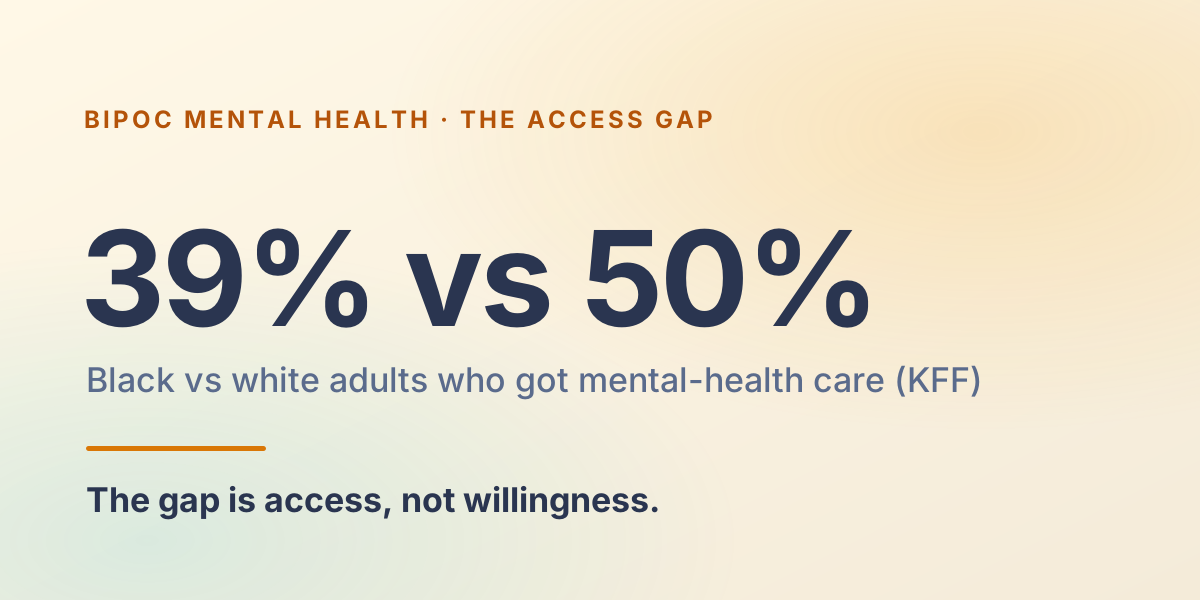
July is National Minority Mental Health Awareness Month, and the treatment gap it exists to name hasn’t closed. Among adults reporting fair or poor mental health, 39% of Black adults and 36% of Hispanic adults said they received mental health services, compared with 50% of white adults (KFF, 2026). That gap has nothing to do with who’s willing to ask for help.
I hear the “willingness” story a lot, usually framed gently: stigma runs deeper in some communities, families handle things privately. Some of that is real. None of it is the main event. The main event is a system, an insurance system, a provider pipeline, a regulatory backstop, that was never built with equal reach.
Quick answer: The BIPOC mental health treatment gap in 2026 is a system problem, not a cultural one. Among adults with fair or poor mental health, 39% of Black adults and 36% of Hispanic adults got treatment versus 50% of white adults (KFF, 2026), and Asian American adults trail every group. Insurance networks, provider supply, and parity enforcement don’t reach BIPOC communities the same way they reach everyone else.
How big is the BIPOC mental health treatment gap in 2026?
The gap is measurable and specific, not a vague sense that “things are harder.” KFF’s Survey of Racism, Discrimination, and Health found that among adults who report fair or poor mental health, 39% of Black adults and 36% of Hispanic adults say they received mental health services, against 50% of white adults with the same self-reported mental health status (KFF, 2026).
Asian American adults post the lowest treatment rate of any racial group tracked, roughly one in four, against roughly one in two for white adults. The precise national figure varies by dataset and year, which is itself worth naming rather than papering over with a false-precision decimal: what’s consistent across every credible source is the direction and the rough size of the gap, not a single clean number.
July’s designation exists because these numbers haven’t closed on their own. National Minority Mental Health Awareness Month was established by a 2008 U.S. House resolution honoring author and mental health advocate Bebe Moore Campbell, who spent years pushing for recognition of exactly this disparity (CDC; Mental Health America). Almost two decades of awareness campaigns later, the treatment-rate gap is still there. That should tell you something about what kind of problem this actually is.
Why do BIPOC adults get less care, even when they have insurance?
Having a health plan and having usable access to a therapist are two different things, and the gap between them falls harder on BIPOC patients. In-network mental health provider directories are measurably thinner in majority-Black and majority-Hispanic ZIP codes than in whiter, wealthier areas covered by the same plans. A plan can technically cover therapy and still leave the nearest in-network clinician an hour and a half away.
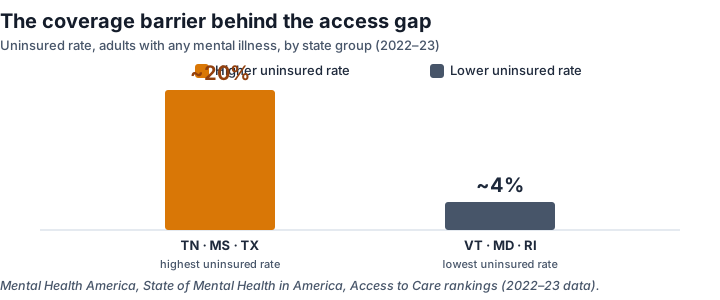
Coverage itself isn’t evenly distributed either. State-level access gaps concentrate hardest in the South: nearly 20% of adults with any mental illness in Tennessee, Mississippi, and Texas were uninsured as of 2022-23, versus roughly 4% in Vermont, Maryland, and Rhode Island (Mental Health America, State of Mental Health in America). No coverage means no directory, no appointment, no visit. The gap starts before care ever enters the picture.
Layer in the low reimbursement rates that push mental health clinicians out of network faster than medical providers in the same plan, and you get a network that’s thinner everywhere, but thinnest in the ZIP codes with the least leverage to push back.
Where are the culturally matched providers?
A real piece of the gap is supply, and the supply doesn’t match the country it serves. BIPOC Americans make up roughly 40% of the U.S. population but only about 20% of the mental health workforce identifies as BIPOC. That imbalance has held for years, not months, which means it isn’t correcting itself through the normal training pipeline.
For a lot of patients, finding a therapist who shares their language, cultural background, or lived experience with racism isn’t a preference. It’s the difference between opening up in a first session and shutting down. When that specific match doesn’t exist in-network, in driving distance, or accepting new patients, patients don’t get a slightly worse version of care. Often they get none.
The workforce-shortage conversation in mental health usually gets discussed as one undifferentiated number, therapists per capita, wait times, shortage areas. That framing hides a second, narrower shortage sitting inside the first one: even where general capacity exists, culturally matched capacity often doesn’t, and that specific scarcity tracks with the treatment gap more closely than raw provider counts do.
Is the gap about to get worse? The parity-enforcement threat
There’s a real risk this gets harder before it gets easier. Federal regulators are not enforcing key provisions of the 2024 Mental Health Parity and Addiction Equity Act final rule and are rewriting it rather than defending it in court, which reverts enforcement to a pre-2024 framework (Commonwealth Fund; Georgetown CHIR). Parity enforcement is one of the few levers that pushes insurers to build out the networks BIPOC patients disproportionately rely on.
Community mental health centers absorb a lot of that risk directly. This is our own read, not a cited statistic: centers serving a disproportionately BIPOC and lower-income patient base lean on parity enforcement more than higher-resourced private practices do, because their patients have fewer alternative payment paths if a claim gets denied or a network thins further. Weaker enforcement doesn’t hit every provider evenly. It hits the ones already carrying the patients the rest of the system underserves.
What would actually close the gap?
None of this closes through more awareness campaigns alone, however necessary they are. It closes through the same three levers every access gap in mental health closes through: coverage that reaches people, networks that include providers patients can actually use, and enforcement that has teeth when insurers cut corners.
Expand who’s actually in-network, not just who’s technically covered. A plan that lists a provider forty minutes away with a three-month waitlist isn’t functionally different from no coverage. Insurers can be measured on reach, not just roster size.
Invest in the culturally matched pipeline directly. A patient who doesn’t have to spend the first twenty minutes of a first session explaining their cultural context before the clinical work can start gets more out of every session that follows. Scarcity of matched providers means most patients never get the choice.
Keep parity enforcement funded and active. A law that isn’t enforced is a press release. The communities most dependent on that enforcement, including the ones this month is named for, are the ones with the least room to absorb its absence.
July is a good moment to say the gap out loud. Naming a month doesn’t move a treatment rate. Fixing the system underneath it does.
FAQ
Why do BIPOC adults get less mental health treatment than white adults? Not because of lower need or less willingness to seek help. Among adults reporting fair or poor mental health, 39% of Black adults and 36% of Hispanic adults said they received mental health services, versus 50% of white adults (KFF, 2026). Asian American adults have the lowest treatment rate of any racial group tracked, roughly one in four versus roughly one in two white adults. Insurance gaps, thin in-network directories, and a shortage of culturally matched providers account for most of the difference.
What is BIPOC Mental Health Month? July is officially National Minority Mental Health Awareness Month, established by a 2008 U.S. House resolution honoring author and advocate Bebe Moore Campbell. It exists to spotlight documented barriers BIPOC communities face in reaching care, not to suggest the need for care differs by race.
Is mental health parity enforcement getting weaker in 2026? Yes. Federal regulators are not enforcing key provisions of the 2024 MHPAEA parity rule and are rewriting it rather than defending it in court, reverting enforcement to a pre-2024 framework. Community mental health centers, which serve a disproportionately BIPOC and lower-income patient base, rely on that enforcement more than higher-resourced practices do.
Is there really a shortage of culturally matched therapists? The gap is structural. BIPOC Americans make up roughly 40% of the U.S. population but only about 20% of the mental health workforce, a mismatch that has held for years, not months.
Sources
- KFF, “Black and Hispanic Adults With Fair or Poor Mental Health Are Less Likely Than White Adults to Say They Received Mental Health Services,” 2026. kff.org
- CDC, “Prioritizing Minority Mental Health.” cdc.gov
- Mental Health America, “BIPOC Mental Health Month.” mhanational.org
- Mental Health America, “State of Mental Health in America, Access to Care.” mhanational.org
- Commonwealth Fund, “Behavioral Health Parity Takes a Step Backward Under Trump Administration,” 2026. commonwealthfund.org
- Georgetown University Center on Health Insurance Reforms, “Behavioral Health Parity Takes a Step Backward,” 2026. chir.georgetown.edu
Figures current as of July 2026.
Disclaimer
This article is for educational and informational purposes only. It does not constitute medical, clinical, legal, or therapeutic advice, and reading it does not create a therapist-client relationship with Matthew Sexton, LCSW or Mental Wealth Solutions, Inc. Although the author is a licensed clinical social worker, the content in this article is not clinical assessment, diagnosis, or treatment.
Treatment-rate disparities, insurance network data, and mental health parity enforcement described here reflect national trends and aggregate research, and individual experiences vary by state, insurance plan, and provider availability. What is described here may not match every reader’s situation. If you are having trouble finding a therapist who fits your needs, including cultural or language match, a local community mental health center or your insurer’s member services line can help you search beyond the standard online directory.
If you are in immediate emotional crisis, you can reach the 988 Suicide & Crisis Lifeline by calling or texting 988 (US). If you are experiencing domestic violence or are in physical danger, contact the National Domestic Violence Hotline at 1-800-799-7233 or visit thehotline.org. In a life-threatening emergency, call 911.
Frequently asked questions.
- Why do BIPOC adults get less mental health treatment than white adults?
- Not because of lower need or less willingness to seek help. Among adults reporting fair or poor mental health, 39% of Black adults and 36% of Hispanic adults said they received mental health services, versus 50% of white adults (KFF, 2026). Asian American adults have the lowest treatment rate of any racial group tracked, roughly one in four versus roughly one in two white adults. Insurance gaps, thin in-network directories, and a shortage of culturally matched providers account for most of the difference.
- What is BIPOC Mental Health Month?
- July is officially National Minority Mental Health Awareness Month, established by a 2008 U.S. House resolution honoring author and mental health advocate Bebe Moore Campbell. It exists to spotlight documented barriers BIPOC communities face in reaching mental health care, not to suggest the need for care differs by race.
- Is mental health parity enforcement getting weaker in 2026?
- Yes. Federal regulators are not enforcing key provisions of the 2024 MHPAEA parity rule and are rewriting it rather than defending it in court, reverting enforcement to a pre-2024 framework (Commonwealth Fund, Georgetown CHIR, 2026). Community mental health centers, which serve a disproportionately BIPOC and lower-income patient base, rely on that enforcement more than higher-resourced practices do.
- Is there really a shortage of culturally matched therapists?
- The gap is structural. BIPOC Americans make up roughly 40% of the U.S. population but only about 20% of the mental health workforce, a mismatch that has held for years, not months.
If you're the therapist here.
Your clients get 4 sessions a month. The other 26 days they're on their own. VibeCheck.luxury is the between-session companion that carries those days back to you — clients check in daily, and you walk in already knowing what kind of week it was. Built by Matthew Sexton, LCSW, NATC.