
Quick answer: Health plans sold on the insurance marketplaces are supposed to offer you a routine mental health appointment within 10 business days, at least 90% of the time. Independent “secret shopper” surveys check whether they really do (CMS QHP certification standards, 2025). Starting January 1, 2026, federal time-and-distance network rules extend to the state-run marketplaces in every state (HHS 2025 payment rule, April 2024).
Let me be honest up front. There is no single law called “the 2026 network adequacy rule.” Instead, a set of rules all land on one day: January 1, 2026. Marketplace plans are the ones you buy on a state or federal exchange. They already carry a clock. They must offer a routine mental health appointment within 10 business days. And they must hit that mark at least 90% of the time (CMS QHP certification standards, 2025). Now three more pieces snap into place. State-run marketplaces must use the same stopwatch-and-map rules. New York’s own 10-day rule reaches most commercial plans as they renew. And a big federal parity rule was supposed to start. Its enforcement is paused. I read the fine print so you don’t have to.
What does “network adequacy” actually mean?
Plain English first. When you buy insurance, you are really buying a list. The list holds the doctors and therapists who agree to take your plan. Network adequacy rules say that list has to be real. It needs enough providers, close enough to reach, with appointments you can actually get.
Why would we need a rule for that? Because the mental health part of the list is often thin. Anyone who has called twenty therapists from an insurer’s list knows the drill. The list says covered. The phone says voicemail. People call these ghost networks. The list is padded with therapists who are retired, full, or long gone from the plan. I’ve written before about why “just go to therapy” is broken advice.
The numbers back up the frustration. RTI International studied commercial insurance claims. Patients went out of network 3.5 times more often for mental health care than for medical care. For psychiatrists, it was 8.9 times more often. For psychologists, 10.6 times (RTI International, April 2024).
Same study, one more number. Inside the very same plans, insurers paid medical providers 22% more for an office visit than mental health providers (RTI International, April 2024). Pay one group less, and fewer of them join your list. So the list stays thin. I’ve covered how insurers profit from that gap, and therapists keep explaining why commercial insurers pay them so little.
Network adequacy rules are the government’s answer to all of this. Regulators stopped asking insurers to promise a good network. They started measuring one, with a stopwatch and a map.
What are marketplace plans already supposed to guarantee?
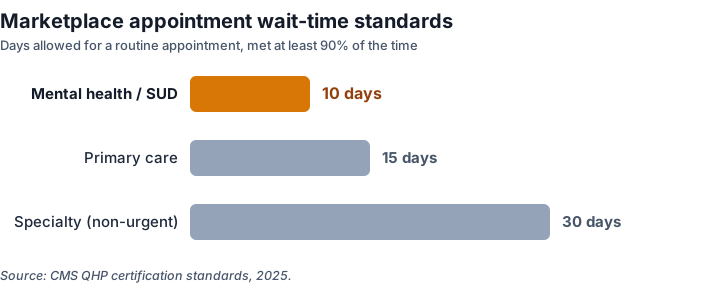
Start with plans sold on HealthCare.gov, the federal marketplace. To be sold there, a plan must pass a yearly review. The official name for these plans is “qualified health plans,” or QHPs for short. Since the 2025 plan year, that review has included appointment wait-time standards (CMS QHP certification FAQs, 2025):
- Routine mental health or substance use care: an appointment within 10 business days.
- Routine primary care: within 15 business days.
- Non-urgent specialty care: within 30 business days.
- Plans must hit these marks at least 90% of the time.
Who checks? Not the insurers themselves. Independent survey firms run “secret shopper” calls every year. Callers pose as patients, ask for appointments, and record the real wait (CMS QHP certification FAQs, 2025).
One timing note, because accuracy matters. The 10-day standard is not new for 2026. It took effect for federal marketplace plans in 2025. It carries straight into 2026 plans. What changes in 2026 is who else must play by these rules. If you shop during open enrollment this fall, every marketplace plan you compare is supposed to carry these same clocks.
Notice the order of that list, too. Mental health care got the shortest clock. Ten business days, tighter than primary care’s fifteen. Regulators put the hardest deadline on the care that is hardest to find. That choice tells you what they think of today’s networks.
What is actually new on January 1, 2026?
The map rules go national. Each year, the federal government puts out a rulebook for marketplace plans. The 2025 edition holds the change that starts now. Here it is. For plan years that begin on or after January 1, 2026, state-based marketplaces must set time-and-distance standards at least as strict as the federal marketplace’s (HHS 2025 payment rule fact sheet, April 2024). State-based marketplaces are the states that run their own exchanges, like New York, California, and Nevada.
Time-and-distance means just what it sounds like. The rules set how many minutes and miles you should have to go to reach an in-network provider. The math is done county by county. So a city block and a rural highway are not judged the same way. State marketplaces must also track which providers offer telehealth, meaning care by video or phone (same rule).
Before this, a plan on a state-run exchange could face looser network math than the same company’s plan one state over. That gap closes for 2026.
States are already moving. Nevada’s exchange told its insurers, in writing: “New for Plan Year 2026: Federal Time and Distance requirements will apply to on-exchange QHP individual health benefit plans.” The list of measured provider types now names licensed clinical social workers and psychologists specifically (Nevada Health Link, Plan Year 2026 letter to issuers, February 2025). Therapists just became dots on the regulator’s map. That part is genuinely new.
What New York just locked in for commercial insurance
New York went further than the marketplaces. A Department of Financial Services rule (11 NYCRR 38, if you want to look it up) gives New Yorkers with commercial insurance an appointment right. Your first outpatient mental health or substance use visit must happen within 10 business days of the request. Outpatient means you are not staying overnight. After a hospital stay, the window is shorter: 7 calendar days (NY DFS, July 2025).
That second clock matters. The days right after a hospital stay are a fragile time, and the rule treats them that way. Seven days, counted on a calendar, not in business days.
Here’s the part I like best. The rule has teeth. Say the insurer cannot find you an in-network appointment in time. Then it must cover an out-of-network provider, and it cannot charge you more (NY DFS, July 2025). Miss the clock, and the insurer pays the extra.
Timing: the rule kicks in for commercial policies as they are issued or renewed on or after July 1, 2025. Most plans renew on January 1. So January 1, 2026 is the day this right reaches nearly every calendar-year commercial plan in the state.
Does any of this cover the plan you get through work?
Here’s the catch, and I won’t bury it. Maybe not.
Marketplace standards cover plans sold on the exchanges. State rules like New York’s cover plans that an insurance company actually insures. Most large employers do something else. They self-fund. That means the employer pays the claims itself, and the insurance company just handles the paperwork. A federal law called ERISA keeps state insurance rules from touching self-funded plans. So most big-company plans carry no 10-day right and no state stopwatch. Not sure which kind you have? Ask HR one question. Is our plan fully insured or self-funded? The answer tells you which rules protect you.
One law does reach self-funded plans: the federal parity law, called MHPAEA. Parity means a plan cannot make mental health care harder to get than medical care. In 2024, federal agencies finished new parity rules with a network piece. Plans would have to collect real data on their own networks. That means how often members go out of network, their time-and-distance results, and what the plan pays providers. Then they would have to fix any big gaps. Plans had to follow these rules for plan years starting on or after January 1, 2026 (U.S. Department of Labor, September 2024).
Had to. On May 15, 2025, the Departments of Labor, HHS, and Treasury said they will not enforce the 2024 rule while an industry lawsuit plays out, plus 18 months after it ends (DOL enforcement statement, May 2025). The lawsuit came from the ERISA Industry Committee, a group that speaks for large employers. So the network rules sit on the books with the engine off. Nobody should sell you a “2026 federal guarantee” for employer plans. Right now, it isn’t one.
What survives the pause? A lot, actually. The parity law itself still stands. So do the 2013 parity rules and the 2021 rule that makes plans show their work, meaning prove they treat mental health care the same as medical care (same DOL statement). State regulators can still act. So can private lawsuits. The parity fines are already real. Only the new data rules are benched, for now.
Will insurers actually follow the stopwatch?
Honest answer: only where someone reads it. The good news is that more states are reading. As of April 2023, 17 states had top wait-time limits for behavioral health in at least one insurance market they oversee. Behavioral health means mental health and substance use care. Seven of those limits came after 2020. State regulators have backed up these limits with fines, and even by canceling contracts (HHS ASPE / RTI International, November 2024).
That’s why the stopwatch model is spreading. “Adequate” can be argued about forever. “An appointment within 10 business days, 90% of the time” can be measured, missed, and fined.
Which brings this back to you. A measurement only bites when someone reports the miss. If you cannot get seen in time in 2026, you have more backing than ever:
- Ask your plan for an in-network appointment inside your state’s or marketplace’s standard. Name the standard out loud.
- Write down every call: the date, the clinic, and the wait you were offered.
- If nobody has an opening, ask the plan in writing to arrange care anyway. In New York, that means an out-of-network provider at no extra cost to you.
- File a complaint with your state insurance department. It’s free, and complaints are how regulators spot the pattern.
A card in your wallet was never the same as a chair in a therapist’s office. For years, insurers alone defined the distance between those two things. Now there’s a clock on the wall and a map on the table. Use them.
FAQ
What is a network adequacy rule? It’s a rule that says an insurer’s provider list must be real: enough clinicians, close enough, and available fast enough. As of April 2023, 17 states had maximum behavioral health wait-time standards in at least one state-regulated insurance market (HHS ASPE / RTI International, November 2024). Marketplace plans also face federal appointment wait-time standards.
Do I have a right to a mental health appointment within 10 business days? Often, yes. Marketplace plans must offer a routine behavioral health appointment within 10 business days at least 90% of the time (CMS QHP certification standards, 2025). New York commercial plans carry a 10-business-day standard as they renew, with out-of-network coverage at no extra cost if the insurer misses (NY DFS, July 2025). Self-funded employer plans are the big exception.
What actually changed on January 1, 2026? Three things converge. State-based marketplaces must apply quantitative time-and-distance network standards at least as strict as the federal marketplace’s (HHS 2025 payment rule, April 2024). New York’s 10-day rule reaches calendar-year commercial plans as they renew. And the federal parity rule’s network-data provisions technically arrive, but federal enforcement is paused during litigation (DOL, May 2025).
What can I do if no in-network therapist is available? Keep records of the search: dates, calls, and the wait times you were offered. Ask your plan in writing to arrange timely care. In New York, an insurer that misses the 10-business-day window must cover an out-of-network provider without raising your cost (NY DFS, July 2025). Then file a complaint with your state insurance department.
Sources
- CMS, QHP Certification: Appointment Wait Time FAQs (standards effective plan year 2025, carried into plan year 2026), accessed July 2026. qhpcertification.cms.gov
- CMS: HHS Notice of Benefit and Payment Parameters for 2025 Final Rule fact sheet, April 2, 2024. cms.gov
- Silver State Health Insurance Exchange (Nevada Health Link): Plan Year 2026 Plan Certification Letter to Issuers, February 2025. nevadahealthlink.com
- New York State Department of Financial Services: press release on the network adequacy regulation (11 NYCRR 38) taking effect, July 8, 2025. dfs.ny.gov
- U.S. Department of Labor, EBSA: fact sheet, Final Rules under the Mental Health Parity and Addiction Equity Act (MHPAEA), September 2024. dol.gov
- U.S. Departments of Labor, HHS, and Treasury: Statement Regarding Enforcement of the Final Rule on Requirements Related to MHPAEA, May 15, 2025. dol.gov
- RTI International: study on disparities in network access for mental health and substance use treatment in commercial plans, April 2024. rti.org
- HHS ASPE / RTI International: Wait Time Standards for Behavioral Health Network Adequacy: Final Report, November 2024. aspe.hhs.gov
Figures current as of July 2026.
Disclaimer
This article is for educational and informational purposes only. It does not constitute medical, clinical, legal, or therapeutic advice, and reading it does not create a therapist-client relationship with Matthew Sexton, LCSW or Mental Wealth Solutions, Inc. Although the author is a licensed clinical social worker, the content in this article is not clinical assessment, diagnosis, or treatment.
Network adequacy standards, appointment wait-time rules, and parity enforcement vary by health plan, state, market, and over time, and may change after this article is published. Whether a specific standard applies to your coverage depends on how your plan is regulated, including whether it is a marketplace plan, a state-regulated commercial policy, or a self-funded employer plan. Nothing here is a substitute for confirming a specific requirement with your insurer, your state insurance department, your benefits administrator, or qualified counsel. Plans and circumstances differ, and what is described here may not match your situation.
If you are in immediate emotional crisis, you can reach the 988 Suicide & Crisis Lifeline by calling or texting 988 (US). If you are experiencing domestic violence or are in physical danger, contact the National Domestic Violence Hotline at 1-800-799-7233 or visit thehotline.org. In a life-threatening emergency, call 911.
Frequently asked questions.
- What is a network adequacy rule?
- It's a rule that says an insurer's provider list must be real: enough clinicians, close enough, and available fast enough. As of April 2023, 17 states had maximum behavioral health wait-time standards in at least one state-regulated insurance market, per an HHS ASPE and RTI International report from November 2024. Marketplace plans also face federal appointment wait-time standards.
- Do I have a right to a mental health appointment within 10 business days?
- Often, yes. Marketplace plans must offer a routine behavioral health appointment within 10 business days at least 90% of the time, under CMS qualified health plan certification standards. New York commercial plans carry a 10-business-day standard as they renew, with out-of-network coverage at no extra cost if the insurer misses. Self-funded employer plans are the big exception.
- What actually changed on January 1, 2026?
- Three things converge. State-based marketplaces must apply quantitative time-and-distance network standards at least as strict as the federal marketplace's, under the HHS 2025 payment rule finalized in April 2024. New York's 10-day rule reaches calendar-year commercial plans as they renew. And the federal parity rule's network-data provisions technically arrive, but federal enforcement is paused during litigation, per a May 2025 agency statement.
- What can I do if no in-network therapist is available?
- Keep records of the search: dates, calls, and the wait times you were offered. Ask your plan in writing to arrange timely care. In New York, an insurer that misses the 10-business-day window must cover an out-of-network provider without raising your cost, per the state's Department of Financial Services. Then file a complaint with your state insurance department.
Want to discuss this for your program?
Book a 30-min conversation. We'll walk you through deployment, the BAA, and what your rollout looks like in production.
Book a 30-min conversation