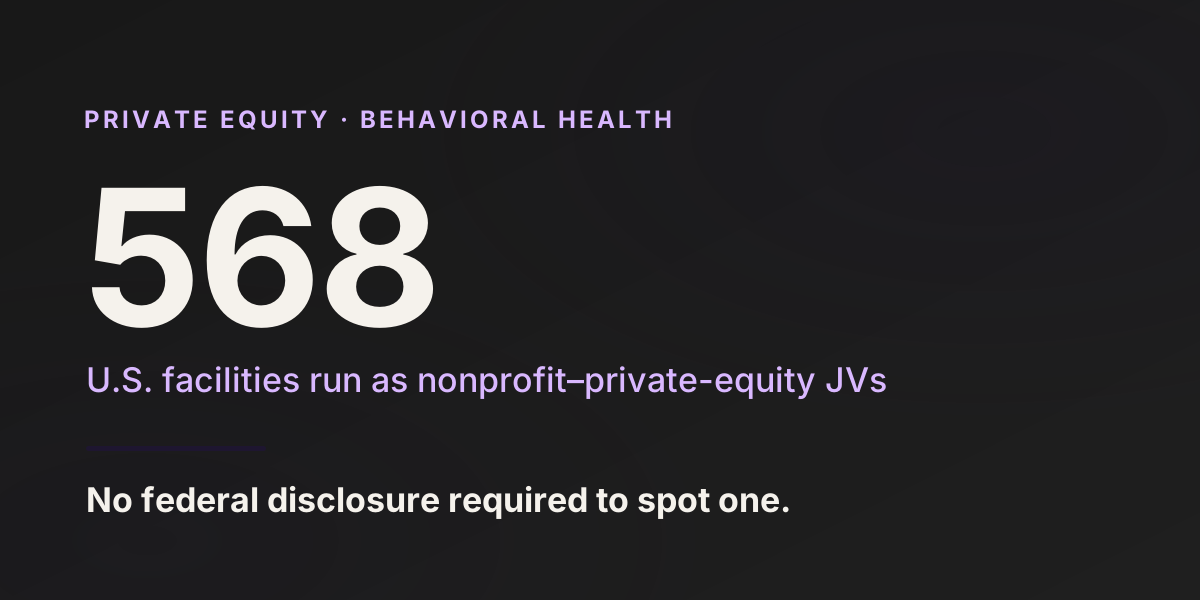
More than 500 U.S. healthcare facilities, 568 by one count, now operate as joint ventures between nonprofit health systems and private-equity-backed companies, according to a Private Equity Stakeholder Project report published July 6, 2026. More than one-fifth of PE-owned hospitals nationally are structured this way, per PESP’s report. The nonprofit name stays on the building. The financial control moves somewhere else, and almost nobody has to tell you that.
Quick answer: PESP’s July 2026 report found 568 healthcare facilities, hospitals, hospice, home health, and behavioral health among them, operating under nonprofit-private equity joint ventures, and more than one-fifth of PE-owned hospitals nationally use this structure. The facility keeps a name patients trust. A PE-backed partner often holds the real management and financial control. There is currently no federal requirement that tells you which one you’re walking into.
I’ve spent my career inside behavioral health systems, watching how ownership shapes care long before anyone in the waiting room finds out who’s really in charge. I’ve written before about what happens after a straightforward PE buyout. This is a different mechanism, and it deserves its own explanation. This one hides in plain sight, because the sign out front never changes.
How Widespread Are These Nonprofit-PE Joint Ventures?
PESP’s report counts 568 facilities nationwide running as nonprofit-PE joint ventures, across hospitals, inpatient rehab, hospice, home health, behavioral health, ambulatory surgery centers, and urgent care (PESP, July 2026). That total spans every one of those sectors combined, not behavioral health on its own, and PESP says even that number is probably low, since it only reflects arrangements that are publicly identifiable.
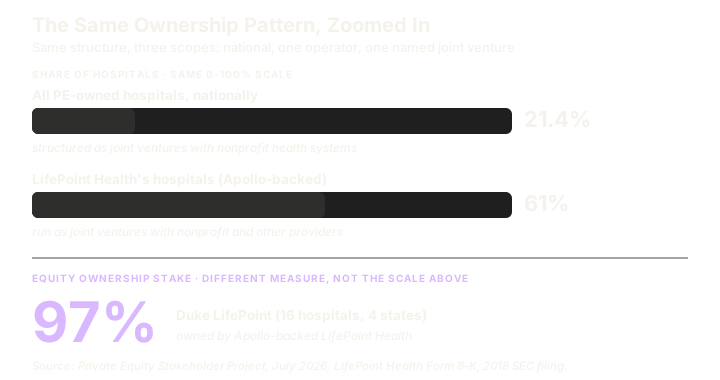
The hospital-specific figure is the one that should stop you. PESP’s report finds that 21.4%, more than one in five, of PE-owned hospitals nationally are structured as joint ventures with nonprofit health systems. That’s not a handful of edge cases. It’s a standard playbook now, applied at scale, across a sector patients still associate with mission over margin.
Zoom in on one operator and the scale gets concrete. PESP reports that Apollo-owned LifePoint Health runs 61% of its hospitals through joint ventures with nonprofit and other providers. Apollo bought LifePoint for $5.6 billion in 2018, a deal confirmed in LifePoint’s own SEC filing that year. Most of what LifePoint runs today, it runs wearing someone else’s name.
How Does a Nonprofit Hospital End Up 97% Owned by a Private Equity Firm?
Duke LifePoint is the clearest case in the report, and I want to be precise about where this number comes from, because it’s a big one. PESP’s report states that Duke LifePoint, the joint venture that operates 16 hospitals across four states under Duke University Health System’s name, is 97% owned by Apollo-backed LifePoint Health.
Duke’s involvement isn’t invented or symbolic. Duke LifePoint traces back to a real 2011 deal, structured through an entity called DLP Healthcare LLC, and Duke University Health System remains the named nonprofit partner today. What changed is who sits behind that partnership financially. After Apollo’s 2018 acquisition of LifePoint, the for-profit side of a venture wearing a trusted university health system’s name became, per PESP’s reporting, almost entirely owned by a private equity firm.
None of that makes the care at those 16 hospitals automatically worse. What it means is that a patient reading “Duke” on a building is reading a brand, not necessarily a governance structure. The name tells you who’s associated. It doesn’t tell you who’s deciding.
Is This Happening in Behavioral Health Too?
Yes, and there’s a named example, not just a category. ECU Health Behavioral Health Hospital is a 144-bed psychiatric hospital in eastern North Carolina, opened as a joint venture between ECU Health, a nonprofit regional system, and Acadia Healthcare, a for-profit behavioral health operator, according to North Carolina Health News (September 2025).
I want to be exact about Acadia, because precision here matters. Acadia Healthcare is publicly traded on the Nasdaq, not a private equity firm outright, though its roots include private equity and institutional investment through Waud Capital. Calling it “PE” would overstate the label. Calling it “just a healthcare company” would understate what’s actually true: a for-profit operator with investor-driven incentives is running the behavioral health side of a facility that carries a nonprofit region’s trusted name.
That’s the pattern PESP’s broader report describes, playing out in exactly the sector I write about most. A community sees “ECU Health” and reasonably assumes the values that name has stood for locally. What runs day-to-day operations and shares in the financial upside is a separate, for-profit partner. Nobody has to announce that split at the front door.
Why Isn’t Any of This Disclosed?
The honest answer is that the rules were never built for this. CMS’s ownership-disclosure rule, effective January 16, 2024, requires disclosure of private equity and REIT ownership, but only for skilled nursing facilities and Medicaid nursing facilities, according to CMS itself (CMS, 2024). Hospitals and standalone behavioral health facilities, the exact categories in this report, aren’t covered.
The federal tax rules underneath these joint ventures are even older. The IRS guidance governing how a nonprofit can partner with a for-profit healthcare company dates to 1998 and 2004, per PESP’s regulatory-gap argument. Those rules predate the current scale of PE-backed healthcare joint ventures by roughly two decades. Nobody wrote a rulebook for a structure this common, because it wasn’t this common yet.
Georgetown Law’s Denny Center for Private Equity and Healthcare has described the broader problem plainly: “A PE firm might effectively dictate a clinic’s operations behind the scenes, while state authorities see only a licensed doctor’s name on the ownership papers… legal loopholes and lack of transparency allow many acquisitions to proceed with minimal scrutiny” (Georgetown Law, Denny Center). Swap “doctor’s name” for “nonprofit health system’s name” and you’ve got this exact structure.
What’s Starting to Change
The gap is real, but it isn’t permanent, and a few states are already moving. As of March 2026, four states, Massachusetts, Indiana, New Mexico, and Washington, have passed their own healthcare ownership-disclosure laws since 2025, according to United States of Care (USofCare, March 2026). It’s a patchwork, not a federal standard. But a patchwork beats silence, and it’s four more states than had any such requirement two years ago.
That’s the actual shape of progress on this issue right now: state by state, driven by reporters and watchdog groups doing the work federal rules haven’t caught up to. Every one of those laws exists because someone asked “who actually owns this place” loudly enough, in public, that a legislature answered. That’s a repeatable pattern, not a fluke.
What Transparent, Clinician-Owned Care Should Look Like
Here’s what I think patients and employers are actually entitled to, and it isn’t complicated. You should be able to find out who controls the money and the management decisions at a facility before you walk in the door, not after a nonprofit disclosure report catches up years later. A trusted name on the building should mean the values that name represents are actually the ones running the place.
That’s the standard we try to build toward at Mental Wealth Solutions: care built and led by clinicians, not financial sponsors, with the ownership structure plain enough to say out loud. It isn’t a hard sell so much as a baseline. Whoever holds the real decision-making power over your care, you should be able to find that out in five minutes, not a five-hundred-facility investigation.
The fix isn’t complicated either. Extend the disclosure rule that already exists for nursing facilities to hospitals and behavioral health facilities. Update tax guidance that’s older than most of the deals it’s supposed to govern. Until then, ask. Ask your hospital, your clinic, your employer’s benefits vendor, who actually holds the financial control behind the name on the door. PESP’s researchers had to build a 568-facility database to answer that question. You shouldn’t have to.
FAQ
How many healthcare facilities are structured as nonprofit-private equity joint ventures? PESP’s July 2026 report identified 568 facilities operating under nonprofit-PE joint ventures, spanning hospitals, inpatient rehab, hospice, home health, behavioral health, ambulatory surgery centers, and urgent care. PESP says the true number is likely higher, since it only captures publicly identifiable arrangements, and the figure covers all those sectors combined, not behavioral health alone.
What does it mean that Duke LifePoint is 97% owned by Apollo? PESP’s report states that Duke LifePoint, the 16-hospital joint venture carrying Duke University Health System’s name across four states, is 97% owned by Apollo-backed LifePoint Health. Apollo acquired LifePoint Health for $5.6 billion in 2018, per LifePoint’s own SEC filing. The Duke LifePoint venture itself dates to a 2011 deal.
Is private equity involved in nonprofit behavioral health facilities specifically? Yes. ECU Health Behavioral Health Hospital, a 144-bed psychiatric hospital, opened as a joint venture between ECU Health, a nonprofit system in eastern North Carolina, and Acadia Healthcare, a publicly traded for-profit behavioral health operator, according to North Carolina Health News (September 2025).
Do patients have a legal right to know if their hospital is really run by a private equity firm? Not in most cases. CMS’s ownership-disclosure rule, effective January 2024, requires PE and REIT ownership disclosure only for skilled nursing facilities and Medicaid nursing facilities, not hospitals or standalone behavioral health facilities, according to CMS. As of March 2026, only Massachusetts, Indiana, New Mexico, and Washington have passed their own disclosure laws to close that gap.
What should transparent healthcare ownership actually look like? A patient should be able to find out who controls the money and management decisions at a facility before they walk in, not after a news investigation runs. That means public ownership disclosure for hospitals and behavioral health facilities, not just nursing homes, and clinicians, not financial sponsors, holding the real operating authority.
Sources
- Private Equity’s Joint Venture Takeover of Nonprofit Healthcare, Private Equity Stakeholder Project (PESP), July 6, 2026 (PDF report)
- LifePoint Health, Form 8-K, FY2018, U.S. Securities and Exchange Commission
- ECU Health and for-profit giant Acadia team up to open new psychiatric hospital, North Carolina Health News, September 3, 2025
- Disclosures of Ownership and Additional Disclosable Parties Information for Skilled Nursing Facilities and Nursing Facilities, Centers for Medicare & Medicaid Services (CMS), 2024
- Medicine & Private Equity, Georgetown Law, Center for Innovation in Private Equity and Healthcare (Denny Center)
- Health Care Ownership One-Pager, United States of Care, March 2026
- Private Equity Bought the Couch: 56 Behavioral Health Deals in 2025, and What New Ownership Means for Your Care, Mental Wealth Solutions, July 2026
Figures current as of July 2026.
Disclaimer
This article is for educational and informational purposes only. It does not constitute medical, clinical, legal, or therapeutic advice, and reading it does not create a therapist-client relationship with Matthew Sexton, LCSW or Mental Wealth Solutions, Inc. Although the author is a licensed clinical social worker, the content in this article is not clinical assessment, diagnosis, or treatment.
Ownership structures, joint venture arrangements, and disclosure requirements described here reflect published reports and public filings available as of the publication date, and ownership can change after a deal closes or a report is published. The facilities and figures named here describe specific documented arrangements and may not reflect every nonprofit health system, hospital, or behavioral health facility. For questions about who owns or controls a specific facility, contact that facility directly, consult its public filings, or speak with qualified counsel.
If you are in immediate emotional crisis, you can reach the 988 Suicide & Crisis Lifeline by calling or texting 988 (US). If you are experiencing domestic violence or are in physical danger, contact the National Domestic Violence Hotline at 1-800-799-7233 or visit thehotline.org. In a life-threatening emergency, call 911.
Frequently asked questions.
- How many healthcare facilities are structured as nonprofit-private equity joint ventures?
- PESP's July 2026 report identified more than 500 facilities, 568 by its count, operating under nonprofit-PE joint ventures, spanning hospitals, inpatient rehab, hospice, home health, behavioral health, ambulatory surgery centers, and urgent care. PESP notes this is likely an undercount, since it only captures publicly identifiable arrangements. The figure covers all of those sectors combined, not behavioral health alone.
- What does it mean that Duke LifePoint is 97% owned by Apollo?
- PESP's report states that Duke LifePoint, the 16-hospital joint venture that carries Duke University Health System's name across four states, is 97% owned by Apollo-backed LifePoint Health. Apollo Global Management acquired LifePoint Health for $5.6 billion in 2018, according to LifePoint's own SEC filing. The Duke LifePoint venture itself dates to a 2011 deal.
- Is private equity involved in nonprofit behavioral health facilities specifically?
- Yes. One documented example is ECU Health Behavioral Health Hospital, a 144-bed psychiatric hospital opened as a joint venture between ECU Health, a nonprofit system in eastern North Carolina, and Acadia Healthcare, a publicly traded for-profit behavioral health operator, according to North Carolina Health News (September 2025).
- Do patients have a legal right to know if their hospital is really run by a private equity firm?
- Not in most cases. CMS's ownership-disclosure rule, effective January 2024, requires PE and REIT ownership disclosure only for skilled nursing facilities and Medicaid nursing facilities, not hospitals or standalone behavioral health facilities, according to CMS. As of March 2026, only a handful of states, Massachusetts, Indiana, New Mexico, and Washington, have passed their own disclosure laws to close that gap.
- What should transparent healthcare ownership actually look like?
- At minimum, a patient should be able to find out who controls the money and the management decisions at a facility before they walk in, not after a news investigation runs. That means public ownership disclosure for hospitals and behavioral health facilities, not just nursing homes, and it means clinicians, not financial sponsors, holding the actual operating authority.
Want to discuss this for your program?
Book a 30-min conversation. We'll walk you through deployment, the BAA, and what your rollout looks like in production.
Book a 30-min conversation