Many behavioral health practices in the United States are owned by companies you will never see named on the sign, the intake form, or your therapist’s business card. In 2025, private equity firms closed 56 behavioral health deals, part of a record year of 1,029 U.S. health care buyouts (Private Equity Stakeholder Project, February 2026). Ownership matters because it sets the budget a practice runs on, but it is often invisible from the waiting room. This guide is how you trace it anyway.
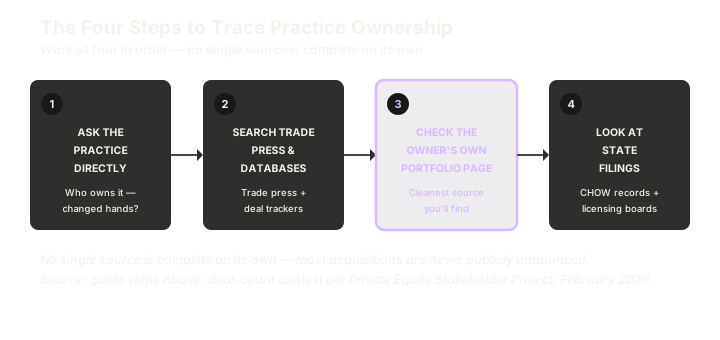
Quick answer: To find out who owns your therapy practice, work four sources in order — ask the practice directly, search the trade press and deal databases, check the suspected owner’s own portfolio page, and look at state change-of-ownership filings. No single source is complete, because many deals are never announced, so treat the absence of a public record as an unknown rather than proof of independence.
I have spent years inside behavioral health systems as a clinician and a program director, and ownership rarely announces itself in the waiting room. The logo stays the same, the receptionist is the same, and for a while your therapist is the same. What changes first is the budget above them. Here is how to find the company that writes it.
Why ownership is hard to see
Two things make this harder than it should be.
First, most acquisitions are never publicly announced. A practice can be bought, kept under its old name, and run for years with the same staff while the ownership sits several layers up a corporate chain.
Second, the name on the door is not the owner. A clinic can carry a warm local brand that a national company acquired quietly. The brand is a storefront; the owner is whoever the storefront reports to.
That is why this is a tracing exercise, not a lookup. You are assembling a picture from several partial sources.
The four steps to find out who owns your therapy practice
1. Ask the practice directly
Ask who owns the company, and whether it has changed hands recently. This is an ordinary question from a paying client, and the answer — or a vague non-answer — is itself information. Follow up with two practical ones: how long has my therapist been here, and what happens to my records if the practice is sold.
2. Search the trade press and deal databases
Behavioral health M&A is covered in specialized outlets. Behavioral Health Business and Axios Pro report acquisitions, often with dates and firm names. Deal trackers such as PitchBook and Mertz Taggart catalog transactions across the sector. A search for your practice’s name, its parent brand, or “acquired” alongside either will often surface a dated report.
3. Check the suspected owner’s own portfolio page
Private equity firms and strategic acquirers frequently list their holdings publicly. If a search points you at a likely owner, its portfolio or news page can confirm the claim from the buyer’s side, usually with the announcement date. A firm confirming its own investment is about as clean a source as you will find.
4. Look at state filings
Some states publish change-of-ownership (CHOW) records or require notice of health care transactions, and state licensing boards list the current corporate operator of a licensed facility. These records lag and vary by state, but they can name an operator that no press release ever did.
What the public record looks like: a few 2026 examples
These are snapshots, dated on purpose, to show what a traceable ownership fact looks like — not a maintained list.
- A deal announced by the buyer. TPG Capital joined Summit Partners and Silversmith Capital Partners in a growth investment in LifeStance Health, announced by TPG on April 16, 2020; LifeStance later went public on the Nasdaq (LFST) in June 2021 (TPG, April 16, 2020). This is the easiest case: the owner announced it.
- A watchdog report. The Private Equity Stakeholder Project documented that Mindpath Health is owned by Centerbridge Partners and Leonard Green & Partners, assembled through the Community Psychiatry platform the firms acquired in 2020 (Private Equity Stakeholder Project, 2023). When a firm does not publicize a holding, an advocacy group tracking the sector sometimes has.
- A restructuring that surfaced the owner. Ownership can also become visible when debt comes due. Behavioral Health Business reported that Discovery Behavioral Health, backed by Webster Equity Partners, passed toward its lenders after a December 2025 default, with HPS Investment Partners reported to have taken a majority stake by June 2026 (Behavioral Health Business, June 2, 2026). A distressed deal generates a paper trail.
- A public company — just read the ticker. Not every large operator is private-equity-owned. Acadia Healthcare is publicly traded on the Nasdaq (ACHC), owned by its public shareholders; its ownership and scale are in its own investor filings (Acadia Healthcare investor information). If a company files with the SEC, its ownership is public by law.
Each of these was findable through the steps above. Yours may be too.
Ownership moves, so check rather than memorize
Ownership in this sector does not sit still. Platforms change hands as debt comes due, insurers buy provider groups, and firms enter and exit. That is exactly why the move is to trace ownership when you want to know it, using the steps here, rather than to trust a list that was accurate the month it was written.
If your care changed after an ownership change, the frustration is fair, and it belongs upstream. Your therapist works inside a budget written above their head. For how a change in ownership actually reaches your appointment, see what changes when private equity buys your therapy practice. For the wider deal landscape, see what happens when private equity buys the couch.
FAQ
How do I find out who owns my therapy practice? Ask the practice directly who owns the company and whether it has changed hands recently. Then search the trade press and deal databases (Behavioral Health Business, PitchBook, Mertz Taggart), check the suspected owner’s own portfolio page, and look at state change-of-ownership filings and licensing records. No single source is complete, so treat a missing public record as an unknown, not proof of independence.
Why is it so hard to tell who owns a mental health clinic? Many acquisitions are never publicly announced, and the name on the door rarely changes when the company behind it does. A practice can be acquired, keep its brand and staff, and shift ownership and budget quietly above them. Ownership also moves often, so any snapshot ages quickly.
Does it matter who owns my therapy practice? It can. Ownership sets the budget and incentives a practice runs on, which can affect caseload size, session availability, billing, and how long your clinician stays. It does not change the quality of an individual therapist, but it explains changes that appear after a sale and tells you where to direct questions.
Is my therapy practice owned by private equity? It might be, and you often cannot tell from the waiting room. Private equity closed 56 behavioral health deals in 2025 alone (Private Equity Stakeholder Project). Watch for signals — familiar clinicians leaving quickly, shorter or harder-to-book sessions, new billing pressure — and use the tracing steps above to confirm.
Sources
- Private Equity Healthcare Deals: 2025 in Review, Private Equity Stakeholder Project, February 11, 2026: 56 behavioral health deals in 2025 within 1,029 total U.S. health care deals; deal value the highest on record.
- LifeStance Health Partners with TPG, Summit Partners, and Silversmith, TPG, April 16, 2020: TPG joins Summit Partners and Silversmith Capital Partners as investors in LifeStance Health (public on Nasdaq as LFST, June 2021).
- Two PE-owned behavioral health companies initiate closures, layoffs in Florida and Ohio, Private Equity Stakeholder Project, 2023: Mindpath Health owned by Centerbridge Partners and Leonard Green & Partners; Community Psychiatry platform acquired 2020.
- HPS Takes Majority Stake in Discovery Behavioral Health, Behavioral Health Business, June 2, 2026: Webster Equity Partners sponsor; December 2025 default; HPS Investment Partners reported majority stake.
- Acadia Healthcare Investor Information, Acadia Healthcare: publicly traded (Nasdaq: ACHC), owned by public shareholders.
Figures current as of July 2026.
Disclaimer
This article is for educational and informational purposes only. It does not constitute medical, clinical, legal, or financial advice, and reading it does not create a therapist-client relationship with Matthew Sexton, LCSW or Mental Wealth Solutions, Inc. Although the author is a licensed clinical social worker, the content in this article is not clinical assessment, diagnosis, or treatment.
The statistics, ownership facts, and market patterns described here reflect published sources and are accurate as of their stated publication dates. Ownership changes; verify current details against the linked sources and primary filings before relying on them. For decisions about your specific situation, consult the relevant professional, licensing board, or qualified legal or financial counsel.
If you are in immediate emotional crisis, you can reach the 988 Suicide & Crisis Lifeline by calling or texting 988 (US). If you are experiencing domestic violence or are in physical danger, contact the National Domestic Violence Hotline at 1-800-799-7233 or visit thehotline.org. In a life-threatening emergency, call 911.
Frequently asked questions.
- How do I find out who owns my therapy practice?
- Start by asking the practice directly who owns the company and whether it has changed hands recently. Then search the trade press and deal databases (Behavioral Health Business, PitchBook, Mertz Taggart), check the suspected owner's own portfolio page, and look at state change-of-ownership filings and licensing records. Many deals are never announced, so no single source is complete; the absence of a public record does not confirm a practice is independent.
- Why is it so hard to tell who owns a mental health clinic?
- Because many acquisitions are never publicly announced, and the name on the door rarely changes when the company behind it does. A practice can be acquired, rebranded slowly or not at all, and keep the same clinicians and front desk while the ownership and the budget shift above them. Ownership also moves often, so any list is a snapshot rather than a permanent record.
- Does it matter who owns my therapy practice?
- It can. Ownership sets the budget and the incentives a practice runs on, which can affect caseload size, session availability, billing practices, and how long your clinician stays. Knowing who owns the practice does not change the quality of an individual therapist, but it explains changes that appear after a practice is sold and tells you where to direct questions.
- Is my therapy practice owned by private equity?
- It might be, and you often cannot tell from the waiting room. Private equity closed 56 behavioral health deals in 2025 alone, per the Private Equity Stakeholder Project. Watch for signals — familiar clinicians leaving and new names rotating through quickly, shorter or harder-to-book sessions, and new billing pressure — and use the tracing steps in this guide to confirm.
Want to discuss this for your program?
Book a 30-min conversation. We'll walk you through deployment, the BAA, and what your rollout looks like in production.
Book a 30-min conversation