
Not at My Table: How Telling the Truth Breaks the Spell of Narcissistic Abuse
- Matthew Sexton
- Dec 10, 2025
- 3 min read

Updated: 2 days ago
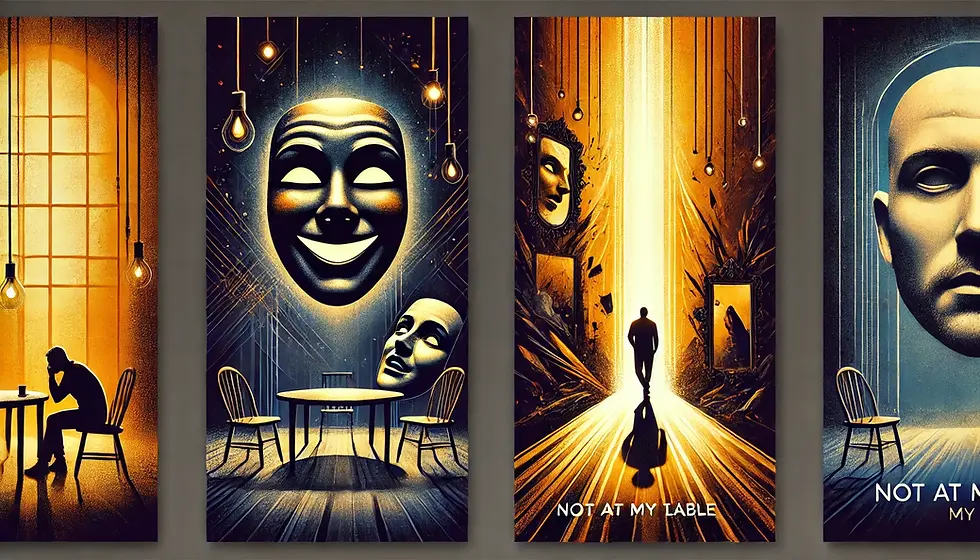
There’s a reason the culture feels charged right now around conversations about power, narcissism, and hidden lives.
When stories emerge that expose the double realities of influential people — public empathy paired with private harm — they don’t just shock. They validate something survivors have been saying quietly for years:
Some people construct entire worlds out of sight — and then rely on your love, loyalty, and silence to keep those worlds intact.
This isn’t about gossip. It’s about recognizing a pattern.
Not people who “made mistakes,” but people who perform remorse while practicing deception.People who can cry convincingly yet avoid accountability.People who treat guilt as optics and intimacy as leverage.
That pattern shows up everywhere — not just in headlines, but in ordinary relationships.
Performative Empathy vs. Lived Reality
Psychology has language for this kind of split existence. One way to describe it is performative empathy — care that looks real from a distance but collapses under proximity.
From the outside, these individuals may speak fluently about growth, stress, or self-work. Up close, a different reality emerges:
Loyalty is demanded while trust is violated
Victimhood is claimed while harm is inflicted
Reality is rewritten while you’re told you’re “overreacting”
Parallel lives are built while commitment is promised
The same structure repeats across contexts: relationships, families, workplaces, communities.
The mask holds — until it doesn’t.
Gaslighting: When Reality Becomes the Battlefield
In these dynamics, deception alone isn’t enough. Control requires destabilization.
Gaslighting isn’t simple confusion. It’s the systematic erosion of your confidence in your own perception. Over time, you stop trusting what you see, what you feel, what you remember.
At first, the behavior is reframed as stress.Then as misunderstanding.Then as your insecurity.
Until something breaks through.
And when it does, the shift isn’t dramatic — it’s clarifying. Chaos stops feeling random and starts revealing a pattern.
That’s often what people describe as “waking up.”
When the Story Collapses
Every person who lives a double life relies on narrative management.
But lies are heavy. They require maintenance.
Eventually, the cracks show:
The excuses repeat
The timelines blur
The empathy sounds rehearsed
You’re no longer reacting — you’re observing.
And once you see the pattern, you can’t unsee it.
No Contact Isn’t Punishment — It’s Preservation
Walking away from someone who destabilizes you isn’t cruelty. It’s discernment.
No contact isn’t about revenge.It’s about reclaiming mental space.It’s about refusing to keep negotiating your worth with someone who benefits from your doubt.
Distance isn’t an attack — it’s a boundary.
And boundaries aren’t meant to change other people.They’re meant to protect you.
Compassion Without Access
There’s a difference between hatred and clarity.
You can wish someone growth without giving them proximity.You can acknowledge their humanity without offering your vulnerability.You can hold compassion without sacrificing your peace.
That’s not bitterness.That’s maturity.
As the saying goes: I hope you eat — just not at my table.
Why Telling the Truth Breaks the Spell
Toxic dynamics survive on silence.
They rely on shame to keep people quiet and confusion to keep them stuck. That’s why naming what you lived through — in writing, therapy, art, or conversation — is so disruptive.
Truth destabilizes control.
When you speak honestly:
The spell breaks
The narrative collapses
The power shifts
And when the culture starts recognizing the same patterns at scale, something important happens:
You realize you weren’t imagining it.You weren’t “too sensitive.”You weren’t the problem.
You were just standing too close to someone who needed darkness to function.
And you chose light.
Your Truth Is the Beginning
Your boundaries aren’t punishment.Your clarity isn’t cruelty.Your voice isn’t petty — it’s necessary.
Once you see behind the performance, you don’t argue with it.
You leave.
And you don’t pull out another chair.
Author’s Disclaimer & Professional Boundary Statement
This blog contains personal reflections and first-person accounts of my own experiences, perceptions, and emotional responses. It is not intended to assert objective facts about any specific individual, nor to diagnose, evaluate, or characterize the mental health, motives, or intent of any person.
Although I am a licensed clinician, this writing is not clinical work, therapy, assessment, or professional opinion, and no therapeutic relationship is implied. I am not acting in a professional or evaluative capacity in this forum.
Descriptions of behaviors, dynamics, or patterns are shared solely from my subjective perspective and lived experience, for reflective and educational purposes. Others may experience or interpret the same events differently.
Identifying details have been altered or omitted to protect privacy. Any resemblance to specific individuals, organizations, or circumstances is incidental and not intended to assert factual claims about any person.


Comments