Here is what happens at most hospitals in America right now: a patient walks in, someone hands them a tablet or a paper form, they answer questions about whether they have stable housing, enough food, reliable transportation, and whether they feel safe at home. The answers get documented in the EHR. A social worker may or may not see them. The patient leaves. Nothing changes.
That is not healthcare. That is a checkbox.
I have been a clinical social worker for over a decade. I have run clinics, managed forensic ACT teams, coordinated disaster case management, and built screening programs from the ground up. I have seen what SDOH screening looks like when it works and what it looks like when it is theater. Right now, the overwhelming majority of it is theater.
The SDOH Screening Explosion
CMS has been pushing SDOH screening hard. The Accountable Health Communities (AHC) model, which ran from 2017 to 2023, was the first large-scale test of whether screening for social needs in clinical settings could improve outcomes and reduce costs. The results were instructive — not because they proved screening works, but because they exposed what happens when you screen without building the infrastructure to act on what you find.
The AHC model screened over 300,000 Medicare and Medicaid beneficiaries for five core social needs: housing instability, food insecurity, transportation problems, utility difficulties, and interpersonal violence. The screening part worked. They found needs. Lots of them.
What happened next is where the system broke down.
Navigation — the process of actually connecting patients to services — was inconsistent, under-resourced, and fragmented. Community organizations were overwhelmed. Follow-up rates varied wildly across sites. The patients with the most complex needs often fell through the widest cracks because nobody owned the referral process end to end.
This is the fundamental problem. Screening is the easy part. Any organization can buy a PRAPARE tool, embed it in their EHR workflow, and check the CMS box. The hard part — the part that actually changes patient outcomes — is what happens in the thirty minutes after you identify that a dialysis patient cannot afford their phosphate binders, has no reliable transportation to three-times-weekly treatments, and is facing eviction.
The Referral Facilitation Gap
Let me be specific about what I mean by referral facilitation, because this term gets thrown around loosely.
Referral facilitation is not handing a patient a printed list of phone numbers. It is not saying “call 211.” It is not documenting a referral in the EHR and assuming someone else will handle it.
Referral facilitation means:
-
Identifying the specific need — not just “housing insecurity” as a category, but the patient’s actual situation. Are they behind on rent? Facing eviction in 10 days? Living in their car? Each requires a different intervention.
-
Matching to an appropriate resource — not a generic directory, but a service that is currently accepting referrals, serves the patient’s geographic area, accepts their insurance or financial situation, and has capacity. This changes daily.
-
Making the connection — a warm handoff, not a cold referral. Calling the organization with the patient present. Sending a structured referral with the patient’s consent. Introducing them to the intake coordinator by name.
-
Following up — did the patient actually connect? Did they show up for the appointment? Was the service what they needed? If not, what is the backup plan?
-
Closing the loop — documenting the outcome back in the clinical record so the care team knows whether the social need was addressed or is still active.
This is a full workflow. It requires time, knowledge of local resources, relationships with community organizations, and systems to track everything. Most hospitals have none of this infrastructure. They have a screening tool and a social work department that is already drowning.
Why Social Workers Cannot Close This Gap Alone
I say this as someone who has lived it: the caseload math does not work.
A hospital social worker in a busy dialysis center might be responsible for 80 to 120 patients. Each of those patients has an average of 2.5 unmet social needs, according to AHC model data. That is 200 to 300 active social needs to manage on top of discharge planning, insurance authorizations, advance directives, and crisis interventions.
Referral facilitation for a single need — done properly — takes 30 to 90 minutes. Finding the right resource, making the call, navigating eligibility requirements, completing intake paperwork, following up. Multiply that by 200 needs and you are looking at a full-time job just for referral facilitation. But the social worker already has a full-time job doing everything else.
So what happens? Social workers triage. They handle the crises — the patient who is actively suicidal, the domestic violence disclosure, the uninsured patient who needs emergency surgery. Everything else gets a printed resource list and a “call if you need help.”
This is not a failure of social workers. It is a failure of systems that mandate screening without funding the follow-through.
The Data on Screening Without Action
The evidence is clear that screening alone does not improve outcomes. A 2023 systematic review in Health Affairs found that SDOH screening programs without navigation or referral facilitation showed no significant improvement in patient health outcomes compared to usual care. Screening identified needs. Identified needs without intervention remained unmet needs.
The AHC model’s final evaluation found that navigation services reduced emergency department visits by about 9% — but only in the sites that actually implemented robust navigation. Sites that screened without strong navigation infrastructure saw no meaningful difference from control groups.
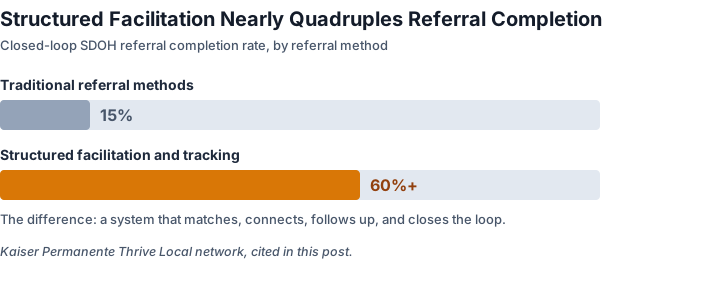
Kaiser Permanente’s Thrive Local network, which connects clinical sites to community-based organizations through a technology platform, found that closed-loop referral completion rates jumped from around 15% with traditional referral methods to over 60% with structured facilitation and tracking. The difference was not better screening. It was better infrastructure for acting on what screening reveals.
This is the gap I have spent the last year building technology to close.
What Referral Facilitation Actually Looks Like in Kidney Care
Transplant and dialysis patients face some of the most complex social needs in all of healthcare. End-stage renal disease (ESRD) patients on dialysis spend 12 to 15 hours per week in treatment. They have dietary restrictions that require specific (and expensive) foods. Many cannot work full-time. Transportation to three-times-weekly dialysis is a constant barrier. Depression rates in dialysis patients run between 20% and 30%.
And here is the kicker: patients with unaddressed social needs have significantly worse transplant outcomes. A patient who is food insecure is less likely to adhere to the post-transplant immunosuppressive regimen. A patient without stable housing may not be able to maintain the sterile environment needed after surgery. A patient without transportation may miss critical follow-up appointments during the fragile post-transplant window.
Social determinants are not soft metrics in transplant care. They are hard clinical variables that predict graft survival and mortality.
This is why I built TransplantCheck. Not because we needed another screening tool — we have plenty of those. We needed a system that takes the output of screening and converts it into action. Every screen that identifies a need triggers a referral workflow. The system matches the patient’s specific situation to available resources, initiates the referral, and tracks it to completion.
The social worker is still in the loop. They still make clinical decisions. But they are not spending their time on the phone with 211 trying to figure out which food bank serves ZIP code 37206 and whether they accept referrals from non-Medicaid patients on Tuesdays. The system handles the logistics so the clinician can focus on the clinical relationship.
The CMS Trajectory Is Clear
CMS is not going to stop at screening mandates. The trajectory is toward accountability for action.
The SCREEN Act proposals, if passed, would require Medicaid managed care plans to screen for social needs AND demonstrate follow-through. Several state Medicaid programs — North Carolina, Oregon, California — are already piloting payment models that reimburse for community health worker navigation and referral facilitation, not just screening.
The Joint Commission added health equity accreditation standards in 2023 that go beyond screening to require organizations to demonstrate how they address identified social needs. “We screened them” is no longer sufficient for accreditation purposes. “We screened them, identified food insecurity, connected them to a food assistance program, and confirmed enrollment” is the new standard.
Organizations that invested only in screening tools are going to find themselves scrambling to build referral facilitation infrastructure that should have been part of the original implementation. The ones that built the full pipeline — screen, identify, refer, track, close — will be positioned for the value-based payment models that reward outcomes rather than documentation.
What Needs to Change
Three things need to happen for SDOH screening to stop being performative:
1. Fund the follow-through. Every dollar spent on screening tools should be matched by at least two dollars spent on navigation and referral facilitation infrastructure. This means community health workers, care coordinators, and technology platforms that manage the referral workflow. Screening without referral facilitation is like diagnosing diabetes and sending the patient home without insulin.
2. Build closed-loop systems. Open-loop referrals — where you send a referral and hope for the best — fail at rates between 50% and 85%. Closed-loop systems that track referral status, automate follow-up, and report outcomes back to the referring clinician are not optional. They are the difference between documentation and care.
3. Measure what matters. Stop measuring screening rates. Start measuring referral completion rates, time to connection, and whether the identified need was actually resolved. A hospital that screens 100% of patients but resolves 5% of identified needs is not doing better than a hospital that screens 50% but resolves 80%.
The Bottom Line
SDOH screening has become one of healthcare’s favorite compliance activities. It looks good on quality reports. It satisfies CMS checkboxes. It generates data. But data without action is just surveillance.
Patients do not benefit from being asked whether they have enough food. They benefit from being connected to a food assistance program that has capacity, serves their area, and will actually enroll them this week.
The gap between screening and facilitation is where patients are falling. Closing that gap is not a technology problem or a funding problem — it is a commitment problem. It requires healthcare organizations to decide that identifying social needs creates an obligation to address them.
I built TransplantCheck because I watched too many patients get screened, documented, and forgotten. The technology exists to do better. The evidence says we must do better. The only question is whether healthcare systems will treat referral facilitation as essential infrastructure or continue pretending that screening is enough.
It is not.
Matthew Sexton is a Licensed Clinical Social Worker and the founder of Mental Wealth Solutions. He builds AI-powered SDOH screening and referral facilitation tools for transplant care, veteran services, and behavioral health. Reach him at [email protected].
Frequently asked questions.
- What is SDOH screening in healthcare?
- SDOH screening involves using standardized tools (like PRAPARE or AHC-HRSN) to identify non-medical factors that affect patient health, including housing instability, food insecurity, transportation barriers, and social isolation.
- Why is SDOH screening alone not enough?
- Screening identifies needs but does not resolve them. Without referral facilitation — the active process of connecting patients to community resources and following up — screening becomes documentation without impact.
- What is referral facilitation?
- Referral facilitation is the process of actively connecting patients to community-based services after screening, including warm handoffs, follow-up, and closed-loop tracking to ensure the patient actually received help.
- Does CMS require SDOH screening?
- CMS has increasingly tied SDOH screening to quality measures and value-based payment models. The CY 2024 Physician Fee Schedule finalized SDOH-related codes, and several CMS Innovation Center models require community health needs screening.
Want to discuss this for your program?
Book a 30-min conversation. We'll walk you through deployment, the BAA, and what your rollout looks like in production.
Book a 30-min conversation