
On January 17, 2025, a lobbying group called the ERISA Industry Committee filed a federal lawsuit to block the most significant upgrade to mental health coverage rules in more than a decade. The court issued a stay on May 12, 2025. Three days later, the Departments of Labor, Health and Human Services, and Treasury announced they would not enforce the new rule until at least 18 months after the case is fully resolved — no hard date, no guarantee the rule ever comes back in its current form. The workers covered by those plans found out, if they found out at all, by reading a law firm’s client alert written for their employer, not for them.
Quick answer: Large self-insured employers, through their lobbying group ERIC, sued to block a 2024 federal rule that would have required real mental health parity upgrades starting January 1, 2026. A federal court froze enforcement in May 2025, and the government announced it will not pursue compliance actions until 18 months after the litigation concludes — an indefinite pause with no guaranteed end date.
Key Takeaways
- ERIC, representing Fortune 500 employers covering 25 million workers, sued the federal government to block the 2024 MHPAEA Final Rule (January 2025)
- A federal court froze enforcement in May 2025; the government then paused all enforcement for at least 18 months after final resolution
- The paused rule would have required meaningful benefits coverage, data transparency, and fiduciary accountability — none of which are currently required
- Large self-insured employer plans under ERISA are exempt from state parity laws, making the federal rule the only upgrade mechanism available
- The 2013 baseline parity law and the 2021 comparative analysis requirement technically remain — it is the 2024 upgrade that is suspended
What is ERISA, and why can’t your state fix this?
Before getting to the lawsuit, it helps to understand why this particular fight matters more than most people realize. ERISA, the Employee Retirement Income Security Act, is a federal law from 1974 that governs how large employers design and run benefit plans. Companies big enough to self-insure — meaning they fund the health plan themselves rather than buying a policy from a carrier — fall under ERISA, not state insurance regulation.
That matters because states have been passing mental health parity laws for years. States can and do require fully-insured commercial plans to cover mental health at the same level they cover physical health. But ERISA preempts state law. A self-insured employer plan, even one that looks identical to a commercial insurance policy from the outside, is legally invisible to state regulators. (Crowell & Moring, May 2025)
So if you work for a large employer — a hospital system, a law firm, a Fortune 500 company — and your plan is self-insured, your state’s mental health parity rules do not apply to you. The federal Mental Health Parity and Addiction Equity Act, MHPAEA, is the only tool that exists to require your employer to treat mental health coverage the same way it treats coverage for a broken arm or a cancer diagnosis. When the federal enforcement mechanism gets paused, there is no backup.
What the 2024 rule would have actually required
The original MHPAEA passed in 2008. It was a floor, not a ceiling, and over the years the enforcement record showed just how easy it was to technically comply while still denying mental health care at much higher rates than physical care. The 2024 Final Rule was meant to close those gaps. Here is what it would have done.
Meaningful benefits standard. If a plan covers any mental health condition, it has to actually cover core treatment for that condition. Not list a benefit that requires 17 prior authorizations and then denies the claim. Cover it in a way that functions. (DOL Fact Sheet, September 2024)
Prohibition on discriminatory design factors. Plans have long used what regulators call non-quantitative treatment limits, NQTLs, to restrict mental health care. Prior authorization requirements, step-therapy mandates, fail-first policies — these are the mechanisms that make coverage work on paper and vanish in practice. The 2024 rule would have banned using these tools more restrictively for mental health than for comparable medical or surgical care.
Mandatory data collection. Plans would have been required to gather and analyze their own data comparing mental health claim denial rates with medical and surgical claim denial rates. If the data showed disparity, the plan would have to fix it. This was the part the industry found most threatening, because it would have made the gap visible and legally actionable.
Fiduciary certification. The people responsible for running the plan would have had to sign off, as fiduciaries with legal accountability, that the parity comparative analysis was done properly and in good faith. Not a checkbox — an actual certification with real consequences for doing it badly.
All four of those requirements are now on hold.
Who is ERIC, and what did they actually argue?
The ERISA Industry Committee is not a household name, which is part of how this works. ERIC is a lobbying organization representing large employers — Fortune 500 companies across virtually every sector of the economy. Its members provide benefits directly to roughly 25 million active and retired workers and their families, according to ERIC’s own website. (ERIC, current)
On January 17, 2025, ERIC filed suit in the U.S. District Court for the District of Columbia (Case 1:25-cv-00136), challenging the 2024 MHPAEA Final Rule under the Administrative Procedure Act. (Georgetown University Health Care Litigation Tracker, January 2025)
Their argument deserves a straight reading, because the framing is instructive. ERIC called the rule “so burdensome and unworkable that they will substantially increase administrative costs and discourage plans from offering mental health benefits.” (ERIC press release, January 2025)
Read that again. The argument is not that the rule is inaccurate about how mental health coverage works, or that parity is a bad goal. The argument is that requiring employers to be accountable for how they cover mental health is too administratively hard — and that faced with those requirements, employers might just stop covering mental health at all. That is the threat implicit in the sentence. The companies that sued cover 25 million people, and the leverage in the lawsuit is: make us comply, and we’ll take the benefit away.
I have sat with patients who hit every one of the barriers the 2024 rule was designed to eliminate. The prior authorization that required failing first on a medication that made things worse. The denial letter that cited “not medically necessary” for something a physician and I both recommended. The appeal process that took six weeks and ended with the same denial. These are not edge cases. They are the architecture of a benefit that was designed to look like coverage and function as a gate. The 2024 rule would have required employers to look at their own data and see that. ERIC filed suit before any employer had to do that.
What the mental health parity enforcement pause actually means for your coverage
On May 12, 2025, the court granted a stay — a legal freeze — on the litigation while the parties sorted out whether the rule would even survive. Three days later, on May 15, 2025, the Departments of Labor, HHS, and Treasury published an official statement: “Departments will not enforce the 2024 Final Rule or otherwise pursue enforcement actions based on a failure to comply that occurs prior to a final decision in the litigation, plus an additional 18 months.” (U.S. Department of Labor, May 15, 2025)
There is no end date on this. The government has also signaled it may issue a new proposed rulemaking to rescind or modify the 2024 rule entirely. The parties file joint status reports every 90 days. This could drag on for years. (Morgan Lewis, May 2025)
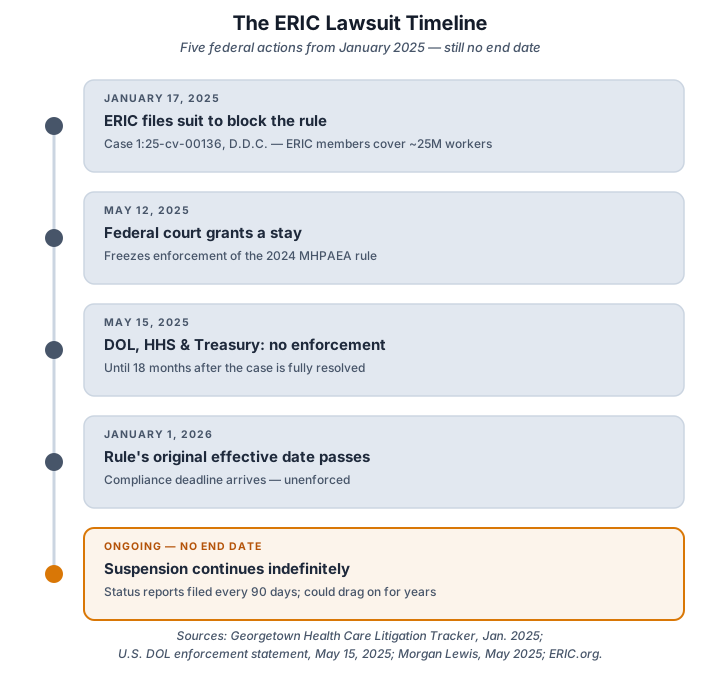
What this means practically: if you are covered by a large self-insured employer plan, the mental health coverage upgrade that was supposed to take effect January 1, 2026 is suspended indefinitely. The four protections described above — meaningful benefits, prohibited discriminatory design, data transparency, and fiduciary accountability — are not in effect and cannot be enforced. Your employer is not required to do any of them, and no federal agency will cite them for not doing so.
I want to be precise about what did not get paused, because the distinction matters. The 2013 MHPAEA baseline rules are still technically in force. The 2021 Consolidated Appropriations Act requirement for a comparative analysis of non-quantitative treatment limits also technically stands. Your employer is still supposed to be doing a parity analysis. But without the 2024 rule’s data requirements and fiduciary certification, the analysis is self-reported and self-certified, with no mandate to actually measure the disparity it might reveal. The baseline without the upgrade is a floor with most of the enforcement removed.
What is striking about the timing is that the enforcement pause landed six weeks before the 2024 rule’s effective date. The January 1, 2026 compliance deadline was real, and employers had been preparing — or deciding not to prepare. The lawsuit, filed in January 2025, essentially gave employers legal cover to stop preparing. By the time the stay came through in May, the decision about whether to actually build out the data infrastructure had already been made by most large plan sponsors. Even if the rule is reinstated, that compliance window does not come back. The upgrade was already quietly abandoned before anyone officially said it was paused.
The part no law firm client alert will tell you
The employer-facing coverage of this story is thorough. Law firms like Crowell & Moring, Morgan Lewis, and Ogletree Deakins published detailed alerts in May and June 2025 walking employers through what they no longer have to do. The client alert format is designed to be useful to the client reading it — which in this case is the employer, not the employee.
Workers covered by these plans are not the audience for those alerts. And the story most public outlets told, to the extent they covered this at all, centered on the federal government’s enforcement choices. The part that got less attention: this did not happen to the federal government. An industry lobbying group whose members cover 25 million workers chose to sue to prevent an upgrade to those workers’ coverage, and won a freeze long enough to effectively kill the compliance timeline.
That is not a regulatory failure in the ordinary sense. It is a feature of a system where the people designing and funding a benefit can also sue to keep that benefit from being upgraded, without the people receiving the benefit having any standing in the lawsuit at all.
FAQ
What is ERISA and why does it matter for mental health coverage? ERISA governs self-insured employer health plans, which large companies fund directly. Because ERISA preempts state law, these plans are not subject to state mental health parity requirements. The federal MHPAEA rules were the only mechanism to force large employers to upgrade mental health coverage, which is why the lawsuit against those federal rules has no state-level substitute.
What did the 2024 MHPAEA Final Rule actually require? Four things, all now paused: a meaningful benefits standard requiring plans to actually cover core mental health treatments, a prohibition on discriminatory plan-design factors like prior authorization being applied more harshly to mental health than to medical care, mandatory data collection comparing mental health versus medical claim denial rates, and fiduciary certification that the parity analysis was done in good faith. (DOL Fact Sheet, September 2024)
Who sued to block the mental health parity rules, and why? The ERISA Industry Committee (ERIC), representing Fortune 500 employers covering roughly 25 million workers, filed suit on January 17, 2025 (Case 1:25-cv-00136, D.D.C.). ERIC argued the rules were “so burdensome and unworkable” that they would raise costs and could lead employers to scale back mental health benefits — essentially threatening the coverage of 25 million people as leverage against a regulation designed to protect those 25 million people. (Georgetown Litigation Tracker, January 2025)
Is all mental health parity law now paused? No. The 2013 MHPAEA baseline rules and the 2021 CAA comparative analysis requirement technically remain in force. What is paused is the 2024 upgrade — the meaningful benefits standard, the data evaluation mandate, and the fiduciary certification requirement. The baseline law still exists. But without the 2024 rule’s enforcement teeth, the practical effect for covered workers is a parity framework with the accountability provisions removed.
Sources
-
Georgetown University Health Care Litigation Tracker, ERIC v. U.S. Departments of Labor, HHS, and Treasury, Case 1:25-cv-00136 — lawsuit filed January 17, 2025.
-
ERIC, ERIC Sues to Stop Recent Biden Administration Mental Health Regulations — press release and quoted language, January 2025.
-
U.S. Department of Labor, Statement Regarding Enforcement of the Final Rule on Requirements Related to MHPAEA — official nonenforcement statement, May 15, 2025.
-
U.S. Department of Labor, Fact Sheet: Final Rules Under the Mental Health Parity and Addiction Equity Act (MHPAEA) — rule requirements summary, September 2024.
-
Crowell & Moring, Trump Administration Pauses Enforcement of the MHPAEA Final Rule — ERISA preemption analysis and employer plan implications, May 2025.
-
ERIC, About ERIC — member coverage figure, 25 million active and retired workers.
-
Morgan Lewis, US District Court Grants Freeze on Mental Health Parity Enforcement — stay details, 90-day status report schedule, potential rescission rulemaking, May 2025.
Figures current as of June 2026.
Disclaimer
This article is for educational and informational purposes only. It does not constitute medical, clinical, legal, or therapeutic advice, and reading it does not create a therapist-client relationship with Matthew Sexton, LCSW or Mental Wealth Solutions, Inc. Although the author is a licensed clinical social worker, the content in this article is not clinical assessment, diagnosis, or treatment.
The legal and regulatory information in this article reflects publicly available sources as of the publication date. ERISA plan terms, mental health parity enforcement status, and the outcome of pending litigation can change after publication. What applies to one employer plan may not apply to another: whether your specific plan is self-insured, how it is structured, and what state or federal rules govern it are questions for your HR or benefits team, your plan administrator, or a qualified ERISA benefits attorney. Nothing here is a substitute for advice about your specific coverage situation.
If you are in immediate emotional crisis, you can reach the 988 Suicide & Crisis Lifeline by calling or texting 988 (US). If you are experiencing domestic violence or are in physical danger, contact the National Domestic Violence Hotline at 1-800-799-7233 or visit thehotline.org. In a life-threatening emergency, call 911.
Frequently asked questions.
- What is ERISA and why does it matter for mental health coverage?
- ERISA (the Employee Retirement Income Security Act) governs self-insured employer health plans — meaning plans large companies fund directly rather than buying insurance from a carrier. Because ERISA preempts state law, these plans are not subject to state mental health parity requirements. The federal MHPAEA rules were the only mechanism that could force large employers to upgrade their mental health coverage.
- What did the 2024 MHPAEA Final Rule actually require?
- The 2024 rule (89 Fed. Reg. 77586, effective January 1, 2026) would have required plans to cover core treatments for any mental health condition they recognize, prohibited discriminatory plan-design factors, mandated data collection comparing mental health versus medical claim denial rates, and required plan fiduciaries to certify the parity analysis was done properly. All four requirements are now paused.
- Who sued to block the mental health parity rules, and why?
- The ERISA Industry Committee (ERIC) filed suit on January 17, 2025 (Case 1:25-cv-00136, D.D.C.), representing Fortune 500 employers whose plans cover roughly 25 million workers and retirees. ERIC argued the rules were 'so burdensome and unworkable' they would increase costs and discourage plans from offering mental health benefits at all.
- Is all mental health parity law now paused?
- No, and the distinction matters. The 2013 MHPAEA baseline rules and the 2021 CAA requirement for a comparative analysis of non-quantitative treatment limits technically remain in force. What is paused is the 2024 upgrade: the meaningful benefits standard, the data evaluation mandate, and the fiduciary certification requirement. The enforcement gap is real — but it is specific.
Want to discuss this for your program?
Book a 30-min conversation. We'll walk you through deployment, the BAA, and what your rollout looks like in production.
Book a 30-min conversation