
Depression and anxiety cost the global economy about $1 trillion a year, almost entirely through lost productivity, and roughly 12 billion working days disappear to them annually, according to the World Health Organization. That is the part employers have finally absorbed. Mental health stopped being a private matter somewhere on the way to becoming a line item.
What hasn’t landed yet is the second half: most of the money companies spend trying to fix it goes nowhere. The benefits get bought, announced, printed in the handbook — and then they sit. Not because workers don’t want help. Because the help was designed for a person who doesn’t exist.
Quick answer: Mental health is a workplace problem because the cost of it lands on the employer, and employers keep treating it as a motivation problem when it is an access problem. The fix most companies reach for is more programs and more awareness. The thing that actually moves the number is removing the steps between an employee in distress and the support they were already paying for.
The problem moved onto the org’s books
For years, “mental health at work” meant a flyer and a 1-800 number. The framing was individual: if you’re struggling, here’s a resource, the rest is on you. That framing is comfortable because it keeps the problem personal. It is also wrong about where the cost falls.
The WHO puts the prevalence plainly: about 15% of working-age adults live with a mental disorder at any given time. That is not a fringe population. It is one in seven people on a payroll, in any given quarter, carrying something. Their distress doesn’t stay personal. It shows up as a missed deadline, a resignation letter, a team that quietly stops volunteering for things.
And the pressure is getting worse, not better. In a May 2026 Modern Health survey of 1,000 full-time employees, 69% believed AI would lead to layoffs at their company and 49% feared losing their own job to it. Roughly half said work had hurt their mental health in the past year. People are not just anxious about their lives — they are anxious about the job itself, which is a newer and more corrosive thing. When the source of the stress and the source of the paycheck are the same building, “go use the EAP” lands differently.
So the question stops being whether mental health belongs at work. It is already there. The question is whether what you bought to address it actually reaches anyone.
The benefits get bought. They don’t get used.
Here is the number that should keep benefits leaders up at night. Employee Assistance Programs — the default corporate mental health benefit — run at roughly 3 to 6 percent annual utilization in the U.S. I wrote a whole piece on why that happens, on the 3% EAP utilization problem, so I won’t relitigate the whole thing here. The short version: 94 cents of every EAP dollar sits untouched, and it isn’t because employees don’t care.
The trust gap is visible even when the coverage is good. In that same 2026 Modern Health survey, 76% of employees said they had adequate mental health coverage — and trust in their employer’s support stayed low anyway. Seventy-two percent said their employer prioritizes productivity over their wellbeing. The share who strongly agreed their employer valued their mental health fell from 41% in 2025 to 33% in 2026. Coverage went one way; belief went the other.
That divergence is the whole story. When people have a benefit and still won’t touch it, the standard reaction is to assume something is wrong with the people. More awareness. Another email. A wellness week. But you can’t awareness-campaign your way out of a design flaw, and a benefit nobody reaches is a design flaw.
The NAMI-Ipsos Workplace Mental Health Poll, fielded across companies with 100-plus employees in early 2026, found only 54% of workers feel their company as a whole makes mental health a priority — even though 78% feel their direct manager cares about them personally. The care exists at the human level and evaporates at the institutional one. That is what a structural gap looks like from the inside.
It’s an access problem, not a motivation problem
Picture the actual path. An employee is having a bad stretch. To use the benefit, they have to find the number in a portal, call during business hours, explain themselves to a stranger, get a list of names with nothing to distinguish them, pick one, call that one, learn there’s a three-week wait, and then show up still ready to talk. Eight steps, every one a place to quit, asked of the person least equipped in that moment to push through them.
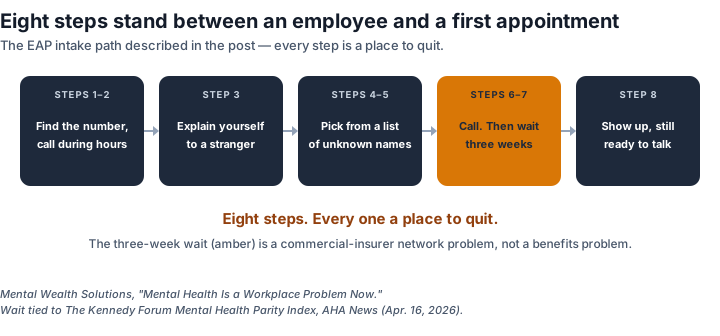
That is not a flaw in the employee. It is a flaw in the architecture. The whole apparatus assumes a calm, organized, low-stakes person doing administrative errands — which is the exact opposite of the person who needs it. We built the front door for someone who isn’t the one knocking.
Some of those steps aren’t even the employer’s to fix, and that’s worth naming. The three-week wait at the end of the path is often a commercial-insurer problem, not a benefits problem. The Kennedy Forum’s Mental Health Parity Index, published in April 2026, found the four largest commercial insurers — Aetna, BlueCross BlueShield, Cigna, and UnitedHealthcare — pay clinicians less for outpatient mental health care than for physical health care in all 43 states it examined, inside the same plans. Pay a therapist a fraction of what you pay a physician and many of them stop taking the plan, which is how a network ends up looking full on paper and empty when an employee calls down the list. So the employer buys “coverage,” and the employee discovers the in-network names are booked solid or no longer in-network at all. Covered was never the same as reachable.
This is why “is it covered?” and “can they reach it?” are different questions, and why answering the first one lets everybody stop asking the second. A benefit on paper produces the appearance of access. An employee in an actual chair producing actual relief is access. The distance between those two is where the trillion dollars goes.
None of this is a mystery the field hasn’t solved. The behavioral evidence on how to close that distance is decades old; it just rarely gets applied to benefits. Default enrollment beats opt-in. A two-minute digital check-in beats a phone tree. A pre-scheduled touchpoint already on the calendar beats asking a struggling person to initiate the call themselves. Each one removes a step, and each removed step is a person who makes it through.
What getting workplace mental health right looks like
The employers moving the number aren’t spending more. They are spending on the part that was missing.
They train the managers. The clearest finding in the 2026 NAMI-Ipsos poll: employees at companies that offer mental health training were far more likely to feel their employer prioritized their mental health — 69% versus 40%. The same poll found roughly 8 in 10 workers said training on recognizing burnout, responding to a crisis, and navigating their own benefits would help. The manager is the person who notices first and routes fastest. Training them is cheaper than the turnover that follows not training them.
They cut the steps. Replace the eight-step intake with a short, low-friction first touch. Make the default “you’re enrolled” rather than “go opt in.” Put the entry point where people already are — in the tools they use, not in a benefits portal they visit once a year. Every step you remove is a measurable lift in follow-through.
They make it safe to use. Half the workers in the Modern Health survey said they avoid taking mental health days out of fear of judgment. No amount of coverage outruns that. Safety is set at the top, in what leadership models and how it’s talked about, and it is the cheapest lever on this list.
They measure reach, not spend. Stop reporting how much you spent on the benefit. Report what share of eligible employees actually used it, how fast they got a first appointment, and whether they came back. Those are the numbers that tell you if the money turned into care.
The corporate version of mental health is very good at producing things that look like access — a benefit, a flyer, a wellness week, a number on a card. Each one lets someone say the company is handling it. None of them, on its own, is a person getting better. The employers who get this right in 2026 are the ones who stopped buying the appearance and started designing for the reach. The ones who don’t will keep paying for both the unused benefit and the burnout it was supposed to prevent — which is the most expensive way to do nothing.
FAQ
Why is mental health now considered a workplace problem? Because the cost lands on the employer. The WHO estimates depression and anxiety cost the global economy about $1 trillion a year, mostly through lost productivity, with 12 billion working days lost annually, and that about 15% of working-age adults live with a mental disorder at any point. That shows up as absence, turnover, and disengagement.
Why don’t employees use the mental health benefits their company offers? Not for lack of wanting help. U.S. EAPs run at roughly 3–6% utilization, and in the 2026 Modern Health survey 76% of workers reported adequate coverage while trust in that support stayed low. The barrier is access architecture — too many steps, real stigma, an intake process built for a calm person rather than a distressed one, and a narrow in-network roster, since commercial insurers pay mental-health clinicians less than medical providers in the same plan and many therapists stop taking the plan as a result.
What does getting workplace mental health right actually look like? Solving it as an access problem: default enrollment over opt-in, a low-friction first touch over a phone tree, pre-scheduled check-ins over self-initiated calls, and trained managers. In the 2026 NAMI-Ipsos poll, employees at companies offering mental health training were far likelier to feel their employer prioritized their mental health — 69% versus 40%.
Is workplace mental health getting better or worse in 2026? The pressure is rising. In the 2026 Modern Health survey, 69% of workers believed AI would cause layoffs at their company and 72% felt employers prioritized productivity over wellbeing, while the share strongly agreeing their employer valued their mental health fell from 41% in 2025 to 33% in 2026. Spending rose; trust dropped.
Sources
World Health Organization, Mental health at work — $1 trillion in annual lost productivity, 12 billion working days lost per year, 15% of working-age adults with a mental disorder. Modern Health Workplace Mental Health Report (published May 8, 2026, n=1,000 full-time employees), as reported by Fair Play Talks (May 8, 2026) — AI layoff fear, productivity-over-wellbeing, coverage-vs-trust, mental-health-day avoidance. 2026 NAMI-Ipsos Workplace Mental Health Poll (fielded Jan–Feb 2026) — 54% company-priority figure, 69% vs 40% training effect, demand for training. The Kennedy Forum Mental Health Parity Index, as reported by AHA News (April 16, 2026) — the four largest commercial insurers (Aetna, BlueCross BlueShield, Cigna, UnitedHealthcare) pay less for outpatient mental health than physical health in all 43 states examined, plus in-network access gaps. EAP utilization: Why Your EAP Has a 3% Utilization Problem (Mental Wealth Solutions, April 2026). Figures current as of June 2026.
Disclaimer
This article is for educational and informational purposes only. It does not constitute medical, clinical, legal, or therapeutic advice, and reading it does not create a therapist-client relationship with Matthew Sexton, LCSW or Mental Wealth Solutions, Inc.. Although the author is a licensed clinical social worker, the content in this article is not clinical assessment, diagnosis, or treatment.
Workplace mental health benefits, utilization rates, survey findings, and the design of any specific Employee Assistance Program vary by employer, plan, industry, and over time, and may change after this article is published. Nothing here is a substitute for confirming the details of a particular benefit with your HR or benefits team, your plan administrator, or qualified counsel. Organizations and circumstances differ, and what is described here may not match your situation.
If you are in immediate emotional crisis, you can reach the 988 Suicide & Crisis Lifeline by calling or texting 988 (US). If you are experiencing domestic violence or are in physical danger, contact the National Domestic Violence Hotline at 1-800-799-7233 or visit thehotline.org. In a life-threatening emergency, call 911.
Frequently asked questions.
- Why is mental health now considered a workplace problem?
- Because the cost lands on employers. The World Health Organization estimates depression and anxiety drain about $1 trillion a year from the global economy, mostly through lost productivity, and that 12 billion working days are lost annually. About 15% of working-age adults live with a mental disorder at any given time. Those losses show up as absence, turnover, and disengagement long before they show up anywhere else.
- Why don't employees use the mental health benefits their company offers?
- Not because they don't want help. Employee Assistance Programs in the U.S. typically see 3–6% annual utilization, and in the 2026 Modern Health survey 76% of workers said they had adequate mental health coverage while trust in that support stayed low. The barrier is access architecture — too many steps, too much stigma, a process built for a calm person who isn't the one who needs it, and a narrow in-network roster, since commercial insurers pay mental-health clinicians less than medical providers in the same plan and many therapists stop taking the plan.
- What does getting workplace mental health right actually look like?
- It looks like an access problem solved at the design level: default enrollment instead of opt-in, low-friction first contact instead of a phone tree, pre-scheduled check-ins instead of self-initiated calls, and managers trained to respond. In the 2026 NAMI-Ipsos poll, employees at companies offering mental health training were far more likely to feel their employer prioritized their mental health — 69% versus 40%.
- Is workplace mental health getting better or worse in 2026?
- The pressure is rising. In the 2026 Modern Health survey, 69% of workers believed AI would cause layoffs at their company and 72% felt employers prioritized productivity over wellbeing, with the share who strongly agreed their employer valued their mental health falling from 41% in 2025 to 33% in 2026. Spending on benefits has gone up; trust has gone down.
Want to discuss this for your program?
Book a 30-min conversation. We'll walk you through deployment, the BAA, and what your rollout looks like in production.
Book a 30-min conversation