I’ve been trying to run my own business since I was 11. The first one was a Newsday paper route I took over from a guy on Beach Street in Floral Park. I was awful at it. Couldn’t get the Sundays out till 5 in the afternoon.
I kept trying. Some smart moves. Way more really fucking stupid ones.
By the time I got into my 30s, I figured — maybe if I had a real skill, did something I loved, it would finally happen. I went to grad school. Became a social worker. Said I’d open my own therapy practice.
I’m still going to. Because one day I want clinicians in this field to actually make money. Not feel like cattle. Or like World of Warcraft gold miners sitting in China seeing 100-person caseloads at $30–$35 an hour, no support, maybe health insurance if they’re lucky. The system pretends that’s sustainable. It isn’t.
So I took the leap. Then I took another, because once you hire people you have to bill the insurance companies directly. I now understand why the guy running healthcare in Brooklyn looks like he’s been broken out more times than the president of Venezuela. Cash flow. Billing. Payment parity. Workers’ comp because I’m the owner. The system is openly hostile to anyone trying to do the work.
Somebody told me I needed a gimmick.
The Gimmick
So I started designing a journaling app.
I’m a behaviorist. Patterns are the job. I’d spent years wanting something simple: a tool where a client journals between sessions and an AI — not a generic chatbot, not a productivity app — mirrors their own patterns back at them. The patterns the body already knows. The patterns the nervous system has been trying to tell them for years.
I already know what my patterns are. It’s still helpful when someone else says them out loud.
In December I had an HTML version running with AI. Started using it on myself. It worked. So I tried to build it into a real app — because why not.
That turned out to mean writing over 100,000 lines of HIPAA-eligible code that connect therapists, doctors, clients, and patients. PHI encrypted at rest via pgcrypto. AWS Bedrock providing BAA-covered AI compute. A three-store PHI boundary architecture so protected information lives in different vaults depending on who’s allowed to see what. Per-service consent partitioning, so a client gets granular control over which care surface knows which thing about them. None of it is glamorous. All of it is the part that everyone skips when they slap a chatbot on a clinical workflow and call it a product.
The first version is VibeCheck.luxury, for mental health.
The next is for end-stage renal disease — helping dialysis patients find their way to a transplant, and giving their social workers time to actually do that work instead of drowning in administrative throughput.
Just for shits and giggles, I filed a patent.
What Got Filed
U.S. Provisional Patent Application No. 64/059,214, filed May 6, 2026, under the USPTO’s micro-entity status. I’m listed as sole inventor. The application covers what we describe internally as a privacy-preserving AI care companion that generates care-team encounter agendas, performs assisted resource outreach, and coordinates cross-service adherence from longitudinal client check-in data.
There are ten claim clusters. In plain language:
-
Persona-mediated AI companion architecture. The companion talks differently to a clinician than to a client — role-aware interaction baked into the system, not bolted on.
-
Care-team encounter agenda generation. Pre-session clinician briefs assembled automatically from the client’s longitudinal check-ins. The clinician walks into the session already oriented.
-
Three-store PHI boundary architecture. Protected health information is segregated by access scope across three distinct stores. Different people can see different things. By design, not by policy.
-
Per-service consent partitioning. Granular client control across multiple care surfaces. The client decides what travels between which providers.
-
Multi-tenant companion fabric. Built for white-label deployment across health systems and FQHCs. One architecture, many clinics.
-
Tiered cost-versus-safety AI model selection. High-risk clinical content gets routed to the higher-capability models. High-volume engagement runs on lighter-weight ones. Safety where it matters; cost discipline everywhere else.
-
Cross-service context carry. The client’s narrative travels across distinct care relationships without forcing them to re-tell their story to every new provider.
-
Closed-loop referral telemetry. When a clinician makes a recommendation, the system measures whether it was followed.
-
Adherence tracking across modalities. Engagement signal unified across text, voice, and structured assessments.
-
Assisted resource outreach. Routing clients to community and clinical services with consent-bounded follow-up.
That’s the patent. That’s the architecture VibeCheck.luxury is built on.
The Apple App Store version is live now.
Why This Mattered Enough to File
A September 2025 MIT Technology Review report flagged the gap between HIPAA-eligible infrastructure and the general-purpose AI chatbots therapists were already using anyway. I lived inside that gap. I watched my peers default to ChatGPT and Claude because there was no compliant alternative built by anyone who actually understood clinical work.
I built VibeCheck.luxury because I needed it.
Filing the patent isn’t about owning the idea. It’s about establishing a priority date so the architecture has time to ship and prove itself without being torn off by someone with more money and a worse understanding of the field.
The Dot-Com Bubble Line
Twenty-five years ago I had no clue how anyone made money in the dot-com era unless they were already rich. You needed a war chest. A team. A year. Investors who treated your roadmap like a hostage negotiation.
The past three or four months, that calculus has changed.
If you have an idea — and the idea is something other than asking ChatGPT to cartoon you and your friends — you can be your own dot-com bubble.
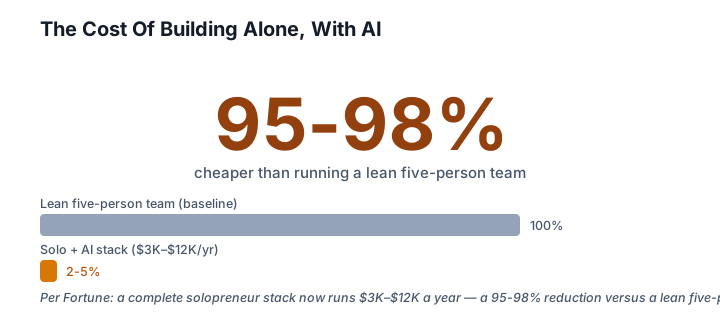
I want to be careful with that sentence, because there’s a whole genre of post right now telling you to quit your job and become a one-person billion-dollar company. Sam Altman has said it. Dario Amodei put a 2026 timeline on it at Anthropic’s Code with Claude conference. There’s already a guy who built a $1.8 billion telehealth company with $20,000 and AI tools in two months. The math is real. A complete solopreneur stack now runs $3K–$12K a year, per Fortune — a 95-98% reduction versus a lean five-person team.
That’s not what I’m doing.
I’m a clinician. I built VibeCheck.luxury because no one else was going to build it for me. I needed it. My clients need it. The clinicians I came up with need it. The 93 percent of us burned out and the ones drowning in admin need it. The patent isn’t a stunt — it’s the priority date that lets a small company hold onto its architecture long enough to actually ship to the people it was built for.
The point isn’t unicorns. The point is that the path now exists.
Twenty-five years ago, the path to building software-grade healthcare infrastructure was: be rich, or be hired by someone rich. Today the path is: spend fifteen years in the system, know what’s broken, learn enough AI to write the thing, file the paper that protects it long enough to ship it.
You can take what you actually know about your field — your patients, your clients, your students, your patrol route, your dialysis floor, your kitchen, whatever — and you can turn it into something real.
I’m not telling you to quit your job. I’m telling you the moat that used to require capital now just requires the idea, paired with the years you already spent learning where things break.
This whole fucking thing may fall flat on its face. Or it may go crazy. I don’t have a clue.
I’m going to enjoy every minute from this point forward, because for the first time I can remember, almost all of us have this amazing opportunity to do whatever we want.
They’ll stop you eventually. That’s how the system works. But right now you have it. Learn AI. Learn to build. The world is ugly right now, and this seems like the thing that can buffer it.
Colophon
Architecture covered by U.S. provisional patent application 64/059,214, filed 2026-05-06 with the United States Patent and Trademark Office. Patent pending. Mental Wealth Solutions, Inc. is a New York–based healthcare software company founded in 2024 by Matthew Sexton, LCSW, NATC. Flagship product: VibeCheck.luxury. More at vibecheck.luxury and mentalwealthsolutions.org.
This is a founder note and a forward-looking one: it describes what has been built and filed, not a guarantee of what ships next. A provisional patent application establishes a priority date; it is not a granted patent.
If you're the therapist here.
Your clients get 4 sessions a month. The other 26 days they're on their own. VibeCheck.luxury is the between-session companion that carries those days back to you — clients check in daily, and you walk in already knowing what kind of week it was. Built by Matthew Sexton, LCSW, NATC.