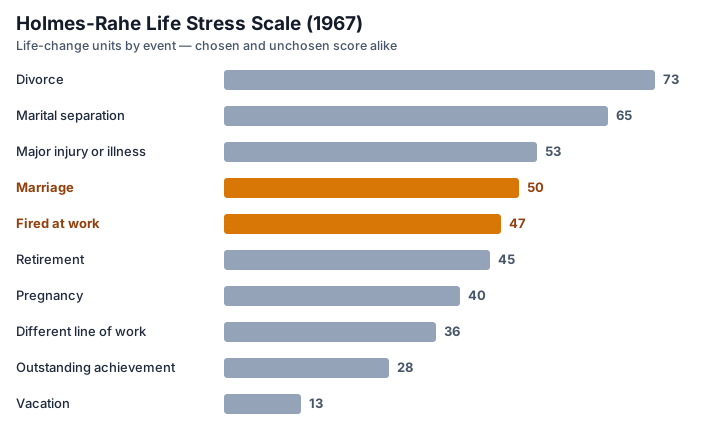
Getting married rates as more stressful than getting fired. On the Holmes-Rahe Social Readjustment Rating Scale, the stress inventory clinicians have used since 1967, marriage scores 50 life-change units while being fired scores 47 (Holmes & Rahe, Journal of Psychosomatic Research, 1967). The scale measures one thing: how much adjustment an event demands from you. Whether you wanted the event never enters the math. That is the entire case in a single line. Chosen change still costs, and most people pay the bill without knowing they were ever billed.
Good news scores points too
Holmes and Rahe asked hundreds of people to rate 43 life events by how much readjustment each demands, then assigned every event a score. Divorce sits at 73. Marital separation, 65. A major personal injury or illness, 53. Then come the events people congratulate you for: marriage at 50, retirement at 45, pregnancy at 40, gaining a new family member at 39, changing to a different line of work at 36.
Keep reading down the list and it gets stranger. Outstanding personal achievement: 28 points. A vacation: 13. The scale was built from what actually wears people down, and what wears people down is change itself, in either direction.
The points also stack, which is the part most people miss. A new job is rarely just a new job. It can be a new line of work (36), plus a major change in financial state (38), plus a move (20), plus new working hours (20). In the Holmes-Rahe prediction model, a total of 150 to 300 points came with roughly a 50% chance of a major stress-related health problem within two years, and more than 300 points pushed the odds to about 80%. One ordinary year of good decisions can quietly clear 300.
What a transition actually breaks
Circumstances change all the time without costing much. Transitions cost because they break identity.
Your brain runs most of daily life on prediction. It knows who you are, what happens at 8 a.m., who is home when you get there, which version of you to load in which room. A major transition deletes whole sections of that map at once. The predictions stop landing, and a brain whose predictions stop landing registers threat, whether the trigger was a divorce or a promotion.
This is why people who make objectively good decisions still feel wrecked afterward. You left the draining job, ended the wrong relationship, moved somewhere better. The decision was correct, and the psychological cost arrived anyway, because you also lost the version of yourself who knew how to live the old life. Even an upgrade begins with demolition.
Adjustment disorder, the common diagnosis almost nobody has heard of
There is a clinical name for struggling after a life change, and it describes one of the most ordinary presentations in mental health care. Adjustment disorders show up in an estimated 5 to 20% of outpatient mental health visits, per the Merck Manual’s professional-edition summary of the DSM-5-TR criteria. The definition: emotional or behavioral symptoms that develop within three months of an identifiable stressor and land harder than the situation alone would predict. Once the stressor and its fallout end, symptoms are expected to resolve within six months.
The symptoms are recognizable:
- Anxiety that feels out of proportion to the event
- Low mood that clashes with the good news everyone congratulated you on
- Sleep that runs too short or too long
- Trouble concentrating or making decisions
- Pulling away from exactly the people who could steady you
- Irritability that surprises even you
If you read that list and see your last three months, take the plain interpretation. A recognized, common, treatable clinical response to disrupted identity fits the evidence better than “I am weak.”
Why powering through backfires
The standard American playbook for transitions is suppression. Stay busy. Keep moving. You will feel better once you settle in.
The playbook has it backwards. Suppression spends your energy performing “fine” while the actual adjustment work sits untouched, so the timeline stretches instead of shrinking. What moves the process along looks different:
- Name it as a transition. “I changed jobs and I am rebuilding an identity” produces less shame than “I got what I wanted and I am failing at it.” The first framing is also the accurate one.
- Let it be a loss. Every transition retires something: a role, a routine, a daily cast of people, a former self. Grieving a chosen loss is still grieving. Skipping it just defers it.
- Rebuild routine on purpose. Transitions demolish structure, and structure is one of the brain’s main anxiety regulators. A fixed wake time, a standing call, the same walk. Small, boring, repeated. Predictability is the point.
- Bring support in early. Adjustment problems compound. The window where a few sessions of therapy makes an outsized difference is early, while the new identity is still wet cement.
- Audit the support system. Transitions reveal which people can sit with your uncertainty and which ones need you to be fine. Lean on the first group.
When it has stopped being adjustment
You do not need a crisis to justify seeing a therapist during a transition. Some signals do say the window for wait-and-see has closed:
- Symptoms past two weeks and trending worse
- Routine tasks failing that never used to fail
- Sleep disruption that has become the norm rather than the exception
- Withdrawal from relationships
- Decisions frozen, small ones included
- Alcohol, food, or anything else drafted in to manage the discomfort
- The sentence “I should be over this by now”
That last one deserves a note. “I should be over this by now” applies a deadline to a process that does not carry one, and the gap between the imagined deadline and the real timeline generates its own distress. Feeling behind schedule is usually evidence of a fictional schedule.
Life transitions are predictable psychological events with a scale, a diagnosis, and a treatment literature behind them. Treat yours like one. The people who fare best are the ones who take the event as seriously as the researchers who scored it.
FAQ
What is adjustment disorder? A clinical diagnosis for emotional or behavioral symptoms that develop within three months of an identifiable stressor, such as a job change, divorce, move, or new diagnosis, and hit harder than the situation would predict. It appears in an estimated 5 to 20% of outpatient mental health visits, making it one of the most common presentations in clinical practice, and it responds well to treatment.
Why do I feel anxious or low after a change I chose? Because the cost of a transition comes from the adjustment it demands, whether or not you wanted it. The Holmes-Rahe stress scale rates marriage (50 points) above being fired (47) for exactly this reason. Chosen changes still dismantle routines, roles, and the version of you that ran the old life, and your brain processes that dismantling as threat.
When should I talk to a therapist about a life transition? When symptoms persist past two weeks, interfere with daily functioning, disrupt sleep chronically, pull you away from people, or freeze your decision-making. Earlier is better than later. Adjustment problems compound, and support early in a transition can keep a rough patch from becoming a long one.
Sources
- Holmes, T.H. & Rahe, R.H., “The Social Readjustment Rating Scale,” Journal of Psychosomatic Research, Vol. 11, 1967; inventory as republished by the University at Buffalo School of Social Work. https://socialwork.buffalo.edu/content/dam/socialwork/home/self-care-kit/holmes-rahe-life-stress-inventory.pdf Supports: all life-change unit scores cited (divorce 73, marital separation 65, major injury or illness 53, marriage 50, fired at work 47, retirement 45, pregnancy 40, new family member 39, change to a different line of work 36, major change in financial state 38, outstanding personal achievement 28, change in residence 20, change in working hours 20, vacation 13) and the prediction-model figures (150 to 300 points, roughly 50% chance of a major stress-induced health problem; over 300 points, about 80%).
- Merck Manual, Professional Version, “Adjustment Disorders,” accessed July 2026. https://www.merckmanuals.com/professional/psychiatric-disorders/anxiety-and-stressor-related-disorders/adjustment-disorders Supports: adjustment disorders present in an estimated 5 to 20% of patients making outpatient mental health visits; DSM-5-TR criteria of symptom onset within 3 months of a stressor and resolution within 6 months after the stressor ends.
Figures current as of July 2026.
Disclaimer
This article is for educational and informational purposes only. It does not constitute medical, clinical, legal, or therapeutic advice, and reading it does not create a therapist-client relationship with Matthew Sexton, LCSW or Mental Wealth Solutions, Inc. Although the author is a licensed clinical social worker, the content in this article is not clinical assessment, diagnosis, or treatment.
The patterns, concepts, and frameworks described here reflect published research and general clinical observations. Individual experiences vary, and what is described here may not match every reader’s situation. If you are working through the concerns described in this article, please consult a licensed mental health professional who can assess your specific circumstances.
If you are in immediate emotional crisis, you can reach the 988 Suicide & Crisis Lifeline by calling or texting 988 (US). If you are experiencing domestic violence or are in physical danger, contact the National Domestic Violence Hotline at 1-800-799-7233 or visit thehotline.org. In a life-threatening emergency, call 911.
Frequently asked questions.
- What is adjustment disorder?
- A clinical diagnosis for emotional or behavioral symptoms that develop within three months of an identifiable stressor, such as a job change, divorce, move, or new diagnosis, and hit harder than the situation would predict. It appears in an estimated 5 to 20% of outpatient mental health visits, making it one of the most common presentations in clinical practice, and it responds well to treatment.
- Why do I feel anxious or low after a change I chose?
- Because the cost of a transition comes from the adjustment it demands, whether or not you wanted it. The Holmes-Rahe stress scale rates marriage (50 points) above being fired (47) for exactly this reason. Chosen changes still dismantle routines, roles, and the version of you that ran the old life, and your brain processes that dismantling as threat.
- When should I talk to a therapist about a life transition?
- When symptoms persist past two weeks, interfere with daily functioning, disrupt sleep chronically, pull you away from people, or freeze your decision-making. Earlier is better than later. Adjustment problems compound, and support early in a transition can keep a rough patch from becoming a long one.
If this named something you're living with —
You don't have to figure it out from articles. Matthew Sexton, LCSW, NATC sees adults in therapy at his separate private practice (telehealth · NY · ME · DE · FL). Or take this piece to your own therapist — it's written to be shared.
Visit the practice