A man scrolls past a marble bust and a Marcus Aurelius quote, and somewhere in the next ten seconds he absorbs a lesson the actual Stoics would have called a mistake: feel nothing, want nothing, show nothing.
TL;DR
Broicism is the manosphere’s hollowed-out version of Stoicism that tells men to feel nothing and grind. Real Stoicism taught almost the opposite. It is a method for examining the judgment under a feeling, which is the same skill that powers cognitive behavioral therapy. The counterfeit swaps that examination for emotional suppression, and the research ties suppression, and the masculine “emotional control” norms it rides on, to worse mood, weaker relationships, avoided help, and higher suicide risk in men. The honest answer is not less stoicism. It is the real thing, which is what the S.T.O.I.C.K. method turns into six usable steps.The word broicism keeps showing up because the thing it names is everywhere. The stoicism tag on TikTok has gathered roughly 2.5 billion views, and a Greek-philosophy professor reviewing that content called most of it disinformation about the actual philosophy (The Conversation, 2023). In January 2026 the philosopher Massimo Pigliucci, who has done more than almost anyone to bring Stoicism to general readers, published a piece called “The Broicism Scam,” arguing that manosphere figures hijacked the brand (Pigliucci, 2026).
I am a licensed clinical social worker. I watch men arrive in therapy fluent in a philosophy that is making them worse, and convinced it is making them stronger. This piece separates the real thing from the product being sold under its name, and then shows you the method I built from the real thing.
What is broicism?
Broicism is a popularized, masculinized misreading of Stoicism that equates strength with feeling nothing. It keeps Stoic aesthetics, the busts and the quotes, and discards the philosophy’s actual content. Critics also call it pseudo-stoicism, a term for emotional suppression dressed up as discipline (Trill, 2026; Pigliucci, 2026).
The tell is the direction of the advice. Broicism tells a man to clamp down on a feeling he is already having. It reads apatheia, the Stoic idea of freedom from destructive passions, as if it meant a man should walk around numb. Writers on hypermasculinity call the commercial machine around this the “stoic industrial complex,” where financial success gets fused with hard masculinity and sold back to men as ancient wisdom (Kill Your Darlings, 2025). The recurring figures include Andrew Tate, the Liver King who built a raw-meat masculinity brand and was later shown to be using steroids, and a tier of productivity influencers.
Is stoicism emotional suppression?
No. Stoicism is closer to cognitive reappraisal than to suppression, and the two are different psychological moves with different outcomes. The Stoics held that an emotion is the result of a judgment, an act of assent to an impression, not an automatic reflex (Internet Encyclopedia of Philosophy). The practice is to inspect the judgment under the feeling and revise it if it is false, which is appraisal, not bottling.
Epictetus put the core idea in one line that later seeded an entire school of therapy: people are disturbed not by things, but by their judgments about things. That is the response real Stoicism aims at. It is a trained reaction, built in the gap between an event and a person’s reply to it, and the training is mental, not muscular.
Two facts end the “feel nothing” reading on their own. The Stoics did not want a life without emotion. They separated destructive passions from the eupatheiai, the good feelings such as rational joy, caution, and goodwill (Internet Encyclopedia of Philosophy). And they kept insisting the strong man is gentle. Marcus Aurelius wrote that gentleness is more human, and so more manly, than anger. Seneca wrote a whole treatise against anger. Epictetus warned that a man who turns himself into a wild beast has lost the human being he was.
The evidence: suppression is the costly strategy
The coping move at the center of broicism is the one psychologists single out as the expensive one. James Gross and Oliver John drew the key distinction in 2003. Cognitive reappraisal changes how a person construes a situation. Expressive suppression hides the outward signs of a feeling the person is already having. Across their studies, habitual reappraisers reported better well-being and better relationships, while habitual suppressors reported worse on both (Gross & John, 2003).
The follow-on research held the pattern. Expressive suppression has been associated with PTSD, anxiety, and depression symptoms in trauma-exposed samples (Moore et al., 2008). Compared with reappraisal, suppression does not lower the felt emotion, it raises physiological stress activation, and it taxes the people nearby, who show more stress while talking with the suppressor (Cutuli, 2014). The face stays calm while the body keeps running the stress response. The feeling does not leave. It goes quiet and stays.
The specific cost to men
Broicism is marketed to men, and the masculinity research lands on the same coping style it sells. Mahalik and colleagues built the Conformity to Masculine Norms Inventory in 2003, which measures how strongly a man endorses norms like emotional control and self-reliance, and a line of studies using these tools points one way.
A latent-profile study sorted men by their pattern of norm endorsement and found a subgroup the authors literally named the “Stoics,” high on emotional control, self-reliance, and risk-taking. That subgroup carried 2.32 times the odds of a lifetime suicide attempt compared with the least-conforming men, and reported the strongest belief that emotional distress is unbearable (latent-profile study of masculine norms, 2024). In a national sample of 785 men, thought suppression statistically mediated the path from the self-reliance norm to suicidality (study in Archives of Suicide Research, 2023). Endorsing toughness norms predicted lower use of mental health services, including among men who were currently depressed. A systematic review concluded that traditional masculine norms shape how men express depression, whether they seek help, and how they cope, in a direction that worsens outcomes (Seidler et al., 2016).
Read together, the picture is blunt. The norm cluster that most resembles the marketed stoic ideal is the same cluster most tied to depression, avoided treatment, and suicide.
The S.T.O.I.C.K. Method: real Stoicism in six steps
Here is where the cultural fight turns useful. If real Stoicism is responding instead of reacting, then it should be teachable as a sequence a man can actually run in the moment. That is the S.T.O.I.C.K. method, the framework I developed and use with clients. The same science that exposes broicism is the evidence under each of its six steps.
The method interrupts the brain’s automatic survival response, the HPA-axis fight-flight-freeze cascade, and replaces a primal reaction with a values-aligned action. Each step rests on an established mechanism.
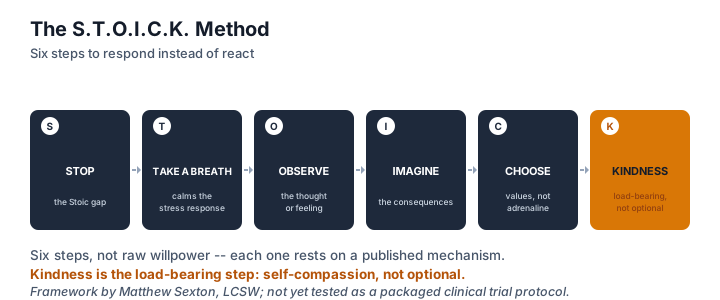
- S — Stop
- A deliberate pause before the reactive behavior lands. This is the Stoic gap between impression and assent, the one moment where a person actually holds power. It is the hardest step, because the survival brain is built to act first and think later.
- T — Take a Breath
- A slow, deliberate breath signals the parasympathetic nervous system to down-regulate the stress response and brings the prefrontal cortex back online. One long exhale is the bridge from reactive to responsive (Zaccaro et al., 2018).
- O — Observe the Thought or Feeling
- Name the internal experience without judging it. “I feel anxious,” not “I am anxious.” Affect-labeling research shows that putting a feeling into words measurably reduces amygdala activation. When you label it, you are watching it instead of inside it (Lieberman et al., 2007).
- I — Imagine the Consequences
- Run the scenario forward. What happens if you react from this state, and what happens if you respond from your values? Even a brief pause to imagine consequences measurably reduces impulsive action. This is the explicit react-versus-respond fork.
- C — Choose
- Act from your values, not your adrenaline. The preceding four steps converge into one decision: what do I actually want to do here, as someone with a clear sense of my values? This is cognitive reappraisal joined to values-based action, the strategy the emotion-regulation evidence favors (Gross & John, 2003).
- K — Kindness
- Respond with kindness, toward yourself first. Self-criticism re-activates the same threat system you just calmed, so self-compassion is load-bearing, not optional. It is what makes the practice sustainable instead of punishing (Neff, 2003; Gilbert).
Two honest notes. None of these steps is novel on its own, and that is the point. The method sequences validated components into one portable tool a person can use without a therapist in the room. And S.T.O.I.C.K. has not been tested as a packaged protocol in a clinical trial, so I do not claim it has. What I claim is narrower and defensible: each step rests on published mechanisms, and the sequence operationalizes the real Stoic move that broicism threw away.
The full breakdown of each step, with the neuroscience behind it, lives on the method page: the S.T.O.I.C.K. Method.
The honest limits
The masculinity findings are neither universal nor mostly proof of cause. A 2026 study of urban Indian men found no significant link between traditional masculine norms and either suppression or reappraisal, which suggests the norm-to-suppression pathway may be specific to Western samples rather than a fact about all men (Frontiers in Sociology, 2026). Most of the masculinity and suppression studies are cross-sectional, so they show association, not proof. Some men also genuinely benefit from real Stoic practice, and that is the whole argument. The problem is brand against substance, not the substance.
If you want a starting move tonight, use the first two steps. When something lands hard, stop, and take one slow breath before you do anything. That pause is the entire philosophy in miniature, and it is the opposite of feeling nothing. The full method is at /stoick.
Sources
- The Conversation (2023). Stoicism on TikTok promises happiness, but the ancient philosophers had something very different in mind. theconversation.com
- Pigliucci, M. (2026). The Broicism Scam: how Stoicism was hijacked by “manosphere” impostors. Big Think.
- Trill Magazine (2026). Broicism: the manosphere’s obsession with Stoicism.
- Kill Your Darlings (2025). Hypermasculinity and the Stoic Industrial Complex.
- Internet Encyclopedia of Philosophy. Stoicism. iep.utm.edu/stoicism
- Gross, J. J., & John, O. P. (2003). Individual differences in two emotion regulation processes. Journal of Personality and Social Psychology, 85(2), 348-362.
- Moore, S. A., Zoellner, L. A., & Mollenholt, N. (2008). Are expressive suppression and cognitive reappraisal associated with stress-related symptoms? Behaviour Research and Therapy, 46(9), 993-1000.
- Cutuli, D. (2014). Cognitive reappraisal and expressive suppression strategies role in emotion regulation. Frontiers in Systems Neuroscience, 8, 175.
- Mahalik, J. R., et al. (2003). Development of the Conformity to Masculine Norms Inventory. Psychology of Men & Masculinity, 4(1), 3-25.
- Seidler, Z. E., et al. (2016). The role of masculinity in men’s help-seeking for depression: a systematic review. Clinical Psychology Review, 49, 106-118.
- Zaccaro, A., et al. (2018). How breath-control can change your life: a systematic review on psycho-physiological correlates of slow breathing. Frontiers in Human Neuroscience, 12, 353.
- Lieberman, M. D., et al. (2007). Putting feelings into words: affect labeling disrupts amygdala activity. Psychological Science, 18(5), 421-428.
- Neff, K. D. (2003). Self-compassion: an alternative conceptualization of a healthy attitude toward oneself. Self and Identity, 2(2), 85-101.
Frequently asked questions.
- Is broicism the same as Stoicism?
- No. Broicism is a popularized misreading that equates Stoic strength with feeling nothing. Real Stoicism is a method for examining and revising the judgments that produce emotions, which is closer to cognitive behavioral therapy than to emotional suppression.
- Is stoicism emotional suppression?
- No. The Stoics treated emotions as judgments to be examined, and they valued good emotions like rational joy and goodwill. Suppression hides a feeling you are already having. Reappraisal changes the judgment underneath it. Stoicism is the second one.
- Why is toxic stoicism bad for men?
- Toxic stoicism promotes emotional suppression and self-reliance as masculine ideals. Research links those norms to depression, lower use of mental health services, and higher suicide risk. One study found a high emotional-control subgroup of men with 2.32 times the odds of a lifetime suicide attempt.
- What did the real Stoics say about emotions?
- The Stoics said emotions come from judgments, so a false judgment can be corrected. They distinguished destructive passions from healthy emotions like joy and goodwill, and they prized gentleness. Marcus Aurelius wrote that gentleness is more manly than anger.
- How does the S.T.O.I.C.K. method relate to Stoicism?
- S.T.O.I.C.K. is the clinical version of the real Stoic move, responding instead of reacting. Its six steps (Stop, Take a Breath, Observe the Thought or Feeling, Imagine the Consequences, Choose, Kindness) sequence validated mechanisms like affect labeling, slow breathing, cognitive reappraisal, and self-compassion into one portable tool.
- Is Stoicism connected to therapy?
- Yes. Albert Ellis credited the Stoic Epictetus as a root of rational emotive behavior therapy, and Aaron Beck's cognitive therapy shares that lineage. The Stoic move of testing the thought under a feeling is the same skill that cognitive behavioral therapy trains.
- Does criticizing broicism mean men should not be tough or self-reliant?
- No. The problem is suppression sold as strength, not resilience itself. Real Stoicism prizes courage and self-discipline, and pairs them with examining your judgments and asking for help when one needs correcting. Toughness plus emotional honesty is the Stoic position, not toughness alone.
If this named something you're living with —
You don't have to figure it out from articles. Matthew Sexton, LCSW, NATC sees adults in therapy at his separate private practice (telehealth · NY · ME · DE · FL). Or take this piece to your own therapist — it's written to be shared.
Visit the practice