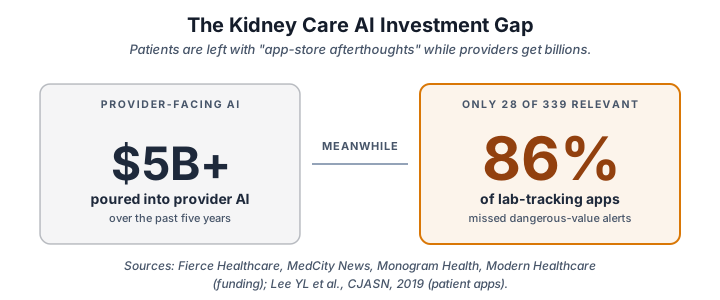
Over the past five years, venture capital firms and health systems have poured more than $5 billion into artificial intelligence platforms for kidney care. These tools predict disease progression, optimize dialysis scheduling, flag high-risk patients, and route them into value-based care programs. They are sophisticated, well-funded, and genuinely useful.
They are also built almost exclusively for providers.
Meanwhile, the 786,000 Americans living with end-stage renal disease and the 37 million with chronic kidney disease have been left with app-store afterthoughts — basic trackers built by solo developers, most of which cannot even alert a user when they enter a dangerously abnormal lab value.1 Thirteen people die every day waiting for a kidney transplant.2 And the tools designed to help them navigate one of the most complex journeys in American healthcare effectively do not exist.
This is the story of a funding gap that has become a patient-safety gap — and why it does not have to stay that way.
What Providers Have: A $5 Billion Arsenal
The investment landscape for provider-facing kidney care AI is staggering in both scale and velocity.
Strive Health closed a $550 million Series D in September 2025 to expand its AI-driven value-based kidney care platform, which uses predictive models to identify patients at risk of disease progression and steer them toward earlier intervention.3 Somatus has raised roughly $500 million at a $2.5 billion valuation, building population health analytics that help payers and health systems manage the cost of kidney disease at scale.4 Monogram Health has secured $542 million across five funding rounds to deploy AI-enabled, in-home kidney care monitoring.5
The largest deal reshaped the industry itself. The merger of Cricket Health and Interwell Health with Fresenius Medical Care’s value-based care division created a $2.4 billion entity whose StageSmart machine-learning model predicts CKD stage transitions months in advance.6 Healthmap Solutions has invested over $100 million in its Compass AI platform, which generates “next best action” recommendations for care teams managing renal populations.7
On the diagnostic side, Renalytix earned FDA Breakthrough Device designation for KidneyIntelX, an AI-powered blood test that predicts rapid kidney function decline.8 Vantive, the Baxter kidney care spinoff acquired by Carlyle Group for $3.8 billion, has announced plans to invest $1 billion in AI and digital health capabilities.9
And the two legacy dialysis giants are not standing still. DaVita has deployed its CWOW analytics platform, a peritoneal dialysis loss-prediction model, and a CKD identification model achieving 72% accuracy across its network.10 Fresenius maintains the Apollo Database — one of the largest clinical datasets in nephrology at over 540,000 patients — and runs its IHPM predictive model incorporating more than 1,000 clinical variables.11
This is not a criticism of these investments. Predictive analytics and population health management save lives. The problem is not that providers have powerful tools. The problem is that patients have almost nothing.
What Patients Have: Almost Nothing
The evidence is blunt. A 2019 systematic review published in the Journal of Medical Internet Research screened 431 kidney-disease-related apps and found that only 12 met minimum quality thresholds. None incorporated artificial intelligence or machine learning. Most offered basic calorie tracking or medication reminders with no interactive feedback and no caregiver integration.12
That same year, a Johns Hopkins research team published a parallel evaluation in the Clinical Journal of the American Society of Nephrology. They identified 339 kidney disease apps across iOS and Android. After filtering for relevance, currency, and patient-facing functionality, only 28 remained. Of those with lab-tracking features, 86% failed to alert users when they entered dangerously abnormal values — a critical safety failure for a population managing potassium levels that can trigger cardiac arrest. Sixty-one percent of the apps were built by individual developers, not clinical teams or funded companies. Patient ratings and nephrologist quality assessments were uncorrelated, meaning the apps patients liked were not necessarily the ones that were safe.1
The funding numbers tell the same story from a different angle. Only about 2% of life science venture investment in the US and EU flows to renal and transplant innovation.13 For context, over 100,000 Americans are currently on the kidney transplant waitlist, and non-white ESRD patients remain significantly less likely to be waitlisted or to receive a transplant — a disparity that has persisted for decades.14
The market has made its position clear: kidney patients are a population to be managed, not a customer to be served.
Why the Kidney Care AI Gap Exists
Five structural forces explain why billions flow to the provider side and almost nothing reaches the patient side.
-
VCs fund B2B. Enterprise healthcare buyers — payers, health systems, dialysis networks — sign six- and seven-figure contracts. Individual patients do not. The incentive structure of venture capital directs money toward platforms with enterprise buyers, not toward consumer health tools for a medically complex population.
-
Regulatory ambiguity. Provider-facing clinical decision support tools have clearer FDA pathways than patient-facing health AI. The regulatory gray zone for apps that offer patients algorithmic guidance — without being classified as medical devices — discourages investment.
-
Data access asymmetry. Providers sit on EHR pipelines, claims databases, and lab feeds. Patients are left with manual data entry. Without structured data flowing in, patient-facing AI has less to work with and costs more to build well.
-
No reimbursement pathway. There is no CMS billing code for patient self-management AI in kidney care. Providers can bill for remote patient monitoring and chronic care management. Patients who manage their own health generate no revenue for anyone.
-
Paternalistic assumptions about the population. The ESRD population skews older, sicker, lower-income, and disproportionately non-white. The industry has implicitly decided these patients cannot or will not use digital tools. The research tells a different story: the barrier is not willingness but design. Studies consistently find that ESKD patients face a “persistent digital divide” driven by operational complexity and low eHealth literacy — problems of interface design, not patient capability.15 When researchers actually ask patients what they need, the answer is straightforward: simplified workflows, intuitive interfaces, and tools built with their input from the start.16
None of these barriers are insurmountable. They are choices — made by capital allocators, regulators, and product teams — and they can be reversed.
What Needs to Change
Three shifts would begin to close this gap.
First, build for patients from the beginning — not as a portal bolted onto a provider platform. The research is explicit: patients are “often not involved in development” of the health apps marketed to them.17 Co-design with actual kidney patients — including those on dialysis, those navigating transplant evaluation, and their caregivers — is not a nice-to-have. It is the minimum standard for building something that works.
Second, design for the real population. That means accessibility-first interfaces, health-literacy-appropriate language, multilingual support, and offline capability for patients in areas with inconsistent connectivity. It means acknowledging that a 62-year-old on hemodialysis three times a week has different needs than a 35-year-old tech worker tracking their steps.
Third, fund it. Philanthropy, grants, and mission-driven capital need to fill the gap that venture capital structurally cannot. CMS should explore reimbursement pathways for validated patient self-management tools. And the kidney care industry — which generates over $50 billion annually in the US alone — should invest a fraction of that in tools for the people it serves.
Why We Built TransplantCheck
This gap is why TransplantCheck exists. It is an AI-powered patient navigation platform for people with ESRD and CKD, designed for the transplant journey specifically — the most high-stakes, most confusing, and most consequential pathway a kidney patient will face.
It was built for patients first, not adapted from a provider tool. It is HIPAA-eligible and designed for the actual literacy and accessibility needs of this population. It is not the only solution this space needs. But it is one answer to a question the market has been ignoring for too long.
786,000 Americans are living with ESRD right now. They deserve more than a basic tracker that cannot flag a dangerous potassium level. They deserve the same caliber of intelligence that their providers already have.
The technology exists. The data exists. The investment thesis is the only thing that has been missing — and it is time to write a new one.
References
Footnotes
-
Lee YL, et al. “Smartphone Apps for Chronic Kidney Disease.” Clinical Journal of the American Society of Nephrology, 2019. pmc.ncbi.nlm.nih.gov/articles/PMC6450346 ↩ ↩2
-
United States Renal Data System. 2025 Annual Data Report. usrds-adr.niddk.nih.gov/2025/introduction ↩
-
Fierce Healthcare. “Strive Health Lands $550M Investment to Build Out AI Tools.” fiercehealthcare.com ↩
-
MedCity News. “Somatus Hauls in $325M to Grow Its Value-Based Kidney Care Model.” medcitynews.com ↩
-
Monogram Health. “Monogram Health Closes $375M Growth Capital Raise.” monogramhealth.com ↩
-
Fierce Healthcare. “InterWell Health Finalizes $2.4B Kidney Care Merger.” fiercehealthcare.com ↩
-
Fierce Healthcare. “Healthmap Raises $100M to Scale Value-Based Kidney Care.” fiercehealthcare.com ↩
-
Yahoo Finance. “FDA Grants De Novo Marketing Authorization for KidneyIntelX.” finance.yahoo.com ↩
-
Modern Healthcare. “Vantive to Invest $1B in Digitally-Enabled Kidney Care.” modernhealthcare.com ↩
-
DaVita Newsroom. “Sustaining Home Dialysis Success: Predictive Analytics & AI.” newsroom.davita.com; “Predictive Analytics in Upstream Kidney Care.” newsroom.davita.com ↩
-
CIO. “Predictive Analytics Helps Fresenius Anticipate Dialysis Complications.” cio.com; Healthcare Innovation Group. “Fresenius Building Large-Scale Dialysis Database.” hcinnovationgroup.com ↩
-
Ong SW, et al. “Apps for Patients With Chronic Kidney Disease: A Systematic Review.” Journal of Medical Internet Research, 2019. pmc.ncbi.nlm.nih.gov/articles/PMC6753688 ↩
-
National Kidney Foundation. “Innovation Fund.” kidney.org/professionals/innovation-fund ↩
-
Centers for Medicare & Medicaid Services. “CMS Takes Steps to Reduce Health Care Disparities Among Patients with CKD and ESRD.” cms.gov ↩
-
Zhou Y, et al. “Digital Health Interventions for Patients with ESKD.” 2024. pmc.ncbi.nlm.nih.gov/articles/PMC12466795 ↩
-
“eHealth Barriers for Hemodialysis Patients.” Journal of Medical Internet Research, 2024. jmir.org/2024/1/e51900 ↩
-
Becker S, et al. “Got CKD? There’s an App for That!” Clinical Journal of the American Society of Nephrology, 2019. pmc.ncbi.nlm.nih.gov/articles/PMC6450351 ↩
Want to discuss this for your program?
Book a 30-min conversation. We'll walk you through deployment, the BAA, and what your rollout looks like in production.
Book a 30-min conversation