
Quick answer: The No Surprises Act protects mental health patients from surprise bills for emergency care and from out-of-network clinicians they never chose, and it gives uninsured and self-pay therapy clients a written price estimate before care starts. It does not cap the bill when you knowingly choose an out-of-network therapist. Behind the scenes, providers and insurers filed 1.2 million billing disputes under the law in the first half of 2025, more than double the same period in 2024, in a system federal officials expected to handle about 17,000 disputes a year (Georgetown CHIR, March 2026).
The No Surprises Act took effect for patients in January 2022. Its job is easy to say: stop medical bills you never saw coming. Quick terms first. In-network means your insurance plan has a contract with a provider. Out-of-network means it does not. For mental health, this law does three real things. It shields you in an emergency. It shields you from hidden out-of-network clinicians at in-network hospitals. And it puts your therapy price in writing when you pay for care yourself.
It also leaves one giant gap. When you choose an out-of-network therapist, the law treats that as your decision. No cap applies. In mental health, that gap is where most people actually live. I’ll walk through both halves, plainly.
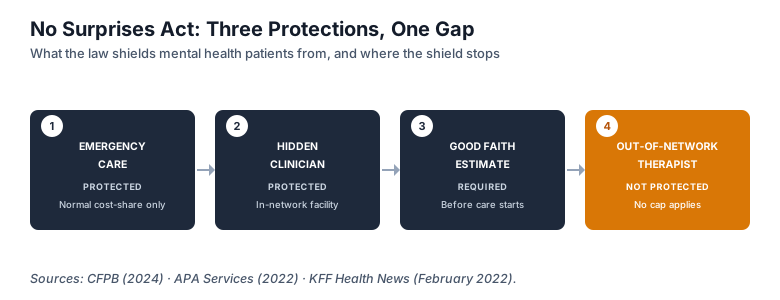
What does the No Surprises Act protect you from?
Start with the shield. Before 2022, you could do everything right and still get burned. You picked an in-network hospital. The anesthesiologist who treated you there was out-of-network. Weeks later, a bill arrived for the difference. That practice has a name: balance billing. It means a provider bills you for whatever your insurance plan refused to pay.
The No Surprises Act banned balance billing in specific places. According to the Consumer Financial Protection Bureau (2024), the protection covers three situations:
- Emergency care. An out-of-network emergency room or emergency facility cannot balance-bill you for covered emergency services.
- Hidden out-of-network clinicians. An out-of-network clinician working at an in-network hospital or facility cannot balance-bill you either.
- Your share stays normal. In those cases, you owe only your regular in-network cost-sharing. That means your usual copay, coinsurance, and deductible. Nothing extra.
A mental health emergency counts the same way a broken arm does. If a crisis sends you to the emergency room, the emergency protection applies. One catch matters here. A visit to a therapist’s or psychiatrist’s office does not count as “emergency services” under this law. The shield covers the emergency room door. It does not cover the therapy office door.
What changed in practice? Before this law, one terrible night in an out-of-network ER could turn into months of collection calls. Now, for covered emergency care, the fight over payment happens between the provider and the plan. Your bill is supposed to look the same as it would at an in-network ER. That part of the law is real, and it holds.
What is a Good Faith Estimate, and why is it the part therapy clients actually use?
Now the part of the law most therapy clients will actually touch. Since January 1, 2022, uninsured and self-pay patients must receive a written cost estimate before care. That includes psychotherapy clients, according to APA Services (2022). The document is called a Good Faith Estimate, or GFE. The law requires it. You should never have to beg for one.
The estimate has teeth. If the final bill lands $400 or more above the estimate, you can formally dispute it through a federal process. The CFPB says you have 120 days from the bill date to file. That window is firm, so keep your paperwork.
Why does this matter so much in therapy? Because so much therapy is self-pay. KFF Health News reported in February 2022 that an estimated one-third to one-half of psychologists are not in-network with any insurer. For a huge share of clients, insurance never enters the room at all. The estimate is the protection those clients will actually use. I’ve written before about why finding covered care is so hard in the first place.
Four steps to make it work for you:
- Ask for your Good Faith Estimate in writing before your first session.
- Save it. A photo on your phone is fine.
- Compare every bill against it.
- If a bill runs $400 or more over the estimate, file your dispute within 120 days.
One more practical note. If a practice never mentions the estimate, ask anyway. Providers are required to give it to uninsured and self-pay clients, and a good practice will not flinch at the question. If your care changes, like adding more sessions than planned, ask for an updated estimate so your paper trail stays current.
The honest caveat: choosing an out-of-network therapist is not a “surprise bill”
Now the half the headlines skip. This law only stops bills you did not choose. KFF confirms the protections do not apply when a patient knowingly picks an out-of-network provider. You sign a form. You agree to the rate. Under the law, that is a choice, even when the size of the bill still shocks you.
This caveat hits mental health harder than any other corner of medicine. RTI International studied commercial insurance claims from 2019 through 2021. Patients went out-of-network 3.5 times more often to see a behavioral health clinician than a medical or surgical one (RTI International, April 2024). So the most common mental health bill is exactly the kind this law leaves alone.
Why do so many people leave the network for therapy? Often because staying in it gets them nothing. Commercial insurers pay mental health clinicians less than they pay medical providers for comparable care, so clinicians leave the panels, and the directory becomes a list of full voicemail boxes. States have started fining commercial insurers over exactly these gaps. I’ve traced how the whole model works in The Business of Being Unwell. And for the clinicians reading, the pay math itself is laid out on our clinician blog, here.
Call it what it is: a constrained choice. A patient calls name after name on the in-network list, gets a couple of callbacks and zero openings, then books the out-of-network therapist who can actually see them this month. The plan’s paperwork calls that voluntary. The law agrees with the plan. Your card says covered. Whether you can actually get seen is a separate question entirely.
What do 1.2 million billing disputes tell us about the system?
One more layer, because it shows the state of the whole machine. When an out-of-network provider and an insurer disagree over payment under this law, the fight goes to a referee. The official name is independent dispute resolution, or IDR. Patients are not parties to these fights. They are money fights between providers and insurance plans.
The numbers got big fast. Federal officials originally expected about 17,000 disputes a year. Instead, parties filed 1.2 million new disputes in the first half of 2025 alone, more than double the roughly 590,000 filed in the first half of 2024 (Georgetown CHIR, March 2026). The total since 2022 has reached 3.4 million, roughly 4.8 million through the end of 2025.
Running the referee system costs real money too. Administrative and arbitration fees hit $844 million in the first six months of 2025, per the same Georgetown analysis. That nearly matches the $885 million charged across all of 2022 through 2024 combined. And about 430,000 disputes were still waiting in line as of late June 2025.
Two honest notes. First, mental health providers are not driving this surge. Most filings come from a handful of large emergency-staffing and billing firms. Second, the outcomes say something about how commercial plans pay in the first place. Providers won 88% of these disputes in the first half of 2025, the highest rate recorded to date (Georgetown CHIR, March 2026). When a payment fight reaches a neutral referee, the referee sides against the plan’s opening payment almost nine times out of ten.
So hold both facts at once. The patient shield still works. The machine enforcing it is jammed and expensive.
Where this leaves mental health patients
Use the law for what it truly does. If an emergency sends you to the ER, you owe your normal in-network share and nothing more, so question any bill that claims otherwise. If you pay for therapy yourself, get your Good Faith Estimate in writing and hold your provider to it. If you choose an out-of-network therapist, ask for the full fee up front, and ask what, if anything, your plan reimburses, because no federal law caps that bill.
Then hold the bigger point. The No Surprises Act fixed the ambush. It never touched the reason mental health patients go out of network in the first place: thin networks built on low pay from commercial insurers. Closing the distance between the coverage on your card and the care you can actually reach is the work I care about most. It is part of why we build VibeCheck.luxury at Mental Wealth Solutions. The law stopped one kind of bleeding. Someone still has to make care easier to reach.
FAQ
Does the No Surprises Act cover regular therapy sessions? Mostly no. Routine outpatient therapy rarely happens in emergency rooms or in-network facilities, so the balance-billing ban rarely applies to it. KFF confirms the law does not apply when you knowingly choose an out-of-network provider (KFF Health News, February 2022). The part that does reach therapy is the Good Faith Estimate for uninsured and self-pay clients.
What is a Good Faith Estimate, and when can I dispute a therapy bill? It is a written cost estimate that uninsured and self-pay patients, including psychotherapy clients, must receive before care. It has been required since January 1, 2022 (APA Services). If the final bill is $400 or more above the estimate, you can file a patient-provider dispute within 120 days of the bill date (CFPB, 2024).
Does the No Surprises Act cover a mental health emergency? Yes, through its general emergency protection. If a crisis takes you to an out-of-network emergency room or emergency facility, you cannot be balance-billed for covered emergency services. You owe only your normal in-network cost-sharing (CFPB, 2024). A visit to a therapist’s or psychiatrist’s office does not count as emergency services under the law.
Why are there so many No Surprises Act disputes? Providers and insurers filed 1.2 million payment disputes in the first half of 2025, more than double the first half of 2024, against an original federal projection of about 17,000 a year (Georgetown CHIR, March 2026). These are provider-versus-insurer arbitrations, and patients are not parties. Providers won 88% of them in that period.
Sources
- Georgetown University Center on Health Insurance Reforms, The No Surprises Act IDR Process: An Early Look at 2025 Data (March 2026). Dispute volumes, fees, backlog, and win rates, drawn from federal IDR data.
- Consumer Financial Protection Bureau, What is a surprise medical bill and what should I know about the No Surprises Act? (last modified August 2024). Balance-billing protections and the $400, 120-day dispute rules.
- APA Services (American Psychological Association), FAQs on the No Surprises Act (January 2022). Good Faith Estimate requirements for psychotherapy clients.
- KFF Health News (Julie Appleby), reporting on how the No Surprises Act treats therapy clients (February 2022). The voluntary out-of-network caveat and the share of psychologists not in-network.
- RTI International, study on disparities in network access for mental health and substance use treatment (April 2024). The 3.5x out-of-network gap under commercial insurance.
Disclaimer
This article is for educational and informational purposes only. It does not constitute medical, clinical, legal, or therapeutic advice, and reading it does not create a therapist-client relationship with Matthew Sexton, LCSW or Mental Wealth Solutions, Inc. Although the author is a licensed clinical social worker, the content in this article is not clinical assessment, diagnosis, or treatment.
The No Surprises Act’s balance-billing protections, Good Faith Estimate rules, and dispute processes vary by plan type, state, and situation, and they may change after this article is published. Deadlines and dollar thresholds described here can be updated by regulators. Nothing here is a substitute for confirming your specific bill or coverage question with your health plan, your state insurance department, a billing advocate, or qualified counsel. Situations differ, and what is described here may not match yours.
If you are in immediate emotional crisis, you can reach the 988 Suicide & Crisis Lifeline by calling or texting 988 (US). If you are experiencing domestic violence or are in physical danger, contact the National Domestic Violence Hotline at 1-800-799-7233 or visit thehotline.org. In a life-threatening emergency, call 911.
Frequently asked questions.
- Does the No Surprises Act cover regular therapy sessions?
- Mostly no. Routine outpatient therapy rarely happens in emergency rooms or in-network facilities, so the balance-billing ban rarely applies to it, and KFF confirms the law does not apply when you knowingly choose an out-of-network provider (KFF Health News, February 2022). The part of the law that does reach therapy is the Good Faith Estimate: uninsured and self-pay clients must get a written cost estimate before care starts.
- What is a Good Faith Estimate, and when can I dispute a therapy bill?
- It is a written cost estimate that uninsured and self-pay patients, including psychotherapy clients, must receive before care. It has been required since January 1, 2022 (APA Services). If the final bill comes in $400 or more above the estimate, you can file a patient-provider dispute, and the CFPB says you have 120 days from the bill date to do it.
- Does the No Surprises Act cover a mental health emergency?
- Yes, through its general emergency protection. If a mental health crisis takes you to an out-of-network emergency room or emergency facility, you cannot be balance-billed for covered emergency services. You owe only your normal in-network cost-sharing, meaning your usual copay, coinsurance, and deductible (CFPB, 2024). A visit to a therapist's or psychiatrist's office does not count as emergency services under the law.
- Why are there so many No Surprises Act disputes?
- Providers and insurers filed 1.2 million payment disputes in the first half of 2025, more than double the first half of 2024, in a system federal officials originally expected to handle about 17,000 disputes a year (Georgetown CHIR, March 2026). These are provider-versus-insurer arbitrations, and patients are not parties to them. Providers won 88% of the disputes decided in that period, the highest rate recorded to date.
If you're the therapist here.
Your clients get 4 sessions a month. The other 26 days they're on their own. VibeCheck.luxury is the between-session companion that carries those days back to you — clients check in daily, and you walk in already knowing what kind of week it was. Built by Matthew Sexton, LCSW, NATC.