The Narcissism Conversation Has a Gender Problem
Say “narcissist” out loud and most people picture a man. The domineering CEO. The manipulative ex-boyfriend. The emotionally unavailable father. The entire cultural conversation around narcissistic abuse — the podcasts, the TikTok explainers, the Instagram carousels — overwhelmingly centers male perpetrators.
And the data partially supports that. The DSM-5 reports that up to 75% of those diagnosed with Narcissistic Personality Disorder are male.[1] A 2015 meta-analysis of 470,846 participants across 355 studies found that men scored higher on narcissism overall.[2]
But here’s what almost nobody talks about: that gender gap is driven entirely by grandiose narcissism — the loud, dominant, authority-seeking kind. The subtypes where men pull ahead are Exploitative/Entitlement and Leadership/Authority. The Grandiose/Exhibitionism gap? Nearly zero.[2]
And vulnerable narcissism — the shame-based, victimhood-driven, emotionally manipulative kind — showed no gender difference at all. Across 42 studies and 46,735 participants, men and women scored virtually identically (d = −.04).[2]
Some research goes further. A study in Personality and Individual Differences found that women actually scored significantly higher on vulnerable narcissism than men.[3] A 2022 review in SAGE Journals argued that vulnerable narcissism “tends to be more prevalent in women” but gets systematically overlooked because the DSM diagnostic criteria were built around the grandiose, male-presenting archetype.[4]
The result? Women with narcissistic pathology aren’t being identified as narcissists. They’re being misdiagnosed — often as Borderline Personality Disorder — because their narcissism doesn’t look like what clinicians are trained to see.[5]
And here’s where this matters for families: vulnerable narcissism is the subtype most strongly linked to child maladjustment.[6] The version of narcissism that damages children the most is the one we’re least willing to name — especially when the person doing the damage is a mother.
It’s time to talk about narcissistic mothers. Not because fathers can’t be narcissists. But because the research on maternal narcissism is clear, growing, and being ignored by a culture that still treats motherhood as sacred and above scrutiny.
What Is Vulnerable Narcissism — and Why Does It Look Like “Good” Mothering?
The core traits of narcissism are the same regardless of subtype: entitlement, lack of empathy, a deep need for admiration. The delivery system is what changes.
Grandiose narcissism is the one you recognize: extroverted, dominant, overtly superior. Vulnerable narcissism is its shadow — introverted, shame-based, hypersensitive, and deeply invested in the identity of being misunderstood or victimized.[7]
In a mother, vulnerable narcissism doesn’t look like tyranny. It looks like devotion. The mom who’s “so real” about her struggles. The mom who cries on camera about how hard motherhood is. The mom who makes her mess into a brand and calls it authenticity. The mom who needs you — her child, her audience — to regulate her emotions for her.
Covert and vulnerable are often used interchangeably, but they’re not identical. Covert refers to the style — hidden, masked, under the radar. Vulnerable refers to the emotional core — shame-based, hypersensitive, victimhood-prone. A person can be both, but “relatable” maps specifically to the vulnerable subtype, because the vulnerability is what they show.
Covert narcissists hide. Vulnerable narcissist mothers perform the wound — and recruit their children into the performance.
Simply Psychology describes vulnerable narcissists as relying on emotional manipulation to sustain fragile self-esteem, presenting as misunderstood victims to gain sympathy and deflect responsibility — while secretly maintaining beliefs of superiority.[7] When this personality structure inhabits a maternal role, the child doesn’t just grow up with a difficult mom. The child grows up inside someone else’s emotional economy — where their job is to regulate a person who should be regulating them.
What the Research Says About Narcissistic Mothers — Specifically
The literature on maternal narcissism has exploded in the past three years. The findings are consistent, disturbing, and almost entirely absent from public conversation.
Vulnerable Narcissistic Mothers See Their Children as the Problem
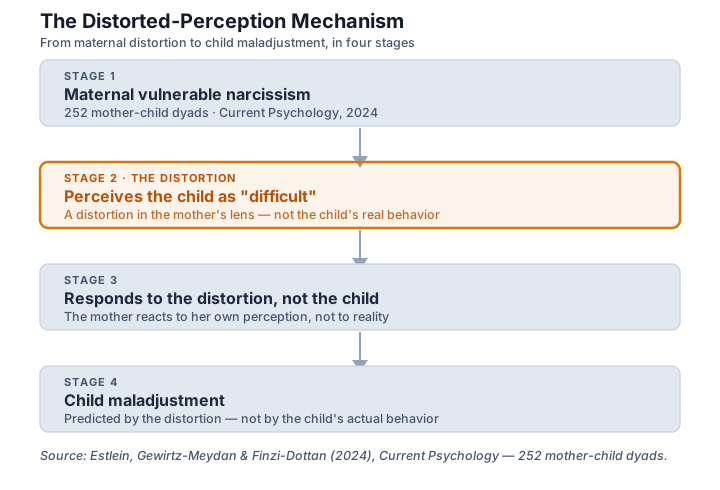
A 2024 study in Current Psychology examined 252 mother-child dyads. The headline finding: only maternal vulnerable narcissism — not grandiose narcissism — was significantly associated with child maladjustment. And the mechanism? Mothers with vulnerable narcissistic traits were more likely to perceive their child as “difficult.” That distorted perception was what actually predicted the child’s problems.[8]
The child isn’t actually difficult. The mother’s lens makes them appear that way — and then the mother responds to the distortion, not the child.
Narcissistic Mothers Create Narcissistic Daughters — and Suppress Empathy
A 2025 study published in Frontiers in Psychology surveyed 416 female university students at King Faisal University. The results: a strong positive correlation between maternal narcissism and daughters’ own narcissistic traits. Maternal narcissism was also negatively associated with daughters’ capacity for empathy. Daughters of narcissistic mothers learn early that external appearances outweigh emotions and that emotional suppression is how you avoid pain.[9]
Maternal Narcissism Predicts Self-Criticism, Depression, and Anxiety in Adulthood
A Turkish study using Structural Equation Modeling with 512 adults found that perceived maternal narcissism during childhood directly predicted self-criticism in adulthood (beta = 0.72). That self-criticism then mediated both depression and anxiety disorder symptoms. The mother’s narcissistic traits literally reshape the child’s internal voice — into one that attacks them.[10]
Narcissistic Mothers Scapegoat — and It Causes Measurable Harm
A 2023 study of 504 Australian adults (Vignando & Bizumic) found that both maternal vulnerable and grandiose narcissism predicted scapegoating behavior, and scapegoating mediated the relationship to anxiety and depression in adult children. Mothers with narcissistic traits were more likely to designate one child as the family problem — and that designation left measurable psychological damage decades later.[11]
The Parentification Trap
A 2025 systematic review in Cureus found that parents with vulnerable narcissistic profiles frequently misinterpret their child’s behavior and react with disproportionate distress, expecting the child to provide reassurance. This dynamic creates parentification — a role reversal where the child becomes the emotional caretaker of the parent.[6]
In a mother-child relationship, this is devastating. The child learns that their purpose is to stabilize their mother’s emotional state. Their own needs become secondary — or invisible.
The Gender-Specific Finding
Green et al. found that maternal coldness was more strongly associated with vulnerable narcissism specifically in daughters — suggesting a gendered transmission pathway where narcissistic mothers may disproportionately damage their daughters’ self-concept through emotional withdrawal tied to the mother’s own fragile self-esteem.[4]
The Momfluencer Pipeline: When Social Media Monetizes Maternal Narcissism
Social media didn’t create narcissistic mothers. But it gave maternal narcissism a revenue model.
Research consistently finds a positive relationship between social media use and narcissistic traits, with platforms functioning as supply delivery systems — offering the likes, comments, and engagement that narcissistic personalities require.[12] For vulnerable narcissists specifically, platforms allow the curation of a sympathetic self-image that would be hard to maintain face-to-face.[13]
The “momfluencer” economy is almost entirely built by women. And it incentivizes exactly the behavior pattern that the clinical literature identifies as harmful: children as content assets, motherhood as brand, vulnerability as performance, chaos as engagement.
A study in Brain Informatics examined how narcissistic parents influence children’s social media behavior, finding that children may share content either to mirror the parent’s narcissistic tendencies or as their own expression — but the parent’s pathology shapes what the child learns about self-presentation and validation-seeking regardless.[14]
Fortesa Latifi, author of Like, Follow, Subscribe: Influencer Kids and the Cost of a Childhood Online, has observed that online motherhood is frequently portrayed as effortless and curated — and when serious allegations emerge, the gap between performance and reality becomes a form of public harm in itself.[15]
The child in this system doesn’t get to be a child. They get to be a deliverable.
Case Study: Taylor Frankie Paul — The Vulnerable Narcissistic Mother in Real Time
Note: This is a behavioral pattern analysis based on publicly documented events and clinical frameworks — not a clinical diagnosis. See full disclaimer below.
Taylor Frankie Paul is not an outlier. She’s the case study that maps almost perfectly onto the clinical literature on vulnerable narcissistic motherhood — the relatable mess who weaponizes her own chaos while her children sit inside the blast radius.
1. Platform Centrality as Grandiosity
Paul didn’t just participate in MomTok — she founded it in 2020, positioning herself as the gravitational center of a group of Mormon mom influencers in Utah.[16] When the soft-swinging scandal broke in 2022, she went on TikTok Live and publicly revealed the group’s involvement — detonating other people’s marriages and careers to control her own narrative.[17]
That’s not transparency. That’s a power move dressed as vulnerability.
2. Motherhood as Brand, Children as Supply
Paul has amassed over 6 million TikTok followers and 2.3 million on Instagram.[18] Her entire brand was built on her children as content assets — aestheticized Mormon family life, curated milestones, shareable moments. That’s the MomTok formula, and she was its architect.
When the scandal broke, she kept posting the kids. When the arrest happened, the bodycam footage became the opening scene of her Hulu series.[17] Her children’s disrupted home became a monetized narrative arc across four seasons of The Secret Lives of Mormon Wives.
In narcissistic family systems, children serve a function: supply extension. Their purpose is to generate engagement, sympathy, and validation for the parent. The child’s needs are secondary to their utility.[19] Paul’s relationship with her kids has been almost entirely mediated through a camera — and that camera has never turned off.
3. The Domestic Violence Incident — With a Child in the Room
In February 2023, Paul was arrested and charged with aggravated assault, two counts of domestic violence in the presence of a child, child abuse with injury, and criminal mischief following an altercation with then-boyfriend Dakota Mortensen. She admitted to police that she threw metal chairs and a wooden play set at Mortensen.[20]
Court documents confirmed that one of those chairs struck her then-five-year-old daughter, who was on the couch next to Mortensen during the incident.[21]
Video of the 2023 incident, released by TMZ on March 19, 2026, shows Paul attempting to put Mortensen in a headlock, kicking him, and throwing barstools — all while her daughter was present.[21] On March 20, Disney pulled her season of The Bachelorette, which had been set to premiere two days later.[15]
Reactive aggression under perceived threat of abandonment is consistent with narcissistic injury response — particularly in someone whose identity is constructed through image management. The escalation to physical violence, in the presence of a child, maps directly onto the research linking vulnerable narcissism with impaired emotion regulation.[6]
4. The Victimhood-to-Comeback Pipeline
Post-arrest. Post-scandal. Post-divorce. What followed? A Hulu deal. Four seasons. A Bachelorette selection — the first lead in franchise history who didn’t come from the Bachelor system.[22]
She monetized the wreckage. That’s not resilience. That’s leveraging chaos as content, which requires a specific relationship with shame — or rather, the absence of it.
Even the consequences became content. Even after her castmates told ABC executives they had concerns about continuing if she remained involved,[23] her spokesperson’s response to the released video framed Paul as the victim of her ex’s “destructive campaign.”[21]
The wound doesn’t stop being performed just because real damage is visible on camera. And the children are still inside the frame.
Red Flags: How to Spot the Vulnerable Narcissistic Mother
If you grew up with a mother who fits this profile — or if you’re watching one operate in real time — these are the behavioral signatures the research identifies.
Chronic victimhood as a parenting posture. She’s always the one being wronged. The child learns that their mother’s pain is the organizing principle of the household. Their job is to manage it, soothe it, or at minimum not add to it.[19]
Inconsistent warmth tied to compliance. Affection flows when the child mirrors the mother’s needs. Independence, disagreement, or emotional separation is met with withdrawal, guilt, or punishment. The 2024 maternal narcissism study found this dynamic predicted child maladjustment.[8]
The child as emotional regulator. Research on parental reflective functioning shows that mothers with vulnerable narcissistic traits have difficulty understanding their child’s internal motivations. They misattribute the child’s behavior and rely on the child to stabilize their own emotional state.[8]
Empathy suppression in daughters. Daughters of narcissistic mothers learn to suppress their own emotions to avoid harsh criticism, internalizing early that external appearances outweigh feelings.[9]
Public performance of motherhood. The curated Instagram post. The TikTok showing how “real” and “messy” motherhood is. The authenticity is itself the performance. The child’s experience is secondary to how the parenting looks.
Chaos as recurring environment. The household cycles through crises — and the mother is consistently at the center of them. The child adapts by becoming hypervigilant, learning to read the room before they learn to read a book.
Why Nobody Wants to Say “Narcissistic Mother”
Motherhood occupies a protected cultural space. We’ll say “narcissistic ex.” We’ll say “narcissistic boss.” We’ll say “narcissistic father” without flinching. But “narcissistic mother” triggers a different response — defensiveness, disbelief, accusations of misogyny.
The diagnostic system reinforces this. The DSM-5’s NPD criteria were designed around grandiose narcissism, which skews male. Women presenting with narcissistic vulnerability are more likely to receive a BPD diagnosis instead.[5] The disorder gets relabeled. The behavior doesn’t change.
And the momfluencer economy provides cultural cover. A mother who posts her children constantly is “dedicated.” A mother who monetizes her family’s dysfunction is “brave.” A mother who performs vulnerability is “relatable.” None of those words exist in the clinical literature on narcissistic parenting.
The research doesn’t care about cultural protection. It measures outcomes. And the outcomes for children of narcissistic mothers are measurable, replicable, and harmful: self-criticism, anxiety, depression, impaired empathy, insecure attachment, narcissistic trait transmission.[8][9][10][11]
Breaking the Pattern
If you recognize this dynamic in your own upbringing, the first step isn’t forgiveness or confrontation. It’s recognition. Naming the system you grew up in is the beginning of not replicating it.
The intergenerational transmission is real. Research consistently shows that childhood neglect and emotional inconsistency from narcissistic mothers predicts the development of vulnerable narcissistic traits in the next generation.[24] Daughters of narcissistic mothers are at particular risk — learning to suppress empathy and develop self-critical internal voices that persist into adulthood.[9][10]
If you see this playing out in someone’s public life — on a reality show, on a social media feed, in the curated chaos of influencer culture — understanding the clinical framework helps you stop consuming dysfunction as entertainment.
The child on camera didn’t consent to being content. The child in the room during the DV incident didn’t consent to being collateral. And the child growing up inside a mother’s emotional economy didn’t consent to being supply.
They were recruited. Not raised.
“Children of vulnerable narcissists are often caught in a real bind. Be a positive reflection on them, and you have their favor. But dare to be your true self or declare your own worth, and you might have trouble.”
— Dr. George Simon, Clinical Psychologist
Seeing the pattern is the investment. Breaking it is the return.
Maybe yourself.
References
- American Psychiatric Association. (2013). Diagnostic and Statistical Manual of Mental Disorders (5th ed.). DSM-5 reports up to 75% of those diagnosed with NPD are male. Referenced via: Hoertel, N., et al. (2018). Examining Sex Differences in DSM-IV Narcissistic Personality Disorder Symptom Expression Using Item Response Theory. PMC. PMC6002876
- Grijalva, E., Newman, D.A., Tay, L., Donnellan, M.B., Harms, P.D., Robins, R.W., & Yan, T. (2015). Gender Differences in Narcissism: A Meta-Analytic Review. Psychological Bulletin, 141(2), 261–310. N = 470,846 across 355 studies. Vulnerable narcissism: d = −.04 (no gender difference). PubMed
- Green, A., MacLean, R., & Charles, K. (2020). Unmasking Gender Differences in Narcissism Within Intimate Partner Violence. Personality and Individual Differences, 167. Females scored significantly higher on vulnerable narcissism. ScienceDirect
- Green, A., MacLean, R., & Charles, K. (2022). Female Narcissism: Assessment, Aetiology, and Behavioural Manifestations. Psychological Reports (SAGE). SAGE Journals
- Kampe, L., et al. (2023). Clinician Perception of Pathological Narcissism in Females: A Vignette-Based Study. Frontiers in Psychology, 14. Women presenting narcissistic vulnerability more likely diagnosed with BPD. Frontiers
- Orovou, E., Jotautis, V., Vousoura, E., et al. (2025). Impact of Parental Narcissistic Personality Disorder on Parent-Child Relationship Quality and Child Well-Being: A Systematic Review. Cureus, 17(12), e100229. Cureus
- McLeod, S. & Drescher, A. (2025). Vulnerable Narcissist: How to Spot Them and How to Cope. Simply Psychology. Simply Psychology
- Estlein, R., Gewirtz-Meydan, A., & Finzi-Dottan, R. (2024). Maternal Narcissism and Child Maladjustment: A Dyadic Study. Current Psychology. 252 mother-child dyads. Only vulnerable narcissism predicted child maladjustment. Springer
- The Narcissistic Personalities of Mothers as Perceived by Their Daughters and Its Relationship to Emotional Balance. (2025). Frontiers in Psychology. N = 416 female students, King Faisal University. PMC
- Alpay, E.H. & Aydin, A. (2023). Development of the Perceived Maternal Narcissism Scale. Klinik Psikoloji Dergisi, 7, 313–324. N = 512 adults. Maternal narcissism → self-criticism (beta = 0.72) → depression and anxiety. Dergipark
- Vignando, M. & Bizumic, B. (2023). Parental Narcissism Leads to Anxiety and Depression in Children via Scapegoating. N = 504 Australian adults. Reported via PsyPost. PsyPost
- Gultzow, T., et al. (2020). The Relationship Between Social Media Use and Narcissism. Demiroglu Science University Florence Nightingale Journal of Transplantation, 5(1-2). Journal
- A Place of Hope / Dr. Gregory Jantz. (2026). Is Social Media Turning Us Into Narcissists? A Place of Hope
- Jabeen, F., et al. (2021). Healing the Next Generation: An Adaptive Agent Model for the Effects of Parental Narcissism. Brain Informatics / PMC. PMC
- Taylor Frankie Paul Tested How Reality TV Confronts Abuse Allegations. The 19th, March 20, 2026. The 19th
- Taylor Frankie Paul. Secret Lives of Mormon Wives Wiki / Fandom. Fandom
- Inside the MomTok Scandal: How Taylor Frankie Paul Sparked a Viral Reality Show. Biography.com, March 18, 2026. Biography.com
- NBC News. (2026, March 19). Secret Lives of Mormon Wives Pauses Filming Amid Taylor Frankie Paul Investigation. NBC News
- Simon, G.K. (2020). Adult Children of Vulnerable Narcissists. Character Matters (DrGeorgeSimon.com). DrGeorgeSimon.com
- Cohen, R. & Melendez, P. (2026, March 20). Taylor Frankie Paul Seen Attacking Ex-Boyfriend with Chair in Newly Released Video. NBC News. NBC News
- Video of Taylor Frankie Paul, Dakota Mortensen’s 2023 Physical Altercation Surfaces. E! News, March 20, 2026. Court documents confirmed child was struck. E! News
- Fox News. (2026, March 18). Bachelorette Star Taylor Frankie Paul Says Domestic Violence Allegations Feel ‘Like the End of the World.’ Fox News
- NBC News. (2026, March 20). Secret Lives of Mormon Wives Cast Raised Taylor Frankie Paul Concerns at Meeting with ABC Executives. NBC News
- Pereira, D.M., et al. (2024). Adverse Childhood Experiences Leading to Narcissistic Personality Disorder: A Case Report. PMC / National Library of Medicine. Stronger association between ACEs and vulnerable narcissism than grandiose. PMC
- Kealy, D., Hadjipavlou, G., & Ogrodniczuk, J.S. (2020). Narcissistic Traits in Young People: Understanding the Role of Parenting and Maltreatment. Borderline Personality Disorder and Emotion Dysregulation, 7, Article 10. BioMed Central
Clinical Disclaimer
This article is for educational and informational purposes only and does not constitute a clinical diagnosis, psychological evaluation, or professional mental health advice. The behavioral analysis of public figures referenced herein is based on publicly available information, documented legal proceedings, and established clinical frameworks from peer-reviewed research. No individual discussed in this article has been personally assessed by the author.
Narcissistic Personality Disorder (NPD) and narcissistic traits exist on a spectrum and can only be formally diagnosed by a licensed mental health professional through comprehensive clinical evaluation. The patterns described in this article are intended to help readers recognize behavioral dynamics — not to label or diagnose specific individuals.
This article is not an indictment of mothers broadly. Most mothers — including those who struggle — are not narcissistic. The research cited here addresses a specific clinical population and pattern. The goal is awareness, not stigmatization.
If you or someone you know is experiencing narcissistic abuse, domestic violence, or the effects of growing up with a narcissistic parent, please reach out to a licensed mental health professional. If you are in immediate danger, contact the National Domestic Violence Hotline at (800) 799-7233 or visit thehotline.org.
Matthew Sexton, LCSW · Mental Wealth Solutions, Inc. · mentalwealthsolutions.org
Frequently asked questions.
- Can mothers be narcissists?
- Yes. While 75% of Narcissistic Personality Disorder diagnoses are male according to the DSM-5, research shows this is largely a diagnostic bias. The DSM criteria describe grandiose narcissism, which skews male. A landmark meta-analysis of 470,846 participants (Grijalva et al., 2015) found no gender difference in vulnerable narcissism — the subtype marked by victimhood, emotional manipulation, and hypersensitivity. Some studies (Green et al., 2020) found women actually score higher on vulnerable narcissism than men. Vulnerable narcissism in mothers has been specifically linked to child maladjustment in peer-reviewed research.
- What is a narcissistic mother?
- A narcissistic mother displays core narcissistic traits — entitlement, lack of empathy, need for admiration — while using the maternal role as a vehicle for narcissistic supply. This can manifest as using children as content or image props, parentification (forcing children into an emotional caretaker role), perception distortion (viewing normal child behavior as difficult), and performing motherhood publicly while neglecting childrens emotional needs privately. Research in Current Psychology (2024) found that mothers with vulnerable narcissistic traits were more likely to perceive their children as difficult, which predicted child maladjustment.
- How does a narcissistic mother affect her children?
- Research identifies several pathways: parentification (child becomes emotional caretaker), attachment insecurity, scapegoating, self-criticism development, and impaired empathy. A 2025 study at King Faisal University found a strong positive correlation between maternal narcissism and daughters own narcissistic traits, while maternal narcissism was negatively correlated with daughters empathy. A Turkish study found that perceived maternal narcissism predicted self-criticism (beta=0.72), which mediated depression and anxiety symptoms in adulthood.
- What is the difference between a vulnerable narcissist mother and a grandiose narcissist mother?
- A grandiose narcissistic mother controls through authority, demands for perfection, and emotional coldness. A vulnerable narcissistic mother controls through guilt, victimhood, emotional neediness, and the performance of suffering. Research from Cureus (2025) found that vulnerable narcissism in parents was more strongly associated with child maladjustment through mechanisms like parentification and attachment insecurity. The vulnerable narcissistic mother does not demand admiration — she extracts it through sympathy.
- Why are narcissistic mothers underdiagnosed?
- The DSM-5 criteria for NPD emphasize grandiose traits — dominance, entitlement, overt superiority — which align more with male social role expectations. Vulnerable narcissism, which is equally or more prevalent in women, is barely captured by the current diagnostic framework. Research published in Frontiers in Psychology (2023) found that clinicians were more likely to diagnose women presenting with narcissistic vulnerability as having Borderline Personality Disorder instead, contributing to the underdiagnosis of female narcissism.
- Why was Taylor Frankie Paul's Bachelorette season canceled?
- On March 20, 2026, Disney pulled Taylor Frankie Paul's season of The Bachelorette after TMZ released video from a 2023 domestic violence incident showing Paul attacking ex-boyfriend Dakota Mortensen in front of her daughter. Paul had previously been arrested in 2023 on charges including aggravated assault, domestic violence in the presence of a child, and child abuse with injury. Court documents confirmed a thrown chair struck her then-five-year-old daughter.
- Is Taylor Frankie Paul a narcissist?
- No public figure can be clinically diagnosed without a formal evaluation. However, Taylor Frankie Paul's publicly documented behavioral patterns align with clinical markers of vulnerable narcissism as described in peer-reviewed research: platform centrality and narrative control, audience as narcissistic supply (6+ million followers), children used as content assets, reactive aggression consistent with narcissistic injury, a victimhood-to-monetization pipeline (scandal to Hulu deal to Bachelorette selection), and the performance of vulnerability as a brand strategy. These are pattern observations, not a diagnosis.
If this named something you're living with —
You don't have to figure it out from articles. Matthew Sexton, LCSW, NATC sees adults in therapy at his separate private practice (telehealth · NY · ME · DE · FL). Or take this piece to your own therapist — it's written to be shared.
Visit the practice