Narcissistic abuse in open relationships occurs when one partner uses a mutually agreed non-monogamous structure to access multiple sources of validation while enforcing rules on the other partner they have no intention of honoring themselves. It is coercive control dressed in the language of freedom — and it is one of the hardest dynamics to recognize from inside it.
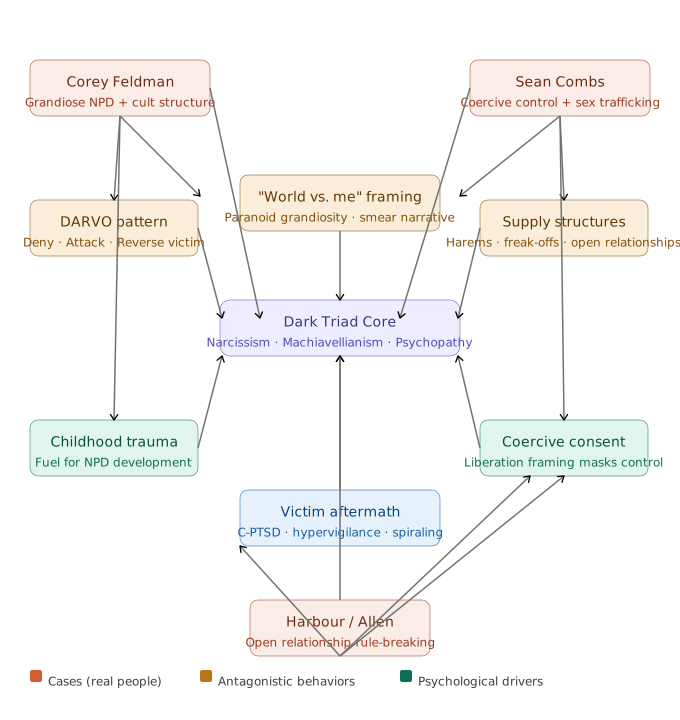
Three stories broke through the cultural noise in the past six months: a documentary about a former child star, a landmark sex trafficking verdict, and one of the messiest celebrity divorces in recent memory. On the surface they look like separate tabloid events. But when you run them through a clinical lens, the same behavioral architecture appears in each one — just dressed in different costumes. This piece maps those correlations. Not to diagnose anyone. Not to prosecute anyone. But because understanding the patterns is exactly how people stop walking into them.
Can Narcissists Use Open Relationships as Abuse?
Most conversations about open relationships center on ethics and communication. What almost never gets discussed is how the same structure can function as a narcissistic architecture — one designed not to liberate both people, but to formalize access to multiple supply sources while binding the primary partner with the language of consent.
The rule the Harbour/Allen open arrangement reportedly contained was that outside encounters had to be with strangers. Harbour allegedly broke that rule by pursuing someone he knew — a costume designer on his own production. The violation wasn’t just infidelity. It was the specific kind of infidelity the rules were designed to prevent: intimacy, not transaction.
This is the diagnostic tell. In ethical non-monogamy, both partners hold equal standing to modify or exit the arrangement. In narcissistic non-monogamy, the framework is proposed by one person because it normalizes exactly what they were already inclined to do — and then gets used as leverage: you agreed to this. When the partner raises a boundary violation, the narcissist pivots to the agreement itself as the defense.
Feldman’s “Corey’s Angels” is the same pattern at higher intensity — a structured arrangement sold as opportunity, rescue, and artistic development, that required women to follow personal rules he set while retaining total discretion for himself.
What Is Coercive Control — and Why Doesn’t It Look Like Abuse?
Every single one of these situations involved a vocabulary of freedom papering over a reality of control. Feldman described his Angels as “lost women” he was trying to help. Combs’s defense framed the freak-offs as consensual lifestyle choices. Harbour and Allen operated inside a mutually agreed framework that should have equalized risk.
The problem with coercive control is that it doesn’t announce itself. It works precisely because it looks like something else — mentorship, a progressive relationship model, a power couple’s arrangement. The clinical research on coercive control consistently shows that sustained manipulation, financial dependency, career leverage, and grooming distort the agency of the person being controlled — to the point where their active participation looks, from the outside, like consent.
Clinical note: Research on coercive control and the sunk-cost fallacy demonstrates that people subjected to ongoing manipulation continue in harmful situations long past the point they would have otherwise exited — not because they want to, but because so much is already at stake. Active participation in a harmful dynamic is not evidence of consent. It is often evidence of how thoroughly the dynamic has worked.
Cassie Ventura’s victim impact statement — describing a constant state of hypervigilance, anticipating demands, fearing retribution for any perceived slight — is a clinically precise description of what sustained narcissistic coercion does to a nervous system. This isn’t hyperbole. It is how trauma actually presents.
Does Childhood Trauma Cause Narcissistic Personality Patterns?
The Feldman documentary is particularly instructive here. Critics, audiences, and reviewers alike noted that understanding his traumatic childhood explains a great deal about who he became — and then immediately watched him recreate those dynamics with the women in his orbit. Understanding is not exoneration. The origin story is important. It is not the whole story.
What the clinical literature on narcissistic personality development consistently shows is that early attachment disruption — whether through abuse, neglect, emotional enmeshment, or boundary violations — can produce a psychological adaptation that prioritizes control, self-protection, and dominance as survival strategies. In children, those strategies make sense. In adults with power over other people, they become the mechanism of harm.
The trap for victims — and for audiences — is that the origin story creates sympathy that delays accountability. Understanding why someone is the way they are feels like it should precede judgment. In practice, it often replaces it. The two things can be held simultaneously: comprehension of the cause, and refusal to excuse the effect.
What Is DARVO? The Narcissistic Defense Pattern Explained
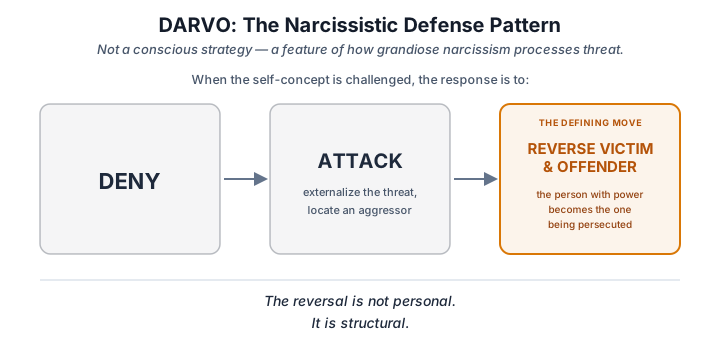
DARVO — Deny, Attack, Reverse Victim and Offender — is not a strategy these individuals consciously selected. It is a feature of how grandiose narcissism processes threat. When the self-concept is challenged, the response is to externalize the threat, locate an aggressor, and reframe the situation so that the person with power becomes the one being persecuted.
In practice, across these three cases:
Feldman filed a cease-and-desist against his own documentary. The director noted that he applied the same reflexive suspicion — the flattening of nuance, the insistence that anything complicated must be an attack — to her that he applied to everyone who challenged him throughout the film.
Combs’s legal team accused federal prosecutors of orchestrating a media smear campaign to undermine a fair trial — framing a federal investigation as a conspiracy against a powerful Black man, which conflated legitimate accountability with racial persecution in a way that muddied both issues simultaneously.
Harbour’s defense described hotel surveillance footage showing him physically assaulting Cassie Ventura as evidence of “a ten-year loving relationship” that broke down due to her jealousy over his infidelity. The judge’s response — “What’s love got to do with that?” — was about as precise a reframe as a courtroom has produced in recent memory.
Clinical note: Research confirms that narcissism is associated with significantly greater anger when recalling relationship threats, and with greater expressed negativity toward partners in those contexts. The DARVO response is not calculated — it is how the narcissistic ego protects itself from a reality it cannot integrate. This is important for victims to understand: the reversal is not personal. It is structural.
Narcissistic Paranoia: Why the Abuser Always Sees Himself as the Victim
The title of the Feldman documentary is almost a diagnostic instrument. He genuinely believes this. The Dark Media. The Corrupt Bus Company. Marilyn Manson sending saboteurs. Two giant monster trucks trying to run him down in the street. These aren’t rhetorical flourishes — they’re the actual worldview he operates inside, in real time, on camera.
This is paranoid ideation as a feature of vulnerable narcissism. The grandiose self-concept requires an explanation for every failure, every consequence, every embarrassment — and that explanation must be external. If the show fails, it’s sabotage. If the documentary portrays him unfavorably, it’s manipulation. If people stop supporting him, they’ve been turned against him. Accountability is structurally impossible in this frame because no negative outcome can originate with the self.
This pattern appears across all three cases, though at different magnitudes: Combs accusing prosecutors of orchestrating a smear campaign, Harbour’s team inverting victim and aggressor, and Feldman’s ongoing war with every institution that does not affirm his narrative.
What Does Narcissistic Abuse Aftermath Look Like? C-PTSD, Hypervigilance, and Spiraling
This is the through-line that should concern anyone working in behavioral health. The victim presentations across all three cases are remarkably uniform — not because the victims are performing distress, but because prolonged narcissistic abuse produces a specific cluster of symptoms that the research literature recognizes clearly.
Lily Allen — spiraling, treatment facility, shadow work, inner child therapy, inability to sustain interest in normal life. Her own words: “The feelings of despair were so strong. The last time I felt anything like that, drugs and alcohol were my way out, so it was excruciating to sit with those feelings and not use them.”
Cassie Ventura — chronic C-PTSD, panic attacks in public spaces she used to love, hypervigilance, dissociation, self-doubt, a fragmented professional record, crippling debt from medical costs, fear of retribution so significant she relocated her family.
Former Corey’s Angel Jezebel Sweet — publicly stated she believed her former employer would “literally murder me with drugs.” That level of stated fear from someone describing a music career arrangement is not normal. It is the language of someone who has been inside coercive control.
The Echo and Narcissus dynamic runs through all three. One person disappears into orbit around the other — not because they wanted to, but because the gravitational pull was engineered to be inescapable. The exit costs — financial, social, professional, psychological — were prohibitive by design.
What Is the Dark Triad? Narcissism, Machiavellianism, and Psychopathy in Relationships
The clinical literature now clearly distinguishes between grandiose narcissism — high self-esteem facade, charming, dominance-oriented — and antagonistic narcissism — exploitative, combative, zero-sum. The research finding that matters most for understanding these cases is this: the positive, self-enhancement aspects of narcissism can produce neutral or even positive social outcomes, while the antagonistic components consistently produce negative ones.
All three of these men exhibit primarily antagonistic patterns. The world exists to be navigated and dominated, not shared. Partners exist as resources to be managed, not people to be known. Rules are provisional — applicable to others, negotiable for the self. This is the full Dark Triad stack operating: narcissism providing the entitlement structure, Machiavellianism providing the strategic manipulation, and psychopathy providing the emotional blunting that allows sustained harm without conscience activation.
What makes this culturally significant right now is that all three cases went public within the same twelve-month window — and in each one, substantial portions of the audience defaulted to defending the powerful person. The Combs verdict produced people in the streets joking about baby oil. The Feldman documentary has viewers rooting for him despite watching him harm people in real time. The Allen album triggered calls to boycott Harbour’s show — but also extensive public debate about whether Allen “agreed to the arrangement” and therefore forfeited the right to feel betrayed.
These responses are not random. They are what happens when a culture has not built adequate frameworks for understanding how coercive consent, supply structures, and antagonistic personality styles actually operate. The work of explaining those frameworks — clearly, without clinical distance, in language people actually use — is exactly what mental health professionals need to be doing right now.
Pattern recognition is a clinical skill. It is also a survival skill. The people in these stories did not walk into obvious situations. They walked into structures that were carefully designed to look like opportunity, love, or freedom — until they didn’t. The distance between those two states is where the education lives.
Book a free consultation today and let’s talk about what you’re facing and how we can work together.
Your mental wealth matters. Let’s build it together.
Professional Disclaimer: This post contains educational reflections on observable behavioral patterns as reported in public media. It is not intended to diagnose, evaluate, or characterize the mental health, personality structure, motivations, or intent of any named or unnamed individual. Although the author is a licensed clinical social worker, this content is not clinical work, therapy, assessment, or professional opinion, and no therapeutic relationship is created or implied.
If this named something you're living with —
You don't have to figure it out from articles. Matthew Sexton, LCSW, NATC sees adults in therapy at his separate private practice (telehealth · NY · ME · DE · FL). Or take this piece to your own therapist — it's written to be shared.
Visit the practice