Mental wealth is psychological capacity you build on purpose: emotional regulation, self-knowledge, stable self-worth, and the skills that carry you through hard seasons. The name treats your inner life like an asset. Assets grow when you invest in them, and they keep paying you back. The gap this idea points at is well documented. When sociologist Corey Keyes first measured complete mental health, only 17.2% of U.S. adults met the criteria for flourishing, per his 2002 study in the Journal of Health and Social Behavior. Most adults landed in the middle: no diagnosis, and a long way from thriving.
The middle zone
Keyes studied 3,032 American adults, ages 25 to 74, and sorted them along a continuum. At one end sat flourishing: feeling good about your life and functioning well in it. At the other end sat languishing: no mental illness on paper, but emptiness, stagnation, running on fumes. His numbers tell the story. 17.2% of adults were flourishing. 56.6% were moderately mentally healthy. 12.1% were languishing. 14.1% met the criteria for a major depressive episode.
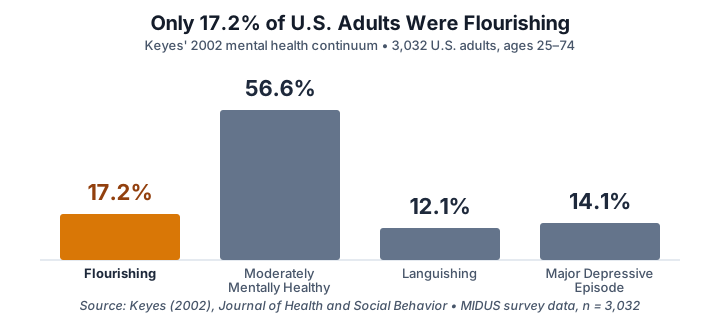
Look at that middle number. More than half of adults were getting by. They carried no diagnosis, and no one would have called them well. The health care system has almost nothing to offer this group, because the system is organized around illness. A diagnosis comes with a treatment path, a billing code, and, in theory, an insurance benefit. Languishing comes with nothing. Nobody bills for “fine, I guess.”
The middle zone carries real risk. In the same study, languishing adults were nearly six times more likely to have a major depressive episode than flourishing adults. Getting by is a slow leak. And the zone has gotten more crowded since: anxiety and depression rose 25% worldwide in the first year of the COVID-19 pandemic, per the World Health Organization (2022).
A definition you can use
Mental wealth is the deliberate accumulation of psychological assets. Resilience. Emotional intelligence. Relational clarity. Self-awareness that holds up under stress. Each one is a capacity you can name, practice, and watch grow.
These capacities sound abstract until you watch them operate. A person with relational clarity does not spend years in a dynamic that drains them. A person with real self-awareness makes career decisions from alignment rather than anxiety. A person who can regulate under pressure thinks clearly in exactly the moments most people cannot.
The word “wealth” is doing specific work here. Wealth compounds. A skill you build for one problem shows up for the next one, and the one after that. Learn to regulate your nervous system during a divorce, and that skill is still there for the job loss, the diagnosis, the hard conversation with your kid. The crisis passes. The capacity stays. And nobody can repossess it.
A mood can change by dinner. Optimism is a temperament. Mental wealth is a set of internal resources that make you more capable, more adaptive, and more honest over time. It can coexist with grief, with stress, and with a genuinely bad year. That is part of the point.
What the assets look like in a person
You cannot see someone’s bank balance by looking at them. Mental wealth is more visible. A person building it:
- Sits with uncertainty without manufacturing false certainty.
- Receives feedback without spiraling into shame or counterattack.
- Holds a boundary without guilt, and offers empathy without disappearing into someone else’s needs.
- Can tell the difference between what they feel and what is true.
- Takes real risks, because they trust their own ability to recover.
None of that requires perfection. Every item on the list is trainable, and capacity grows when you work it, the same way strength does.
How mental wealth gets built
Mental wealth is built in reps. Naming a feeling accurately, today, while it is happening. Making one decision from your values instead of your fear. Telling the truth in a relationship where you usually manage impressions. Checking whether any of this is actually changing, with something better than a hunch.
In my clinical work I organize those reps with a framework I developed called R.A.V.E.S. Five domains, each one measurable:
- Recognition: identifying what you are feeling, thinking, and experiencing in real time, rather than three days later.
- Alignment: closing the distance between your actual values and how you live.
- Value: self-worth that stays stable without a constant drip of outside approval.
- Evidence: concrete, observable proof that change is happening, defined and tracked on purpose.
- Sovereignty: the ability to run your own life from agency, asking for help without needing rescue.
The full definition of each domain lives at the R.A.V.E.S. framework page.
Where therapy fits
Therapy earned its reputation in crisis, and crisis work matters. Stabilization saves lives. Across thirteen years of practice, from acute psychiatric crisis work to coaching rooms, I watched the same pattern: most people reach “stable” and stop. The symptoms ease, insurance stops paying, everyone moves on. Stable becomes the ceiling.
Stable is a floor. It is the foundation you build on, and the building is where life actually gets better. The mental health system, as designed, measures success by the absence of pathology: lower symptom scores, fewer panic attacks, no more crisis calls. Those outcomes matter, and they stop short. There is no billing code for “could be building more.”
That gap is the reason this practice carries the name it does. Mental wealth is the work that starts where symptom relief ends.
FAQ
What is the difference between mental health and mental wealth?
Mental health care, as the system delivers it, mostly treats illness: diagnose, stabilize, discharge. Mental wealth is what you build on top of stability — skills, self-knowledge, and durable self-worth that keep compounding after the symptoms are gone. The first restores your baseline. The second raises it.
Is mental wealth a clinical term?
No. You will not find it in the DSM. The closest research concept is flourishing, which Corey Keyes defined and measured in 2002 as the combination of feeling good about your life and functioning well in it. Mental wealth is the working frame I use in practice for the same territory — deliberately building the capacities that flourishing is made of.
Can you build mental wealth without therapy?
Yes. Therapy is one structured way to build it, with a trained person and a feedback loop. People also build these capacities through honest relationships, disciplined reflection, mentorship, and practice under real stress. The ingredient that stays constant is deliberateness. Capacity grows when you train it on purpose.
Sources
- Keyes, C. L. M. (2002). “The Mental Health Continuum: From Languishing to Flourishing in Life.” Journal of Health and Social Behavior. Supports: 17.2% flourishing, 56.6% moderately mentally healthy, 12.1% languishing, and 14.1% major-depressive-episode prevalence (1995 MIDUS data, n = 3,032, adults ages 25–74), and the finding that languishing adults were nearly six times more likely to have a major depressive episode than flourishing adults. https://pubmed.ncbi.nlm.nih.gov/12096700/
- World Health Organization (March 2, 2022). “COVID-19 pandemic triggers 25% increase in prevalence of anxiety and depression worldwide.” Supports: the 25% rise in anxiety and depression in the first pandemic year. https://www.who.int/news/item/02-03-2022-covid-19-pandemic-triggers-25-increase-in-prevalence-of-anxiety-and-depression-worldwide
Figures current as of July 2026.
Disclaimer
This article is for educational and informational purposes only. It does not constitute medical, clinical, legal, or therapeutic advice, and reading it does not create a therapist-client relationship with Matthew Sexton, LCSW or Mental Wealth Solutions, Inc. Although the author is a licensed clinical social worker, the content in this article is not clinical assessment, diagnosis, or treatment.
The patterns, concepts, and frameworks described here reflect published research and general clinical observations. Individual experiences vary, and what is described here may not match every reader’s situation. If you are working through the concerns described in this article, please consult a licensed mental health professional who can assess your specific circumstances.
If you are in immediate emotional crisis, you can reach the 988 Suicide & Crisis Lifeline by calling or texting 988 (US). If you are experiencing domestic violence or are in physical danger, contact the National Domestic Violence Hotline at 1-800-799-7233 or visit thehotline.org. In a life-threatening emergency, call 911.
Frequently asked questions.
- What is the difference between mental health and mental wealth?
- Mental health care, as the system delivers it, mostly treats illness: diagnose, stabilize, discharge. Mental wealth is what you build on top of stability: skills, self-knowledge, and durable self-worth that keep compounding after the symptoms are gone. The first restores your baseline. The second raises it.
- Is mental wealth a clinical term?
- No. You will not find it in the DSM. The closest research concept is flourishing, which sociologist Corey Keyes defined and measured in 2002 as the combination of feeling good about your life and functioning well in it. Mental wealth is the working frame the author uses in practice for the same territory: deliberately building the capacities that flourishing is made of.
- Can you build mental wealth without therapy?
- Yes. Therapy is one structured way to build it, with a trained person and a feedback loop. People also build these capacities through honest relationships, disciplined reflection, mentorship, and practice under real stress. The ingredient that stays constant is deliberateness. Capacity grows when you train it on purpose.
If this named something you're living with —
You don't have to figure it out from articles. Matthew Sexton, LCSW, NATC sees adults in therapy at his separate private practice (telehealth · NY · ME · DE · FL). Or take this piece to your own therapist — it's written to be shared.
Visit the practice