Survivors of narcissistic abuse often describe the same moment in almost identical language: a split-second during a confrontation when the partner’s face goes blank, the eyes go flat, and something that looks like a mask briefly slips. People call it “narc face.” It is usually followed within a second or two by a performance reset — a new expression, a new tone, a new story. What survivors are describing is consistent with the clinical literature on affective empathy deficits in narcissistic and antisocial traits: cognitive empathy intact, emotional empathy thinned or absent, and a visible gap between the two when the performance briefly fails. That gap is disturbing precisely because it confirms what survivors spent years gaslighting themselves out of knowing.
What Is “Narc Face” and What Do Survivors Actually Report Seeing?
“Narc face” is vernacular, not a clinical term. Survivors of narcissistic abuse developed it to describe a repeatable visual experience standard clinical vocabulary does not capture well. The core phenomenon is a micro-expression — a brief facial shift, lasting a fraction of a second to a few seconds, that occurs most often during confrontation, discovery, or any moment when the partner’s preferred narrative is suddenly threatened.
What survivors consistently report seeing:
- A momentary blankness, often described as “dead eyes” or “the lights going out”
- A brief pause that feels calculating rather than confused — a sense of the other person scanning rather than reacting
- An absence of the small reflexive movements that normally accompany surprise, concern, or guilt
- A look frequently described as “predatory,” “reptilian,” or “a stranger wearing my partner’s face”
- A rapid shift into a new expression that seems chosen rather than felt — tears, indignation, or concern that arrives a beat late and looks rehearsed
The look is not theatrical. It is the opposite of theatrical. It is what happens in the narrow window before the performance restarts — the interval in which the mask is off and nothing has replaced it yet. That is why survivors describe it as disturbing in a way that shouting or crying is not. It is not a big emotional display. It is the absence of one.
Why Is That Moment So Disturbing?
The usual explanation survivors offer is that the look “confirmed something I already knew but didn’t want to know.” That intuition is clinically coherent. Long-term partners of narcissistic individuals have accumulated years of small inconsistencies — moments when stated feelings did not match behavior, when comfort arrived on a delay, when the eyes did not quite join the smile. The conscious mind often explains these away. The nervous system does not.
When the narc-face moment happens, it is the first time visual evidence lines up cleanly with the pattern the body has been tracking. The face the survivor had been working hard to perceive as loving briefly drops, and the underlying affect (or lack of it) becomes visible. The disturbance is not about one expression. It is about what that expression implies about the entire relationship: the possibility that the warmth, the concern, the repair attempts, the apologies, and the “I love yous” were performed rather than felt.
That is an enormous reframe, and the nervous system knows it before the conscious mind does. Survivors often report feeling nauseated, dizzy, or suddenly cold in the moment. Those are autonomic responses, not intellectual ones. The body is registering what Judith Herman (1992) described as the moment of unmistakable revelation in complex trauma — the point at which the protective dissociation that allowed the relationship to continue can no longer be maintained against the incoming evidence.
What Does the Clinical Literature Say About Empathy in Narcissism and Antisocial Traits?
The clinical research on empathy makes a distinction that survivor accounts map onto almost perfectly: the difference between cognitive empathy and affective empathy. Simon Baron-Cohen has been one of the most careful chroniclers of this distinction, particularly in The Science of Evil (Baron-Cohen, 2011), where he separates the cognitive “recognition” component of empathy — the ability to identify what another person is feeling — from the affective “resonance” component — the ability to actually feel something in response to another person’s feeling.
In narcissistic, psychopathic, and callous-unemotional presentations, the research generally shows a characteristic pattern:
- Cognitive empathy is often preserved, sometimes even sharpened. The person can accurately read others’ emotional states, sometimes with unusual speed and precision. This is what survivors describe when they say their partner “always knew exactly what to say.”
- Affective empathy is selectively attenuated. The resonance response — the involuntary felt sense of another person’s pain or joy — is muted, inconsistent, or activated only under specific conditions.
- The gap between the two systems is measurable. Studies using both behavioral and neuroimaging methods consistently find that individuals high in psychopathic traits can identify others’ distress but do not show the typical neural signatures of feeling it (Decety, Chen, Harenski, & Kiehl, 2013).
Decety and colleagues, in neuroimaging work on incarcerated individuals high in psychopathic traits (Decety, Skelly, & Kiehl, 2013; Decety, Chen, Harenski, & Kiehl, 2013), found reduced activation in regions associated with affective resonance — including the anterior insula and anterior midcingulate cortex — when participants viewed others in pain. The cognitive recognition network remained active. The resonance network did not respond the way it does in neurotypical samples. That is a neurobiological correlate of exactly what survivors describe: a partner who could name the feeling but did not share it.
Abigail Marsh’s work, including The Fear Factor (Marsh, 2017), makes a further useful point: affective empathy is not a monolith. The capacity to resonate with another person’s distress has specific neural correlates and real variability across individuals. The thinness of affective empathy in callous-unemotional presentations is not a moral failing the person is choosing — it is, in many cases, a real difference in how the emotion-processing system responds to others’ pain. That difference is clinically relevant because it means a partner cannot be loved, argued, or therapized into feeling what they do not feel. The resonance is not being withheld. It is not being generated.
The same literature does not say these individuals are incapable of performing empathy. They are often exceptionally good at it. Paulhus and Williams’s foundational work on the “dark triad” of narcissism, Machiavellianism, and psychopathy (Paulhus & Williams, 2002) documents individuals who are socially skilled, verbally adept, and capable of producing empathic-looking behavior in the absence of the underlying felt state. That is what the narc-face moment interrupts. When the performance momentarily pauses, what is revealed is the gap between the cognitive-empathy system, which is active, and the affective-empathy system, which is not.
Why Do Survivors Gaslight Themselves Out of Trusting What They Saw?
Seeing the look and believing the look are two different things. Survivors very often report that within minutes of witnessing narc face, they begin talking themselves out of it. Common internal scripts include: “I was tired and imagining things.” “I was being paranoid.” “Their face was just weird in that light.” “I saw what I wanted to see because I was angry.” “I’m being unfair.” The gaslighting in these moments is not coming from the partner. It is coming from the survivor, applied to themselves.
There are several reasons this happens, and most of them are protective rather than pathological:
- Dissonance avoidance. Accepting what the look implies means accepting that the relationship may have been fundamentally different from what the survivor believed. That reality is large enough to destabilize daily functioning, and the psyche will often reject it reflexively.
- Prior conditioning. Survivors of narcissistic abuse have typically been conditioned through repeated gaslighting to distrust their own perceptions (Stark, 2007). When a partner has spent years saying “you’re imagining things,” the survivor internalizes the rule.
- Fear of being wrong publicly. Many survivors fear that if they act on what they saw, they will be told they are overreacting. The social cost of being wrong about a loved one’s character feels higher than the personal cost of staying confused.
- Freeze physiology. The body’s response to witnessing narc face is frequently a freeze response: immobility, numbness, emotional blunting, a sense of watching from outside the body. Stephen Porges’s polyvagal framework (Porges, 2011) explains why: when the nervous system registers inescapable threat from a person who is also supposed to be a source of safety, dorsal vagal shutdown is one of the available responses. The S.T.O.I.C.K. method is one framework for working with that freeze response when it arises — naming the body state, slowing down, and refusing to force a decision while the nervous system is still offline.
The self-gaslighting is not weakness. It is a predictable combination of dissonance, prior conditioning, social cost, and autonomic state. Understanding that is often the first step in learning to trust what was seen.
What Does the Literature on Affective Empathy Imply for Recovery?
Once the gap between cognitive and affective empathy is named, several things about the relationship start to make sense that did not make sense before. A partner who always knew what to say but never seemed to feel what was said; who produced the right apology at the right moment but did not seem changed by the conflict; who could read a room perfectly but was cruel to the person in it — this is what a selectively attenuated affective-empathy system looks like over time in an intimate relationship.
This reframe matters in recovery because it relocates the problem. Most survivors spend years asking themselves what they did wrong, whether they loved hard enough, whether they asked for too much. The literature on affective empathy suggests a different question. If one partner cannot reliably generate the felt response of resonance with the other’s pain, no amount of clarity, effort, or love from the other partner can compensate. The issue is not how much warmth the survivor produced. The issue is what the other person’s system could do with it.
That is not a judgment of the other person’s worth. It is a clinical observation about what recovery requires the survivor to accept. Once accepted, it makes recovery moves possible that were impossible while the survivor was still looking for the missing piece inside themselves.
Frameworks like R.A.V.E.S. exist because recovery from this kind of relationship is a nervous system project, not a willpower project. Trusting your own perception is not a philosophical stance. It is a physiological practice: noticing what the body registered, naming it, and refusing to override the data with the story the mind would prefer.
What Should a Survivor Do When They See It?
The honest clinical answer is that the moment the look happens is usually not the moment to make a large decision. The nervous system is in freeze. Cognitive resources are reduced. Anything said or done in that moment may be used against the survivor later. The work in the moment is physiological, not strategic.
In the minutes and hours after, a few practices are worth keeping in mind:
- Write down exactly what you saw. Not interpretation. Description. “The corners of the mouth stopped moving. The eyes did not follow the change in tone. Two seconds passed before the new expression started.” The goal is a record that resists later rewriting.
- Do not relitigate it in the moment. Narcissistic partners are highly skilled at reframing confrontations, and a survivor in freeze is not equipped to win that conversation.
- Protect the perception. The instinct to explain the look away is strong. Treat that instinct as a symptom, not as wisdom. The data is what you saw.
- Tell one person. Not to build a case, but to anchor the memory outside your own head. A therapist, a trusted friend, or a journal is enough.
- Let the body recover before the mind decides. Decisions made in dorsal vagal shutdown are rarely the decisions a regulated nervous system would make. Sleep, food, movement, distance first. Strategy second.
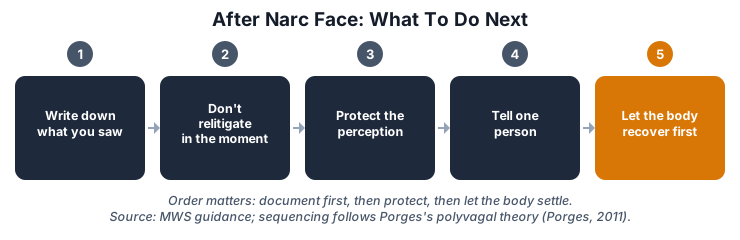
This is not a strategy for confronting a narcissistic partner. It is a strategy for trusting yourself.
Frequently Asked Questions
Is “narc face” a real clinical phenomenon or just something survivors say? “Narc face” is vernacular, not a formal diagnostic term. What survivors describe, though — a momentary mismatch between cognitive empathy and affective empathy that becomes visible when a narcissistic partner’s performance briefly fails — is consistent with the clinical literature on empathy deficits in narcissistic and antisocial presentations. The phenomenon is real even if the label is informal.
Does seeing narc face once mean my partner is a narcissist? No. Human faces do strange things under stress, and a single odd expression is not a diagnosis. What matters clinically is the pattern: repeated experiences of the same mismatch, across time and across situations, alongside other features of narcissistic dynamics. If you have seen something that disturbed you, the honest answer is to treat it as data and watch the pattern, not as a verdict.
Why can’t I trust what I saw, even when I know the relationship was harmful? Because you were conditioned to distrust your own perceptions. Chronic gaslighting (Stark, 2007) trains the nervous system to default to self-doubt whenever a perception contradicts the relationship narrative. Learning to trust your own perception again is one of the core recovery tasks, and it happens slowly, through repeated practice of naming what you saw and refusing to override it.
Is my partner capable of love if they can mimic empathy but not feel it? The literature does not fully answer this, and honest clinicians disagree. What the research does suggest is that cognitive empathy without affective empathy produces a specific kind of relationship — one in which warmth is accurately performed but not reliably felt, and in which the partner is treated as an object of the performance rather than a subject of the resonance. Whether to call that “love” is a philosophical question. Whether it is safe to build a life around it is a clinical one.
Can a narcissistic partner change if they have an affective empathy deficit? Change is difficult, not impossible, and usually requires long-term specialized treatment combined with the partner’s own genuine motivation. It is not something a non-clinical partner can produce through love, effort, or clarity. Hoping a partner will develop affective empathy because they are loved hard enough is, in most cases, a recipe for further injury to the person doing the loving.
A Note on Recovery
The narc-face moment is disturbing because it is clarifying. What survivors are seeing in that split second is not a trick of the light and not a projection of their own anger. It is the brief visibility of a gap that the relationship had been designed to keep invisible. Recovering from that moment is not about deciding whether the partner is “really” a narcissist. It is about learning, slowly, to trust that your own nervous system has been collecting accurate data the whole time — and to act on that data in settings where you are safe enough to act.
If you want to do this work with someone who treats what you saw as physiology and pattern rather than weakness or paranoia, book a free consultation.
Matthew Sexton, LCSW is a licensed clinical social worker with over a decade of experience treating survivors of narcissistic abuse and complex trauma. He has directed clinical programs across thirteen settings, including substance abuse treatment, forensic assertive community treatment, and disaster case management. He founded Mental Wealth Solutions to help survivors rebuild their nervous system, reclaim their sovereignty, and do the real work of recovery in a setting that respects the physiological reality of what they have been through.
Disclaimer
This article is for educational and informational purposes only. It does not constitute medical, clinical, legal, or therapeutic advice, and reading it does not create a therapist-client relationship with Matthew Sexton, LCSW or Mental Wealth Solutions, Inc.. Although the author is a licensed clinical social worker, the content in this article is not clinical assessment, diagnosis, or treatment.
The patterns, concepts, and recovery frameworks described here reflect clinical research and general observations across trauma recovery work. Individual experiences vary, and what is described here may not match every reader’s situation. If you are working through narcissistic abuse, complex trauma, or a trauma bond, please consult a licensed mental health professional who can assess your specific circumstances.
If you are in immediate emotional crisis, you can reach the 988 Suicide & Crisis Lifeline by calling or texting 988 (US). If you are experiencing domestic violence or are in physical danger, contact the National Domestic Violence Hotline at 1-800-799-7233 or visit thehotline.org. In a life-threatening emergency, call 911.
References
Baron-Cohen, S. (2011). The Science of Evil: On Empathy and the Origins of Cruelty. Basic Books.
Decety, J., Chen, C., Harenski, C., & Kiehl, K. A. (2013). An fMRI study of affective perspective taking in individuals with psychopathy: Imagining another in pain does not evoke empathy. Frontiers in Human Neuroscience, 7, 489.
Decety, J., Skelly, L. R., & Kiehl, K. A. (2013). Brain response to empathy-eliciting scenarios involving pain in incarcerated individuals with psychopathy. JAMA Psychiatry, 70(6), 638–645.
Herman, J. L. (1992). Trauma and Recovery: The Aftermath of Violence. Basic Books.
Marsh, A. A. (2017). The Fear Factor: How One Emotion Connects Altruists, Psychopaths, and Everyone In-Between. Basic Books.
Paulhus, D. L., & Williams, K. M. (2002). The dark triad of personality: Narcissism, Machiavellianism, and psychopathy. Journal of Research in Personality, 36(6), 556–563.
Porges, S. W. (2011). The Polyvagal Theory: Neurophysiological Foundations of Emotions, Attachment, Communication, and Self-Regulation. W. W. Norton.
Stark, E. (2007). Coercive Control: How Men Entrap Women in Personal Life. Oxford University Press.
If this named something you're living with —
You don't have to figure it out from articles. Matthew Sexton, LCSW, NATC sees adults in therapy at his separate private practice (telehealth · NY · ME · DE · FL). Or take this piece to your own therapist — it's written to be shared.
Visit the practice