A therapist treats, a coach trains, and a consultant advises, and only the first one needs a license to do the job. The coaching industry counted 109,200 practitioners worldwide in 2022, a 54% increase in three years, according to the International Coaching Federation’s 2023 Global Coaching Study. Over that same stretch, the number of U.S. states requiring a license to practice coaching held steady at zero. These are three genuinely different professions that get confused daily, sometimes expensively. Here is the honest map.
Therapist, coach, or consultant: three jobs, one conversation-shaped container
All three happen in a room, or a video call, where you talk to someone about your situation. The resemblance ends there.
A therapist works on your mental health: diagnosable conditions, symptoms, history, patterns, the nervous system carrying all of it. A coach works on your performance toward a goal: structure, accountability, skills, momentum. A consultant works on the problem itself: your business, your hiring plan, your career materials, delivered as analysis and recommendations.
Different jobs, different protections, different failure modes. The protections are where the differences get concrete.
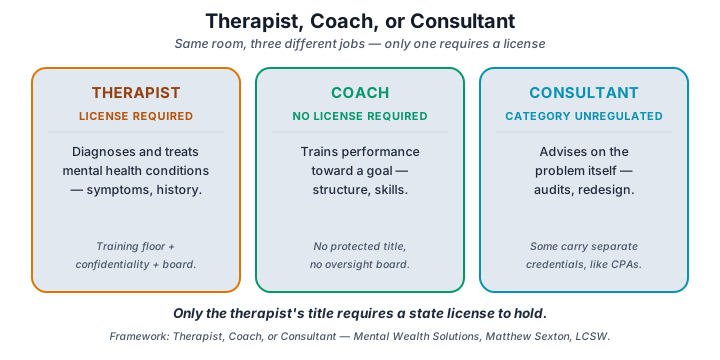
What stands behind a therapist
The license, and everything it took to get one. To practice psychotherapy legally you need a state license, and the price of entry is steep. Take clinical social work in New York as one example, since that is my own lane: a master’s degree of at least 60 semester hours including 12 hours of clinical coursework, then at least three years of supervised post-degree practice in diagnosis and psychotherapy, including 2,000 client-contact hours and at least 100 hours of clinical supervision, then a national board exam, per the New York State Education Department. Psychologists, mental health counselors, and marriage and family therapists walk equivalent gauntlets in their own professions.
That license buys you three protections as a client. Training floors: the person demonstrated minimum competence to a state board before ever charging you. Legal confidentiality: what you say in therapy is protected by law, with narrow exceptions your therapist is required to explain. Accountability: if a therapist harms you, a board exists to take your complaint and, if warranted, the license. The last one is quietly the most important. The threat of losing a license is what keeps the other two protections real.
Therapists are also the only ones of the three who can diagnose and treat mental health conditions. Anxiety, depression, trauma, ADHD, grief that will not move. If the problem has a diagnosis attached, a history underneath it, or symptoms that follow you between contexts, this is the room built for it.
What stands behind a coach
Demand, mostly, and the demand is real. The same ICF study put global coaching revenue at $4.564 billion for 2022, up 60% from its prior study. People pay because a good coach delivers something therapy never promised: sustained, scheduled pressure toward a specific goal, from a person whose entire attention is on your execution.
Here is the factual part, stated plainly. No U.S. state licenses coaches. There is no protected title, no required training, no oversight board, and no legal confidentiality privilege covering what you tell them. Certifications exist, including the ICF’s own credential ladder, but every one of them is voluntary. The title “coach” is legally available to a veteran with thousands of client hours and to someone who finished a weekend webinar, and the word itself will not tell you which one you booked.
None of this means coaches are bad at their jobs. Many are excellent, and coaching is the right tool for a real class of problems. It means the vetting is your job, because no state did it for you.
What stands behind a consultant
A track record, if you check it. Consulting as a category is also unregulated, though some consultants carry separately licensed credentials, like CPAs. The difference from coaching is the object of the work. A consultant works on the problem rather than on you: they audit the books, redesign the org chart, fix the hiring funnel, rebuild the resume. You are buying expertise about a thing, and the thing is usually inspectable afterward, which is its own form of accountability.
That difference shapes the risk. Bad consulting shows up in the output, where you can see it and dispute it. Bad coaching, or unlicensed therapy wearing a coaching label, shows up in you, which is harder to audit and more expensive to repair.
Where the lines actually blur
The risk zone sits on the border between coaching and therapy, and it is not hypothetical. A 2024 investigation by ProPublica and The Salt Lake Tribune found that at least 43 Utah mental health professionals had surrendered or lost their licenses since 2010, and roughly a third of them kept working in adjacent roles, including as life coaches. Utah’s licensing division had cited exactly four life coaches for unauthorized practice in a decade. The license is the accountability mechanism, and “coach” is the title that remains available after the license is gone.
You do not need a scandal to reach the blurry border, though. Plenty of well-meaning coaches drift into treatment territory: “anxiety coaching,” “trauma work,” processing your childhood inside a goal-setting session. The line is simple to state. Helping a healthy person perform is coaching. Treating a condition is therapy, and treating one without a license is exactly what the licensing rules exist to prevent. A good coach knows where the line is and refers out when a client crosses it. Asking a prospective coach when they last referred someone to a therapist is a fair and revealing question.
How to choose
Start from the problem, and be honest about it.
Start with a therapist if symptoms are in the picture: two or more weeks of disrupted sleep, mood, appetite, or focus; a pattern that keeps repeating across jobs and relationships; anything involving trauma, panic, substances, or a past diagnosis. Also start here if you are unsure which you need. A licensed clinician is trained to tell the difference and can honestly say “you’re fine, go hire a coach.” The reverse referral requires training the coach may never have received.
Hire a coach if you are functioning well and want structure, accountability, and speed toward a named goal. Before paying, ask three things: what training they have and from whom, how many client hours they have logged, and what they do when a client shows up in crisis. Good coaches answer all three without flinching, and the third answer should include the word “refer.”
Hire a consultant if the problem would still exist with a different person in your chair. Pricing, positioning, org design, a job search that needs materials and strategy. Check references and past work the way you would with any vendor.
The combination is allowed, and common. Seeing a therapist while working with a coach can be a genuinely strong setup, since they are doing different jobs. Just make sure each knows the other exists, and route anything symptom-shaped to the licensed half of the team.
FAQ
Can a life coach treat anxiety or depression? No. Diagnosing and treating mental health conditions requires a state license in every U.S. state, and coaching carries no license. A coach can support goals and habits alongside treatment, and a good one refers clients to licensed clinicians the moment symptoms enter the picture.
Is coaching regulated at all? By states, no. There is no license, no protected title, and no oversight board. The industry self-regulates through voluntary credentials such as the International Coaching Federation’s, which some coaches hold and many do not. The screening a licensing board performs for therapists falls to you when you hire a coach.
Can I see a therapist and a coach at the same time? Yes, and the pairing often works well. The therapist treats what is underneath while the coach structures what is next. Tell each professional the other exists so the work does not pull in two directions, and route anything symptom-shaped to the licensed side of the pair.
Sources
- International Coaching Federation, 2023 Global Coaching Study, Executive Summary, 2023. https://coachingfederation.org/wp-content/uploads/2023/04/2023ICFGlobalCoachingStudy_ExecutiveSummary.pdf Supports: an estimated 109,200 coach practitioners worldwide in 2022, a 54% increase on the 2019 estimate; total annual industry revenue of $4.564 billion, a 60% increase since ICF’s prior study.
- ProPublica and The Salt Lake Tribune, “When Therapists Lose Their Licenses, Some Turn to the Unregulated Life Coaching Industry Instead,” June 17, 2024. https://www.propublica.org/article/utah-therapists-life-coaches-regulation Supports: at least 43 Utah mental health professionals surrendered or lost licenses since 2010, with roughly a third continuing in adjacent work including life coaching; four life coaches cited for unauthorized practice in a decade; coaching’s largely unregulated status.
- New York State Education Department, Office of the Professions, “LCSW License Requirements,” accessed July 2026. https://www.op.nysed.gov/professions/licensed-clinical-social-worker/license-requirements Supports: New York LCSW requirements of a 60-semester-hour MSW including 12 clinical semester hours, at least three years of supervised post-degree experience including 2,000 client-contact hours and 100 hours of clinical supervision, and the ASWB Clinical examination.
Figures current as of July 2026.
Disclaimer
This article is for educational and informational purposes only. It does not constitute medical, clinical, legal, or therapeutic advice, and reading it does not create a therapist-client relationship with Matthew Sexton, LCSW or Mental Wealth Solutions, Inc. Although the author is a licensed clinical social worker, the content in this article is not clinical assessment, diagnosis, or treatment.
The patterns, concepts, and frameworks described here reflect published research and general clinical observations. Individual experiences vary, and what is described here may not match every reader’s situation. If you are working through the concerns described in this article, please consult a licensed mental health professional who can assess your specific circumstances.
If you are in immediate emotional crisis, you can reach the 988 Suicide & Crisis Lifeline by calling or texting 988 (US). If you are experiencing domestic violence or are in physical danger, contact the National Domestic Violence Hotline at 1-800-799-7233 or visit thehotline.org. In a life-threatening emergency, call 911.
Frequently asked questions.
- Can a life coach treat anxiety or depression?
- No. Diagnosing and treating mental health conditions requires a state license in every U.S. state, and coaching carries no license. A coach can support goals and habits alongside treatment, and a good one refers clients to licensed clinicians the moment symptoms enter the picture.
- Is coaching regulated at all?
- By states, no. There is no license, no protected title, and no oversight board. The industry self-regulates through voluntary credentials such as the International Coaching Federation's, which some coaches hold and many do not. The screening a licensing board performs for therapists falls to you when you hire a coach.
- Can I see a therapist and a coach at the same time?
- Yes, and the pairing often works well. The therapist treats what is underneath while the coach structures what is next. Tell each professional the other exists so the work does not pull in two directions, and route anything symptom-shaped to the licensed side of the pair.
If this named something you're living with —
You don't have to figure it out from articles. Matthew Sexton, LCSW, NATC sees adults in therapy at his separate private practice (telehealth · NY · ME · DE · FL). Or take this piece to your own therapist — it's written to be shared.
Visit the practice