The narcissistic abuse cycle moves through predictable phases — idealization, devaluation, discard, hoovering, and eventual awakening — and each phase has its own clinical picture, felt sense, and neurochemistry. Lenore Walker’s (1979) cycle of violence first described the escalation-reconciliation-calm sequence in battered women, and later work on traumatic bonding (Dutton & Painter, 1993), complex trauma (Herman, 1992), and betrayal bonds (Carnes, 1997) explained why the cycle is so difficult to leave from the inside. Understanding the phases as a nervous system sequence, not a character defect, is the first turning point in recovery.
What Is the Narcissistic Abuse Cycle?
The narcissistic abuse cycle is the repeating pattern that structures many relationships with a person who uses narcissistic control strategies. It is not a one-off bad fight followed by a good week. It is a sequence — idealization, devaluation, discard, hoovering, and repeat — that tightens over time rather than resolving. Each cycle is shorter and more intense than the one before. Each reconciliation lands with more relief and more confusion. Each round makes leaving harder, not easier.
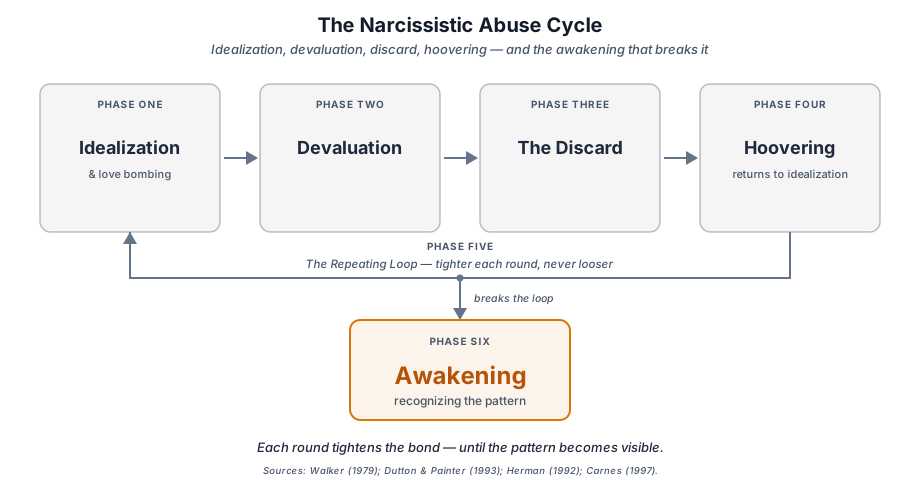
Walker’s (1979) original model, developed in The Battered Woman, described three phases in partner violence: tension building, acute incident, and loving contrition. Applied to narcissistic abuse, the phases do not all involve physical violence, but the underlying structure — rising tension, rupture, and reconciliation — is the same. Dutton and Painter (1993) extended Walker’s work by documenting how the alternation between harm and tenderness produces stronger attachment than consistent kindness, a phenomenon they called traumatic bonding. Herman (1992) framed the same dynamic as part of complex post-traumatic stress.
What matters clinically is that the cycle is not a series of disconnected events. It is a single physiological process with several faces. The body learns the sequence and starts to anticipate each phase before the mind has named it. That is why survivors often describe knowing something was wrong long before they could say what.
Phase One: Idealization and Love Bombing
At first, it felt like finally being seen.
The attention was intense. The connection felt significant in a way that was hard to explain. You were interesting, understood, chosen. Whatever you’d been looking for in other relationships — this seemed to be it.
That’s not a coincidence. The idealization phase is constructed to feel exactly that way. It’s calibrated to your specific needs, your specific history, your specific definition of connection. And it works — not because you were naive, but because humans are wired to respond to genuine-seeming attunement.
What made it so disorienting later was that those early moments felt real. Because to you, they were.
Clinically, the idealization phase — sometimes called love bombing — is the high-intensity early period where the abuser mirrors the survivor’s stated and implied needs with uncanny accuracy. The survivor feels understood at a level that has rarely happened before. Helen Fisher’s imaging work on early-stage romantic attachment (Fisher, 2004; Fisher et al., 2010) shows that the ventral tegmental area and caudate nucleus — dopaminergic reward structures — light up powerfully in response to novel, intense romantic connection. The survivor is not imagining the intensity. Their brain is producing it, in response to an input engineered to produce exactly that response.
What the survivor is feeling in this phase is something close to: this is different, this is the one, this is what I’ve been looking for. What the survivor is believing is that the connection is mutual, spontaneous, and stable. What is actually happening is a high-investment courtship pattern that will later be used as a reference point — the version of the relationship the survivor will spend the rest of the cycle trying to return to.
Phase Two: Devaluation
The shift is rarely dramatic. It’s incremental.
A comment here. A withdrawn warmth there. An accusation that lands sideways — where the logic doesn’t quite hold but you find yourself defending yourself anyway. Small, repeated experiences of being made to feel like the problem.
The devaluation phase works because it doesn’t announce itself. You’re not told “this relationship is changing.” Instead, you’re told — implicitly, consistently — that you are changing. That your needs are too much. That your memory is unreliable. That your reaction to the behavior is worse than the behavior itself.
By the time the pattern is clear, you’ve been living inside it for so long that your reference point has shifted. What once would have been unacceptable has become normal. And you’re exhausted from trying to get back to a version of the relationship that is no longer available — and may never have existed in the form you experienced it.
Clinically, devaluation is where the relationship starts to do its damage. Herman (1992) describes how sustained interpersonal stress, combined with chronic undermining of the survivor’s perception, produces the symptom cluster she termed complex post-traumatic stress — hypervigilance, somatic dysregulation, identity disturbance, and a profound loss of trust in one’s own reality. Bessel van der Kolk (2014), in The Body Keeps the Score, documents how this kind of chronic relational threat keeps the autonomic nervous system locked in sympathetic arousal, and how that arousal becomes the baseline state of the body rather than a response to a specific event.
The felt sense during devaluation is often described as confusion, exhaustion, and a chronic sense of being one more misstep away from losing the relationship. What the survivor is believing is some version of: if I can just figure out what I did wrong, I can get back to how it was at the start. The nervous system is not in love at this point. It is in a low-grade survival response, organized around the management of someone else’s affect. That is not a character failure. That is exactly what a threatened attachment system does.
Phase Three: The Discard
Discards can look many different ways. Sometimes they’re cold and sudden. Sometimes they’re drawn out. Sometimes they recycle — where the ending loops back to the beginning, and the idealization restarts just long enough to re-establish the bond before the cycle continues.
What they have in common is this: the logic doesn’t track. The ending, like the relationship, is about control — not closure. You are not given the resolution that would allow you to make sense of what happened. That’s not accidental.
The confusion that follows a discard is part of the mechanism. A person in confusion keeps seeking answers. Seeking answers means continued engagement. Continued engagement maintains the dynamic even after the relationship has nominally ended.
Neurochemically, the discard phase is where withdrawal begins. Fisher and colleagues (2010) found that the brains of people going through romantic rejection activate regions associated with physical pain, craving, and addiction — specifically the nucleus accumbens, orbitofrontal cortex, and insular cortex. That is not a metaphor. The same circuits that fire in substance withdrawal fire during acute attachment rupture. In a trauma-bonded relationship, where the reward has been intermittent and the attachment has been encoded as survival-relevant, the withdrawal is proportionally more intense. The body is not just grieving a partner. It is detoxing from a conditioning pattern.
What the survivor is feeling is often a physical ache, intrusive thoughts, disrupted sleep, and a compulsion to understand what happened. What the survivor is believing is that the ending is their fault and that enough clarity or the right message will repair it. It will not. The discard is not a communication breakdown. It is a function of the cycle.
Phase Four: Hoovering and the Return to Idealization
Hoovering is the name given to the return. After a discard or a period of distance, the abuser reappears — sometimes with an apology, sometimes with a crisis, sometimes with a casual text that pretends nothing happened. The name comes from the vacuum metaphor: the survivor gets pulled back in.
What makes hoovering work is not the content of the message. It is the timing. It usually arrives right as the survivor’s nervous system is starting to settle, right as the acute withdrawal is easing, right as clarity is starting to form. The reappearance disrupts that process and resets the clock.
This is where intermittent reinforcement does its most powerful work. Variable reinforcement schedules were first described in operant conditioning research (Skinner, 1953), and they have been shown to produce the most persistent behavioral patterns known — more persistent than continuous reinforcement, and strikingly resistant to extinction. In human relationships, the same principle applies. Predictable kindness produces steady, low-arousal attachment. Intermittent kindness produces high-arousal anticipatory attachment. The nervous system learns to wait for the reward window precisely because it is rare.
Dutton and Painter (1993) documented this directly in abusive relationships: the alternation between harm and tenderness produces stronger attachment than tenderness alone. The hoover is the tenderness half of that alternation. It is not a mistake. It is the mechanism.
The felt sense during hoovering is often a surge of relief, hope, and a kind of chemical certainty that things will be different this time. What the survivor is believing is that the apology means something, that the change is real, and that the version of the relationship they have been grieving is coming back. What is actually happening is that the reward schedule is being maintained. The cycle is resetting, not ending.
Phase Five: The Repeating Loop and Why It Is So Hard to Break
Once the cycle has repeated even a few times, the survivor is no longer in the same nervous system they started in. Each round tightens the bond rather than loosening it. Each discard produces more acute withdrawal. Each hoover lands with more relief. The mind may be clearer with each cycle, but the body is more entrenched.
Patrick Carnes (1997), in The Betrayal Bond, writes specifically about why these bonds are so hard to leave from inside. He describes how betrayal itself, when combined with intermittent reward, creates a specific kind of attachment he calls the betrayal bond — one where the very person who is harming the survivor becomes the person the survivor turns to for relief from the harm. That is not a paradox the conscious mind can reason its way out of. It is a physiological loop.
There are several reasons the cycle is so hard to break from inside:
- The reward circuit has been conditioned to expect relief from the same source that produced the threat.
- Each contact, even a single text, reactivates the intermittent reinforcement schedule and resets the withdrawal clock.
- The nervous system has been running in sympathetic arousal for so long that baseline calm feels unfamiliar and sometimes unsafe.
- Shame isolates the survivor from the people who could otherwise provide regulating connection, which re-activates the search for the one person the nervous system associates with relief.
- Cognitive insight and nervous system state are two separate systems, and they do not have to agree. Knowing the relationship is harmful does not stop the body from craving the reward window.
This is the core clinical point: the narcissistic abuse cycle is not maintained by love or by weakness. It is maintained by the way the nervous system encodes intermittent threat and intermittent reward as a single survival-relevant loop. The S.T.O.I.C.K. method is one framework for working with the body state that arises when the loop fires — not to talk the survivor out of the pull, but to give the nervous system something to do with it besides re-enter the cycle. Recovery is a nervous system project, not a willpower project, and the R.A.V.E.S. framework exists for the same reason.
Phase Six: The Awakening
Awakening is not a moment. It’s a slow process of recalibration.
Something shifts — sometimes through therapy, sometimes through distance, sometimes through simply running out of explanations. You begin to see the pattern rather than the individual incidents. And when you see the pattern, the individual incidents stop requiring explanation.
The awakening isn’t anger, though anger often comes. It isn’t relief, though relief follows. It’s clarity. The specific clarity that comes from recognizing that what was presented to you as your failure was, in fact, a function.
What you lost was never what you thought you had. What you’re reclaiming is something older — a relationship with your own perception that predates all of this.
That’s worth recovering.
Clinically, awakening is the phase where cognitive insight and nervous system state begin to align. Herman (1992) described the recovery arc from complex trauma as a three-stage process: establishing safety, remembrance and mourning, and reconnection with ordinary life. Awakening is not the end of that arc. It is the moment the arc becomes possible. Before awakening, the survivor is still inside the cycle, interpreting each round through the logic the relationship provided. After awakening, a new logic becomes available — one in which the pattern is the data and the incidents are consequences, not causes.
Stephen Porges’s polyvagal theory (Porges, 2011) helps explain why awakening often happens slowly and somatically rather than all at once. The ventral vagal branch of the autonomic nervous system, which supports social engagement and felt safety, cannot come fully online while the survivor is still in contact with the threat. Distance, time, and co-regulation with safe others are what allow the nervous system to shift states. Insight helps, but insight without a change in state is not yet awakening. It is the map, not the territory.
What the survivor is feeling during awakening is often grief, anger, disorientation, and an unfamiliar quiet. What the survivor is believing is beginning to reorganize around the pattern rather than around any specific incident. This is the clinical turning point. Everything that follows — the slow fading of the missing, the rebuilding of perception, the eventual return of ordinary life — depends on this shift having happened first.
Frequently Asked Questions
Is the narcissistic abuse cycle the same as Lenore Walker’s cycle of violence? It is closely related. Walker’s (1979) cycle of violence described tension building, acute incident, and loving contrition in the context of battered women, and the underlying structure — rising tension, rupture, reconciliation — maps directly onto the narcissistic abuse cycle. Narcissistic abuse does not always involve physical violence, and researchers like Dutton and Painter (1993) extended Walker’s work to cover the emotional and psychological dynamics of traumatic bonding more broadly.
Why does the cycle get tighter instead of resolving over time? Because each round conditions the nervous system more deeply, not less. Variable reinforcement schedules (Skinner, 1953) are the most persistent form of behavioral conditioning known, and the alternation between harm and tenderness in an abusive relationship is exactly that kind of schedule. Each discard produces more acute withdrawal and each hoover produces more relief, which tightens the bond rather than loosening it.
Is hoovering always intentional? Not always in the sense of a consciously planned manipulation, but it is reliably patterned. The abuser tends to reappear precisely when the survivor’s nervous system is starting to settle, and that timing is not coincidence even when it is not premeditated. Dutton and Painter (1993) documented the dynamic across many relationships, and the consistency of the pattern is what matters clinically, not the abuser’s inner experience of it.
Can awakening happen while still in the relationship? Early awakening can happen while still in the relationship, but full awakening almost always requires distance. Herman (1992) and Porges (2011) both emphasize that cognitive insight alone does not shift the nervous system state, and the nervous system cannot come out of survival mode while still in contact with the threat. Partial insight inside the relationship is often what eventually makes leaving possible, but the deeper reorganization tends to happen after.
Why do I still miss them after awakening? Awakening does not erase the trauma bond. It reorganizes the meaning. The nervous system still has a conditioned response to the reward window the relationship produced, and that response fades with time and no contact, not with insight alone. Missing an abuser after leaving is a physiological withdrawal response, not evidence that the awakening was wrong or that the relationship was not what you now know it was.
A Note on Recovery
Understanding the cycle does not dissolve it. It gives the survivor a frame — a way of recognizing which phase they are in, which phase is likely to come next, and what the nervous system is doing during each. That frame is not a cure. It is the condition under which recovery becomes possible. The slow work of rebuilding the nervous system, mourning what was believed to be real, and reconnecting with ordinary life happens after the frame is in place, not before.
If you want to do this work with someone who treats the cycle as physiology rather than weakness, book a free consultation.
Matthew Sexton, LCSW is a licensed clinical social worker with over a decade of experience treating survivors of narcissistic abuse and complex trauma. He has directed clinical programs across thirteen settings, including substance abuse treatment, forensic assertive community treatment, and disaster case management. He founded Mental Wealth Solutions to help survivors rebuild their nervous system, reclaim their sovereignty, and do the real work of recovery in a setting that respects the physiological reality of what they have been through.
Disclaimer
This article is for educational and informational purposes only. It does not constitute medical, clinical, legal, or therapeutic advice, and reading it does not create a therapist-client relationship with Matthew Sexton, LCSW or Mental Wealth Solutions, Inc.. Although the author is a licensed clinical social worker, the content in this article is not clinical assessment, diagnosis, or treatment.
The patterns, concepts, and recovery frameworks described here reflect clinical research and general observations across trauma recovery work. Individual experiences vary, and what is described here may not match every reader’s situation. If you are working through narcissistic abuse, complex trauma, or a trauma bond, please consult a licensed mental health professional who can assess your specific circumstances.
If you are in immediate emotional crisis, you can reach the 988 Suicide & Crisis Lifeline by calling or texting 988 (US). If you are experiencing domestic violence or are in physical danger, contact the National Domestic Violence Hotline at 1-800-799-7233 or visit thehotline.org. In a life-threatening emergency, call 911.
References
Carnes, P. (1997). The Betrayal Bond: Breaking Free of Exploitive Relationships. Health Communications.
Dutton, D. G., & Painter, S. (1993). Emotional attachments in abusive relationships: A test of traumatic bonding theory. Violence and Victims, 8(2), 105–120.
Fisher, H. (2004). Why We Love: The Nature and Chemistry of Romantic Love. Henry Holt.
Fisher, H. E., Brown, L. L., Aron, A., Strong, G., & Mashek, D. (2010). Reward, addiction, and emotion regulation systems associated with rejection in love. Journal of Neurophysiology, 104(1), 51–60.
Herman, J. L. (1992). Trauma and Recovery: The Aftermath of Violence. Basic Books.
Porges, S. W. (2011). The Polyvagal Theory: Neurophysiological Foundations of Emotions, Attachment, Communication, and Self-Regulation. W. W. Norton.
Skinner, B. F. (1953). Science and Human Behavior. Macmillan.
van der Kolk, B. A. (2014). The Body Keeps the Score: Brain, Mind, and Body in the Healing of Trauma. Viking.
Walker, L. E. (1979). The Battered Woman. Harper & Row.
If this named something you're living with —
You don't have to figure it out from articles. Matthew Sexton, LCSW, NATC sees adults in therapy at his separate private practice (telehealth · NY · ME · DE · FL). Or take this piece to your own therapist — it's written to be shared.
Visit the practice