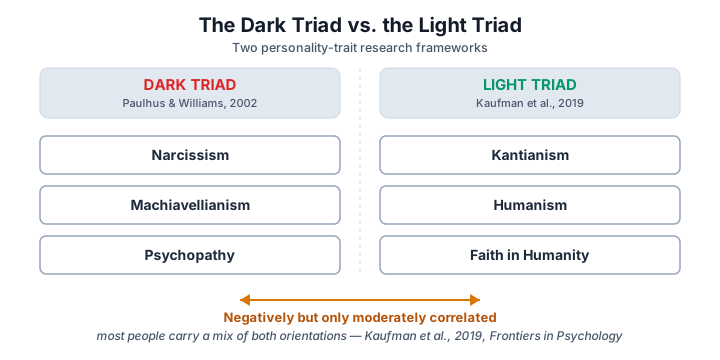
The Dark Triad is a research framework describing three overlapping personality traits — narcissism, Machiavellianism, and psychopathy — that share a common signature of callousness, self-interest, and willingness to instrumentalize other people (Paulhus & Williams, 2002). The Light Triad, proposed nearly two decades later, is a humanistic orientation built from Kantianism, humanism, and faith in humanity (Kaufman et al., 2019). For survivors of a Dark Triad relationship, the clinical value of these constructs is not a label for the other person. It is a name for a pattern that, once seen clearly, stops being a mystery the survivor has to solve.
What Is the Dark Triad?
The Dark Triad is a psychological construct describing three overlapping personality traits: narcissism, Machiavellianism, and psychopathy. Proposed by Paulhus and Williams in 2002, the framework identified a cluster of traits that, while clinically distinct, tend to co-occur and share a common feature — callousness toward others combined with a tendency toward self-interested behavior.
Narcissism in the Dark Triad context refers to grandiosity, entitlement, and a need for admiration. This is not the same as clinical Narcissistic Personality Disorder, but it overlaps with it significantly. People high in this trait tend to prioritize status, become easily threatened by perceived slights, and struggle to maintain reciprocal relationships.
Machiavellianism describes a strategic, manipulative orientation toward others. People high in this trait are calculating and patient — they view relationships primarily as instruments for achieving goals and are comfortable with deception when it serves their interests.
Psychopathy in subclinical form refers to low empathy, high impulsivity, and a lack of guilt or remorse. Unlike clinical psychopathy, the subclinical version does not necessarily involve criminal behavior, but it does involve a reduced capacity for the emotional attunement that makes sustained moral behavior easier.
These three traits correlate moderately with each other, suggesting shared underlying features — particularly reduced empathy and a self-serving interpersonal orientation. Subsequent work by Jonason and Webster (2010), in Psychological Assessment, produced a short-form measure called the Dirty Dozen that has since been used across hundreds of studies, making the Dark Triad one of the most empirically investigated personality clusters in modern psychology.
The Dark Triad is a research framework, not a diagnostic category. It does not appear in the DSM-5. Survivors sometimes feel they need a formal diagnosis in order to trust their own perception of what happened. They do not. The research literature exists precisely because these patterns are consistent, measurable, and observable across cultures and samples.
Why Does the Dark Triad Produce So Much Interpersonal Damage?
The reason the Dark Triad matters clinically is not academic. The trait cluster tends to produce predictable patterns of interpersonal harm, and those patterns are what trauma therapists see in their offices day after day.
People high on the Dark Triad are not necessarily loud or easy to spot. A substantial body of research describes them as strategically charming in the early phase of relationships, effective at reading social cues, and skilled at presenting a curated public self (Jones & Paulhus, 2014). The damage usually arrives later, once the relationship has progressed past the point where leaving feels simple.
What the research literature consistently describes:
- Reduced affective empathy with relatively intact cognitive empathy — they can recognize what others feel without feeling it themselves, which makes manipulation more effective.
- Lies, withdrawal, triangulation, and intermittent warmth used as tools of interpersonal control.
- Short-term mating strategies, infidelity, and rapid partner cycling in the narcissism and psychopathy dimensions.
- Difficulty tolerating perceived slights, with retaliation disproportionate to the triggering event.
Dutton and Painter’s (1993) foundational work on traumatic bonding, in Violence and Victims, documented how intermittent reinforcement in abusive relationships produces attachments that strengthen, rather than weaken, under conditions of harm. That finding maps directly onto the relational patterns the Dark Triad literature describes. The cycle of charm, withdrawal, rupture, and conditional return is not an accident. It is the mechanism.
Judith Herman, in Trauma and Recovery (1992), framed the same phenomenon from the survivor’s side. Complex trauma is not simply the accumulation of bad events. It is prolonged exposure to a relational pattern in which the person responsible for your safety is also the person producing the threat — the person who loved you in the morning is the person who discarded you in the afternoon, and the nervous system cannot reconcile those two facts.
What Is the Light Triad?
In 2019, Scott Barry Kaufman and colleagues proposed a counterpart: the Light Triad. Defined not as the mere absence of Dark Triad traits but as a genuinely humanistic orientation, the Light Triad consists of three distinct constructs.
Kantianism refers to treating others as ends in themselves rather than as means. It is the practical application of the philosophical principle that people have intrinsic value and should not be used merely to serve someone else’s goals.
Humanism describes a genuine interest in and appreciation for other people — a baseline warmth and curiosity about human experience that makes connection feel valuable in itself rather than instrumental.
Faith in Humanity is a generalized belief that people are fundamentally good and capable. This is not naivety — it coexists with the ability to recognize harmful behavior — but it represents an orientation toward others that leads to different interpretations of ambiguous situations.
The Kaufman paper, published in Frontiers in Psychology, made one specific and important claim: the Light Triad is not the statistical opposite of the Dark Triad. In the original analyses, the two triads were negatively but only moderately correlated, meaning most people carry some mix of both orientations. Warmth and self-interest, generosity and competitiveness, care and caution coexist in the same person. The question the Light Triad asks is which orientation is predominant — and what happens in relationships when the person across from you is operating from a different one than you are.
Kaufman and colleagues also reported that high Light Triad scores were associated with higher life satisfaction, greater quiet ego, more secure attachment, and more positive relationships with family and friends. High Dark Triad scores were associated with more aggression, more utilitarian moral reasoning, and a stronger motivation toward power and achievement for their own sake. The constructs are not moral judgments. They are empirical descriptions of orientations that produce different outcomes across the lifespan.
Why Does Naming the Construct Help Survivors?
This is the part of the research that matters most clinically.
Survivors of a relationship with someone high on the Dark Triad often spend years trying to explain, to themselves, what happened. They replay events. They wonder if they misread one conversation, or one tone, or one look. They ask whether they overreacted. They hold the relationship up to the light from every angle and try to make the pieces fit. The pieces do not fit, because the underlying pattern was not a series of disconnected events. It was a coherent trait cluster producing a predictable set of behaviors. What looked like unpredictability from the inside was, from a research standpoint, extremely predictable.
Naming the construct is the moment the survivor stops trying to solve a mystery and starts looking at a map. The map does not undo the harm, and it does not accelerate grief. But it stops the self-interrogation, which is the single most exhausting part of post-abuse recovery. When the pattern has a name, the survivor can stop wondering if they imagined it, and start doing the actual work.
This is where the S.T.O.I.C.K. method becomes relevant in clinical practice. Once the cognitive question of “what was that?” is settled, the remaining work is in the nervous system. The body still reacts to reminders of the person. The chest still tightens around certain dates and songs. That is physiology, not unfinished thinking, and it responds to physiological interventions — breath, orienting, grounded attention to the body — rather than to further analysis.
How Do Dark Triad Patterns Show Up in Relationships?
Research and clinical observation converge on a consistent set of relational markers. None in isolation is diagnostic. All of them, in combination and over time, are worth paying attention to.
- Idealization that arrives too fast. Rapid emotional intensity, grand declarations, and talk of destiny early in a relationship are documented features of narcissistic and psychopathic mating strategies (Jones & Paulhus, 2014).
- A curated public persona that does not match the private one. The gap between the outward self and the private self is often wide.
- Intermittent warmth as a pattern rather than as a mood. Occasional bad days are human. A pattern of warmth given and withdrawn in response to perceived leverage is not.
- Responsibility that never lands. When something goes wrong, the explanation always locates the cause somewhere else — in you, in circumstances, in other people’s failings.
- A low-grade vigilance that never quite resolves. That is the nervous system doing its job in an environment where safety is conditional.
- An asymmetry of emotional labor. Over time, one person is doing nearly all of the repair work and managing of the other person’s emotional state.
Helen Fisher’s work on the neurochemistry of romantic attachment (Fisher, 2004; Fisher et al., 2010, Journal of Neurophysiology) is relevant here. Dopaminergic reward circuitry is particularly responsive to uncertainty, and the intermittent warmth characteristic of Dark Triad relationships activates that circuitry far more powerfully than consistent warmth would. That is why survivors describe these relationships, often retrospectively, as the most intense connection they ever felt. The intensity was real. It was also the biochemical signature of unpredictability, not of love.
The Light Triad Is Not a Clinical Prescription
No. Self-help culture tends to take research frameworks and turn them into prescriptions, and that is a mistake here.
Kaufman and colleagues did not propose the Light Triad as a personality upgrade program. They proposed it as a description of a genuine psychological orientation that some people hold and others do not. Telling a survivor they should “become more Light Triad” after leaving a Dark Triad relationship is, at best, unhelpful. At worst, it is another version of the same pressure they already lived under.
The clinical use of the Light Triad is more specific. It is a description of what a healthy relational orientation looks like, so survivors have something to measure new connections against. It is a reminder that most people in the world are not operating from the Dark Triad end of the spectrum. And it is a counterweight to the post-abuse belief — common and understandable — that everyone is fundamentally self-interested and that safety is no longer something that exists in the world.
Bessel van der Kolk, in The Body Keeps the Score (2014), describes how trauma narrows perception. Survivors start scanning for threat and stop scanning for warmth, because the cost of missing threat is catastrophic. The Light Triad points the perceptual system back toward the half of human experience that trauma has temporarily blocked from view. It is not a new personality — it is the return of a capacity the nervous system already had before the relationship interrupted it. Recovery is a nervous system project, not a willpower project, which is why frameworks like R.A.V.E.S. exist to work with the body rather than against it.
Where Do You Fall?
These frameworks are not binary. Most people fall somewhere on a continuum, with different trait profiles across the six dimensions. Someone can be high in Machiavellianism while also holding genuine faith in humanity. Someone can have subclinical narcissistic traits while also treating others with care and respect.
The clinical value of these frameworks is not in labeling people but in understanding patterns. Understanding where someone — or where a pattern in a relationship — falls on these dimensions can clarify dynamics that felt confusing when described only in terms of specific behaviors.
Tools like the Light Triad Scale and the Short Dark Tetrad (an updated version including sadism) are publicly available and provide a structured starting point for this kind of self-assessment. They are most useful not as verdicts but as conversation-starters — with a therapist, or with oneself. The goal is not to produce a label. The goal is to see the pattern clearly enough to stop asking the nervous system to solve what the intellect already knows.
Frequently Asked Questions
Is the Dark Triad a real diagnosis? No. It is a research framework describing a statistical clustering of three personality traits that tend to co-occur. It does not appear in the DSM-5 and is not used as a clinical diagnosis. It is used across hundreds of peer-reviewed studies to describe patterns consistently observable in real populations. Its value in recovery work is as a name for a pattern, not as a label for a person.
Can someone be high on both the Dark Triad and the Light Triad? Yes, to a degree. Kaufman and colleagues (2019) found the two triads were negatively correlated but not opposite ends of a single axis. Most people carry some mix of both. A partner who scores high on Dark Triad traits may still exhibit warmth in specific moments. That warmth is often what keeps survivors in the relationship, and it is also not evidence that the underlying trait cluster is absent.
Does identifying the pattern help me recover? Yes, though not in the way people expect. Identifying the pattern does not eliminate grief or erase the physical symptoms of a trauma bond. What it does is stop the self-interrogation. Once the pattern has a name, the survivor can stop asking whether they imagined it or whether it was their fault. That mental energy is substantial, and recovering it is often the first stabilizing moment in the work.
Are people high on the Dark Triad capable of change? The research is mixed and largely pessimistic in the short term. The trait cluster is relatively stable across the lifespan, and the interpersonal patterns it produces tend to persist. Change, when it happens, is slow and usually requires circumstances the person did not choose. For survivors, the practical point is that waiting for change is not a recovery strategy.
Where should I start if I think I was in a Dark Triad relationship? Start with a licensed clinician who has specific experience with narcissistic abuse, complex trauma, or intimate partner abuse. Generic talk therapy is often insufficient for this work. What you need is someone who understands that the missing, the confusion, and the physiological symptoms are not signs something is wrong with you — they are signs your nervous system responded predictably to a predictable environment.
A Note on Naming
The value of these research constructs is that they give the survivor a name for what happened. Not a slur for the other person. Not a diagnosis to hand them. A name. The name describes a pattern, and the pattern is what the nervous system was responding to the whole time. When the pattern has a name, the survivor can start to set it down. That is the work, and it is worth doing.
If you want to do this work with someone who treats the missing, the confusion, and the self-interrogation as physiology rather than weakness, book a free consultation.
Matthew Sexton, LCSW is a licensed clinical social worker with over a decade of experience treating survivors of narcissistic abuse and complex trauma. He has directed clinical programs across thirteen settings, including substance abuse treatment, forensic assertive community treatment, and disaster case management. He founded Mental Wealth Solutions to help survivors rebuild their nervous system, reclaim their sovereignty, and do the real work of recovery in a setting that respects the physiological reality of what they have been through.
Disclaimer
This article is for educational and informational purposes only. It does not constitute medical, clinical, legal, or therapeutic advice, and reading it does not create a therapist-client relationship with Matthew Sexton, LCSW or Mental Wealth Solutions, Inc.. Although the author is a licensed clinical social worker, the content in this article is not clinical assessment, diagnosis, or treatment.
The patterns, concepts, and recovery frameworks described here reflect clinical research and general observations across trauma recovery work. Individual experiences vary, and what is described here may not match every reader’s situation. If you are working through narcissistic abuse, complex trauma, or a trauma bond, please consult a licensed mental health professional who can assess your specific circumstances.
If you are in immediate emotional crisis, you can reach the 988 Suicide & Crisis Lifeline by calling or texting 988 (US). If you are experiencing domestic violence or are in physical danger, contact the National Domestic Violence Hotline at 1-800-799-7233 or visit thehotline.org. In a life-threatening emergency, call 911.
References
Dutton, D. G., & Painter, S. (1993). Emotional attachments in abusive relationships: A test of traumatic bonding theory. Violence and Victims, 8(2), 105–120.
Fisher, H. (2004). Why We Love: The Nature and Chemistry of Romantic Love. Henry Holt.
Fisher, H. E., Brown, L. L., Aron, A., Strong, G., & Mashek, D. (2010). Reward, addiction, and emotion regulation systems associated with rejection in love. Journal of Neurophysiology, 104(1), 51–60.
Herman, J. L. (1992). Trauma and Recovery: The Aftermath of Violence. Basic Books.
Jonason, P. K., & Webster, G. D. (2010). The Dirty Dozen: A concise measure of the Dark Triad. Psychological Assessment, 22(2), 420–432.
Jones, D. N., & Paulhus, D. L. (2014). Introducing the Short Dark Triad (SD3): A brief measure of dark personality traits. Assessment, 21(1), 28–41.
Kaufman, S. B., Yaden, D. B., Hyde, E., & Tsukayama, E. (2019). The Light vs. Dark Triad of personality: Contrasting two very different profiles of human nature. Frontiers in Psychology, 10, 467.
Paulhus, D. L., & Williams, K. M. (2002). The Dark Triad of personality: Narcissism, Machiavellianism, and psychopathy. Journal of Research in Personality, 36(6), 556–563.
van der Kolk, B. A. (2014). The Body Keeps the Score: Brain, Mind, and Body in the Healing of Trauma. Viking.
If this named something you're living with —
You don't have to figure it out from articles. Matthew Sexton, LCSW, NATC sees adults in therapy at his separate private practice (telehealth · NY · ME · DE · FL). Or take this piece to your own therapist — it's written to be shared.
Visit the practice