Narcissistic traits interview exceptionally well and manage exceptionally poorly. The same qualities that read as leadership in a 45-minute meeting — confidence, vision, composure under pressure, willingness to make bold claims — are the qualities that predict team erosion, decision distortion, and elevated organizational risk once the person is inside. Meta-analytic research on narcissism and leadership finds a curvilinear relationship: moderate traits are neutral to mildly positive, high traits are actively harmful, and the early signal of “natural leader” has almost no relationship to later effectiveness (Grijalva et al., 2015). Hiring well under these conditions is not about screening personalities. It is about refusing to make consequential decisions based on a performance rather than a track record.
Why do narcissistic traits look like leadership material in interviews?
The interview is a format that rewards exactly the skills narcissistic individuals have practiced their entire lives. A hiring conversation is short, high-stakes, one-directional, and built around self-presentation. It measures how someone performs under brief observation, not how they behave across months of ordinary work.
Individuals with high narcissistic traits often interview exceptionally well. They are confident, charismatic, and skilled at presenting a compelling version of themselves under pressure. They tend to be articulate about their accomplishments, unafraid of ambitious claims, and adept at reading what a hiring manager wants to hear.
This creates a selection problem. The traits that make someone effective in a 45-minute interview — confidence, persuasion, impression management — are not the same traits that make someone effective in a collaborative, sustained work environment. Organizations that over-index on first impression performance are particularly vulnerable to this mismatch.
The research backs up the intuition. Grijalva and colleagues (2015), in a meta-analysis published in Personnel Psychology covering dozens of studies and thousands of participants, found that narcissism has a strong positive association with leader emergence — being perceived as a leader, getting selected for leadership roles, rising in the first impression hierarchy — and a weak, often nonlinear relationship with leader effectiveness. In plain terms: narcissistic people get hired into leadership at elevated rates and then underperform in those roles at elevated rates. The selection signal is real, and it is largely noise about the outcome that matters.
The question is not whether narcissistic charm is effective. It is. The question is what it costs.
What does the research on narcissistic CEOs actually show?
The most widely cited study on narcissism in senior leadership is Chatterjee and Hambrick’s (2007) paper in Administrative Science Quarterly, which built an unobtrusive index of CEO narcissism — measuring things like the prominence of the CEO’s photo in annual reports, the CEO’s use of first-person singular pronouns in interviews, and the gap between the CEO’s cash compensation and the next-highest-paid executive — and then tracked what those firms actually did.
The findings were not subtle. Firms led by more narcissistic CEOs showed:
- More dramatic strategic actions, including larger acquisitions and more frequent shifts in strategy.
- More extreme and volatile firm performance — big wins and big losses, with little middle ground.
- No net advantage to shareholders. On average, narcissistic CEOs did not generate better long-run returns than their less narcissistic peers. What they generated was more variance.
A follow-up study by Chatterjee and Hambrick (2011), also in Administrative Science Quarterly, found that narcissistic CEOs respond differently to objective performance feedback. When the firm is doing poorly, they do not recalibrate the way non-narcissistic CEOs do. They double down, take on more risk, and become more resistant to the same kind of corrective feedback that ordinarily helps an executive adjust course. The narcissism is not just a personality garnish at the top of the org chart. It is a structural risk factor in how the company absorbs information and makes decisions.
Maccoby (2000), in Harvard Business Review, framed this tradeoff as “the incredible pros, the inevitable cons.” He argued that narcissistic leaders — people he called “productive narcissists” — often bring genuine strategic vision and an appetite for transformative change that more conventional leaders lack. But he was equally direct about the cost: poor listening, oversensitivity to criticism, lack of empathy, a tendency to surround themselves with yes-people, and a pattern of leaving organizations more brittle than they found them. Maccoby’s piece is useful precisely because it does not moralize. It treats narcissistic leadership as a real phenomenon with real upside in narrow conditions and real downside across most others.
What are the hidden costs inside the organization?
Research on narcissistic leadership consistently identifies a pattern of short-term performance gains offset by long-term organizational damage. Common outcomes include:
Team erosion. High-performing employees adjacent to narcissistic leaders leave at elevated rates. The combination of credit-taking, unpredictable treatment, and social manipulation creates a working environment that is unsustainable for people with other options. Nevicka and colleagues (2018), in the Journal of Applied Psychology, found that teams under narcissistic leaders showed reduced information sharing and lower perceived team performance, even when individual leader charisma was rated highly. The people under the leader experienced the environment very differently from the people evaluating the leader from the outside.
Decision quality degradation. Narcissistic leaders resist negative feedback and surround themselves with people who avoid delivering it. Over time, this distorts the information environment they operate from. Chatterjee and Hambrick’s (2011) work on feedback response is a specific case of this general pattern: when the information system around an executive is filtered for ego-protection, the quality of the decisions that come out of that system degrades predictably.
Culture corrosion. Normalized boundary violations, public humiliation as a management tool, and the rewarding of sycophancy over competence shift organizational culture in ways that are difficult to reverse. O’Reilly and colleagues (2014), in The Leadership Quarterly, studied technology firms and found that narcissistic CEOs were associated with more interpersonal conflict inside senior teams and with compensation structures that disproportionately rewarded the CEO relative to the rest of the executive group. Culture does not survive that asymmetry for long.
Legal and ethical exposure. The same traits that generate confidence generate entitlement. Harassment complaints, financial misconduct, and ethical violations correlate with high narcissistic trait scores in leadership positions. Rijsenbilt and Commandeur (2013), in the Journal of Business Ethics, found that CEO narcissism was positively associated with the likelihood of fraudulent financial reporting. The risk is not reputational in the abstract. It is specific, measurable, and shows up in the kinds of filings that attract regulators.
None of this requires a clinical diagnosis. Narcissistic traits exist on a continuum in the general population, and most people showing these traits in the workplace will never meet diagnostic criteria for narcissistic personality disorder. The clinical literature on personality and trauma — including Herman’s (1992) work on the institutional dynamics that concentrate power around charismatic figures and van der Kolk’s (2014) observations about how high-stress environments shape the nervous systems of the people working inside them — is a useful reminder that the cost of a toxic leader is absorbed downstream by bodies, not just by spreadsheets.
What are the red flags during the hiring process?
A risk-aware hiring approach for senior roles should include:
Structured behavioral interviews. Unstructured conversation favors charm. Structured questions about specific past situations — especially situations involving failure, conflict, or feedback — are harder to perform through. Ask for a concrete example of a time the candidate was wrong about something important, and listen for whether they can actually describe being wrong without pivoting to how it ultimately proved them right.
Reference quality assessment. High narcissistic trait individuals tend to generate strong advocates and strong detractors. A reference pool that is uniformly positive, or that refuses to name a single significant weakness, is itself informative. Pay attention to who is missing from the reference list, not just who is on it. A pattern of strong references from people above the candidate and vague or declined references from people below is a specific signal.
360 data where available. Peer and direct report assessments surface interpersonal patterns that upward performance reviews miss. If a candidate has managed people before, that data matters, and the absence of any willingness to share it matters too.
Clear behavioral expectations and accountability structures. If a hire proceeds, the ethical obligation is to create an environment where harmful behavior is named and addressed early — not explained away by performance metrics. Define in writing, before the offer, what constitutes an unacceptable pattern of behavior, who is responsible for surfacing it, and what the consequences are. Organizations that only define these things after a crisis find themselves unable to apply them retroactively.
The goal of this framework is not to screen out all people with narcissistic traits. Confidence, drive, and strategic thinking are legitimate organizational assets. The goal is to avoid making consequential hiring decisions based on a performance rather than a track record.
Are there roles where narcissistic traits are net-positive?
Yes, in narrow conditions. Maccoby (2000) argued that productive narcissists can be uniquely effective in situations that require a leader to impose a new direction on a stagnant or declining organization, tolerate public criticism, and push through transformation that more consensus-oriented leaders would abandon. There are moments in a company’s life when the willingness to be disliked is functional. Narcissistic traits can provide that willingness.
The conditions under which this bet pays off, though, are specific:
- The role has a defined, time-limited mandate rather than open-ended authority.
- The leader reports into a structure — a board, an investor group, a peer executive — that has both the standing and the willingness to overrule them.
- The organization has independent information channels that do not run through the leader, so feedback from the ground does not get filtered at the top.
- The cultural norms around accountability exist before the leader arrives and are strong enough to survive them.
Outside those conditions, the research is clear that the downside tends to dominate (Grijalva et al., 2015; Chatterjee & Hambrick, 2007; O’Reilly et al., 2014). Hiring a narcissist into a role with unchecked authority, limited oversight, and a culture of conflict avoidance is a predictably poor outcome. Hiring the same person into a role with clear deliverables, peer accountability, and strong institutional norms is a different calculation.
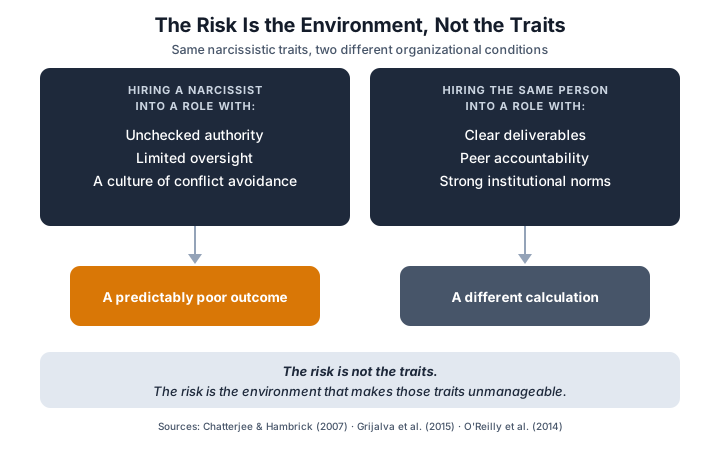
The risk is not the traits. The risk is the environment that makes those traits unmanageable.
What if you already work with one?
Most readers of this piece are not on a hiring committee deciding whether to offer the CEO job. They are on the other side of the problem — inside the org, reporting to or adjacent to someone whose behavior matches everything described above, trying to decide what to do with their own nervous system for the rest of the workday.
The research applies there too. The same distortions that harm the company also harm the people inside it: hypervigilance during meetings, chronic second-guessing of their own competence, the specific kind of exhaustion that comes from managing someone else’s emotional state as a daily job requirement. Herman (1992) described this as one of the defining features of prolonged interpersonal stress under an unpredictable authority figure. It is a physiological pattern, not a character flaw.
Working alongside a narcissistic colleague or boss also produces a very specific impulse: the urge to react in the moment, to defend yourself in the meeting, to correct the record in front of the group, to match their intensity. That impulse is almost always a trap. It gives the narcissistic colleague a fight they are better equipped to win than you are, and it moves the conflict into a public arena where your nervous system is operating at a disadvantage. The S.T.O.I.C.K. method is one framework for working with that impulse at the level of the body — pausing the reaction long enough for the ventral vagal system to come back online, so that whatever response you do make is coming from a regulated state rather than a hijacked one. That is not weakness or accommodation. It is the precondition for making any strategic move that is actually in your interest.
If the exposure has already compounded — if you have been in a toxic work environment long enough that your baseline stress response is elevated, if you are sleeping badly, dissociating in meetings, or catching yourself reacting to ordinary requests the way you would react to threats — then the work is not a mindset adjustment. It is nervous system recovery. R.A.V.E.S. exists because recovery from sustained workplace abuse is a nervous system project, not a willpower project. Porges’s (2011) polyvagal work and van der Kolk’s (2014) clinical observations both converge on the same point: chronic threat exposure reshapes the body’s default state, and the body’s default state has to be renegotiated, over time, in safety, before the cognitive strategies start to land.
The honest answer
The honest answer to the question in the title is: it depends on the role, the structure around it, and the organization’s capacity to hold behavior accountable.
Hiring a narcissist into a position with unchecked authority and a culture of conflict avoidance is a predictable way to generate a crisis. Hiring the same person into a narrowly scoped, heavily supervised role where the organization has the muscle to name and address early warning signs is a different decision with a different expected outcome. The traits are not the problem. The absence of structures that can contain them is the problem.
Organizations that cannot enforce accountability for their senior hires should not be hiring people whose traits require enforcement. The ones that can should still go in with eyes open about what the research actually shows: a real probability of dramatic action, a real probability of variance in both directions, a predictable cost in team turnover and culture damage, and very little reliable upside to shareholders across the long run.
Frequently Asked Questions
Is narcissism a disqualification for leadership? No. Narcissistic traits exist on a continuum, and most people showing some of these traits in the workplace do not meet criteria for a personality disorder. The meta-analytic research (Grijalva et al., 2015) suggests a curvilinear relationship with leader effectiveness: moderate traits can be neutral or mildly positive, high traits are reliably associated with worse outcomes. The risk is not the existence of the traits but the absence of structures that contain them.
Can a narcissistic CEO be good for shareholders? Sometimes, in the short term. Chatterjee and Hambrick (2007) found that narcissistic CEOs generate more extreme and volatile firm performance but no net long-run advantage on average. The same pattern that produces dramatic wins produces dramatic losses, which is why the variance is high and the average is flat. Expecting consistent outperformance from a narcissistic CEO is not supported by the data.
How do I screen for narcissistic traits during an interview? You cannot fully. The interview format itself favors the traits you are trying to detect. What you can do is reduce charm’s advantage: use structured behavioral questions, demand concrete examples of past failure and feedback, scrutinize the reference pool for suspicious uniformity, and require peer and direct-report data where the candidate has managed people. Assume that whoever you hire is a performance until you have six months of track record inside the organization.
Are there industries where narcissistic leadership is more common or more tolerated? Yes. Research (O’Reilly et al., 2014; Chatterjee & Hambrick, 2007) suggests that industries with high volatility, high public visibility, and high founder concentration tend to select for narcissistic traits more heavily than stable, process-driven industries. That is a selection effect, not an endorsement. Sectors that tolerate narcissistic leadership also tend to report higher turnover, more ethics complaints, and more public implosions.
What should I do if I already report to a narcissistic boss? Start with your nervous system, not your strategy. Chronic exposure to an unpredictable authority figure produces real physiological changes that distort the way you assess your own situation (Herman, 1992; van der Kolk, 2014; Porges, 2011). Get the body back to baseline first, in whatever way works for you, before making consequential decisions about whether to stay, push back, or leave. Decisions made out of a hijacked nervous system rarely hold up well under review.
If you want to do this work with someone who treats workplace narcissistic abuse as physiology rather than weakness, book a free consultation.
Matthew Sexton, LCSW is a licensed clinical social worker with over a decade of experience treating survivors of narcissistic abuse and complex trauma. He has directed clinical programs across thirteen settings, including substance abuse treatment, forensic assertive community treatment, and disaster case management. He founded Mental Wealth Solutions to help survivors rebuild their nervous system, reclaim their sovereignty, and do the real work of recovery in a setting that respects the physiological reality of what they have been through.
Disclaimer
This article is for educational and informational purposes only. It does not constitute medical, clinical, legal, or therapeutic advice, and reading it does not create a therapist-client relationship with Matthew Sexton, LCSW or Mental Wealth Solutions, Inc.. Although the author is a licensed clinical social worker, the content in this article is not clinical assessment, diagnosis, or treatment.
The patterns, concepts, and recovery frameworks described here reflect clinical research and general observations across trauma recovery work. Individual experiences vary, and what is described here may not match every reader’s situation. If you are working through narcissistic abuse, complex trauma, or a trauma bond, please consult a licensed mental health professional who can assess your specific circumstances.
If you are in immediate emotional crisis, you can reach the 988 Suicide & Crisis Lifeline by calling or texting 988 (US). If you are experiencing domestic violence or are in physical danger, contact the National Domestic Violence Hotline at 1-800-799-7233 or visit thehotline.org. In a life-threatening emergency, call 911.
References
Chatterjee, A., & Hambrick, D. C. (2007). It’s all about me: Narcissistic chief executive officers and their effects on company strategy and performance. Administrative Science Quarterly, 52(3), 351–386.
Chatterjee, A., & Hambrick, D. C. (2011). Executive personality, capability cues, and risk taking: How narcissistic CEOs react to their successes and stumbles. Administrative Science Quarterly, 56(2), 202–237.
Grijalva, E., Harms, P. D., Newman, D. A., Gaddis, B. H., & Fraley, R. C. (2015). Narcissism and leadership: A meta-analytic review of linear and nonlinear relationships. Personnel Psychology, 68(1), 1–47.
Herman, J. L. (1992). Trauma and Recovery: The Aftermath of Violence. Basic Books.
Maccoby, M. (2000). Narcissistic leaders: The incredible pros, the inevitable cons. Harvard Business Review, 78(1), 68–78.
Nevicka, B., Van Vianen, A. E. M., De Hoogh, A. H. B., & Voorn, B. C. M. (2018). Narcissistic leaders: An asset or a liability? Leader visibility, follower responses, and group-level absenteeism. Journal of Applied Psychology, 103(7), 703–723.
O’Reilly, C. A., Doerr, B., Caldwell, D. F., & Chatman, J. A. (2014). Narcissistic CEOs and executive compensation. The Leadership Quarterly, 25(2), 218–231.
Porges, S. W. (2011). The Polyvagal Theory: Neurophysiological Foundations of Emotions, Attachment, Communication, and Self-Regulation. W. W. Norton.
Rijsenbilt, A., & Commandeur, H. (2013). Narcissus enters the courtroom: CEO narcissism and fraud. Journal of Business Ethics, 117(2), 413–429.
van der Kolk, B. A. (2014). The Body Keeps the Score: Brain, Mind, and Body in the Healing of Trauma. Viking.
Want to discuss this for your program?
Book a 30-min conversation. We'll walk you through deployment, the BAA, and what your rollout looks like in production.
Book a 30-min conversation