The awakening in narcissistic abuse recovery is the moment the pattern becomes visible as a pattern — not a series of isolated incidents, but a system — and once seen, it cannot be unseen. It is rarely a single epiphany. It is usually a slow accumulation of evidence that the survivor’s own perception can no longer explain away, followed by a nervous system shift that reorganizes the relationship in retrospect. What follows the awakening is not relief. It is a disorienting split between knowing and feeling, and a long arc of recovery that the awakening itself does not complete. Understanding the awakening as physiology rather than revelation is the clinical starting point.
What Is the Narcissistic Abuse Awakening?
The awakening is the point at which cognition stops being recruitable by the trauma bond. Until then, the survivor’s explanatory apparatus — empathy, memory, optimism, self-blame, hope — is in near-constant use generating reasons the relationship is not what it appears to be. The awakening is the failure of that apparatus, not because the survivor becomes smarter or braver, but because the cost of the explanations finally exceeds whatever they were protecting.
Awakening is rarely a single moment of clarity. It is a slow accumulation of evidence that your own perception can no longer explain away.
For many people, it starts with exhaustion. The work of maintaining the relationship becomes unsustainable. The explanations stop coming. The hope that things will return to how they were at the beginning begins to lose its grip.
Then something shifts. The pattern becomes visible as a pattern — not a series of isolated incidents, but a system. And once you see the system, you can’t unsee it.
Judith Herman, in Trauma and Recovery (1992), describes the moment captives begin to see their captivity as captivity as one of the most psychologically destabilizing transitions in the entire arc of complex trauma. It is a rupture, not an empowerment. The person they were inside the relationship — the one who could still explain and still hope — is no longer available, and the person they will eventually become has not yet emerged. The awakening is the gap between the two.
Why the Awakening Often Happens After Months or Years of Confusion
The delay is the most common thing survivors apologize for in clinical work. They ask why it took so long. The answer is structural, not moral. The trauma bond is designed — through intermittent reinforcement — to produce confusion as a feature, not a side effect.
Dutton and Painter’s (1993) foundational work on traumatic bonding, published in Violence and Victims, documented that attachment in abusive relationships can strengthen, rather than weaken, under conditions of intermittent harm. The cycle of idealization and devaluation does not merely cause pain. It disorganizes the survivor’s ability to integrate the pain into a coherent narrative. Every “good moment” rewrites the previous “bad moment” in memory. Every reconciliation gets encoded as evidence that the relationship can be saved. This is how the nervous system is wired to respond to variable reinforcement schedules (Skinner, 1953), which produce the most persistent behavioral patterns and are remarkably resistant to extinction. Helen Fisher’s neuroimaging research on romantic attachment and rejection (Fisher, 2004) adds the neurochemical layer: uncertain reward activates dopaminergic circuitry more intensely than reliable reward, which is why the confusion itself feels so physiologically gripping.
What keeps the awakening from happening earlier:
- Cognitive dissonance gets resolved toward “something is wrong with me,” not “something is wrong with them” — it is the less destabilizing option inside an active bond.
- Intermittent reward periodically restores hope, which resets the internal timeline and makes the pattern feel non-cumulative.
- Sustained hypervigilance narrows attention to managing the other person’s state, leaving no bandwidth for pattern recognition.
- Isolation — often cultivated over time — removes external witnesses who could reflect back the pattern.
- Shame prevents disclosure, which prevents corrective feedback.
The awakening is delayed because everything about the relationship is configured to delay it. When it finally arrives, it is not because the survivor “woke up.” It is because the system suppressing it ran out of resources.
How Empathic People Get Trapped in the First Place
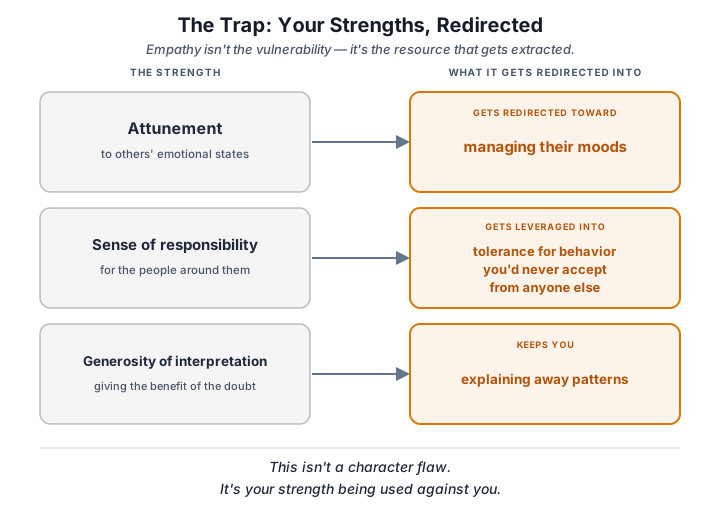
The pairing isn’t accidental. People who lead with empathy — who are attuned to others’ emotional states, who feel responsible for the people around them, who default to giving the benefit of the doubt — present a specific kind of utility to someone with antagonistic personality traits.
Empathy, in this context, becomes something that can be extracted. Your attunement gets redirected toward managing their moods. Your sense of responsibility gets leveraged into tolerance for behavior you’d never accept from anyone else. Your generosity of interpretation keeps you explaining away patterns that, seen clearly, would end the relationship immediately.
This isn’t a character flaw. It’s your strength being used against you. There’s a difference.
The trap is built gradually. By the time it’s visible, you’re already inside it. The initial experience of being deeply understood — the idealization — activates your natural orientation toward connection. You invest. Emotionally, practically, sometimes financially. The investment deepens the attachment. Then the shifts begin. Small at first. A comment that lands wrong. A moment of coldness that seems out of character. An accusation that doesn’t quite add up. Each one, in isolation, is explainable. Your empathy generates the explanations: stress, past trauma, a bad day. You extend the kind of understanding you’d want extended to yourself.
What you don’t see yet is that you’re doing the emotional labor of sustaining a connection that the other person is actively eroding. By the time the pattern is undeniable, you’ve reorganized significant parts of your life around managing it. That reorganization is what makes leaving feel impossible, even when staying feels worse.
What Actually Triggers the Awakening?
There is no universal trigger, but across clinical recovery work certain categories appear repeatedly. The triggers are usually not the “worst” moments of the relationship — those get absorbed back into the cycle through reconciliation. The triggering event is more often a small, incongruous moment the survivor’s explanatory apparatus cannot metabolize: a dropped mask, a contradiction witnessed by a third party, a sentence that reveals intent rather than accident, or an act directed at someone the survivor is still able to protect (a child, a pet, a parent) when they are no longer able to protect themselves.
Common triggering categories:
- A witness. Another person sees the behavior and names it without being filtered through the survivor’s explanations.
- A contradiction the survivor cannot explain away — a lie exposed by hard evidence, a calendar entry, a second phone.
- An attack on something the survivor has preserved as non-negotiable. The threshold for harm to self is usually far lower than the threshold for harm to someone the survivor feels responsible for.
- Physiological collapse. The body gives out — sleep, digestion, immune system — in a way that cannot be hidden.
- A moment of relief during the abuser’s absence that registers as qualitatively different from ordinary loneliness. The contrast becomes the data.
Bessel van der Kolk, in The Body Keeps the Score (2014), describes how the body often “knows” what the cognitive mind cannot yet afford to acknowledge, and how somatic signals frequently precede the conscious recognition of danger by weeks or months. The awakening is often the moment the cognitive mind finally catches up to what the body has been reporting. The S.T.O.I.C.K. method is one framework for listening to those physiological signals without collapsing into them, especially during the period when the body is reporting and the mind has not yet agreed.
The Split Between Knowing and Feeling
The most disorienting feature of the post-awakening period is the split between cognitive knowledge and affective experience. The survivor now knows what the relationship is. They can describe it in clinical detail, list every manipulation tactic, identify every pattern. And they still feel the pull. They still miss the person. They still flinch at the idea of closing the door. They still wake up some mornings believing it was not that bad.
This split is not a sign of incomplete awakening. It is a sign that the two systems involved are running on different timelines.
Stephen Porges’s polyvagal theory (Porges, 2011, The Polyvagal Theory) offers the clearest clinical frame. The cortical systems responsible for pattern recognition and explicit knowledge can update fast. The autonomic systems responsible for attachment, threat detection, and felt safety update much more slowly, and only through repeated lived experience of a different state. The awakening belongs to the cortical layer. Recovery belongs to the autonomic layer. The gap between them is where survivors spend most of the first year.
Judith Herman is explicit that understanding is not the same as feeling, and that recovery from complex trauma requires the nervous system to have its own experience of safety, repeatedly, over time, before the felt sense of the relationship changes. This is why insight-only approaches — reading articles, analyzing the abuser’s personality, compiling evidence — do not produce recovery on their own. They update the cortical layer and leave the autonomic layer untouched. Frameworks like R.A.V.E.S. exist because recovery is a nervous system project, not a willpower project, and the awakening is only the first clause of a much longer sentence.
Why the Awakening Is Not the End
Survivors often expect the awakening to be the end of the difficulty. It is not. In some ways it is the beginning — because now there is grief that was not permissible before, anger that was not safe before, and a reckoning with how much was given to a relationship that was never going to return the investment. There is also, in most cases, a trauma bond that does not know the relationship is over, a nervous system still searching for the reward window, and a set of daily habits organized around someone who is no longer present.
Kenneth Doka’s concept of “disenfranchised grief” (Doka, 1989) is relevant here. The post-awakening survivor is grieving something their social world often does not recognize: not just the loss of the person, but the loss of the version of the person they believed in, and the loss of the self that existed inside that belief. Outsiders tell the survivor they should feel relief. Sometimes there is relief. Usually there is also grief, and the grief is disenfranchised because it cannot be voiced without being misread as nostalgia or regret.
Patrick Carnes, in The Betrayal Bond (1997), writes specifically about the period after the bond has been cognitively recognized but before it has been physiologically resolved. Shame about the ongoing attachment is itself part of what keeps the bond active. Breaking the loop begins with naming the physiology out loud: the attachment is not a choice, the bond is not love, the missing is not evidence that the awakening was wrong. The awakening is accurate. The body is simply slower than the cortex, and the body is the part that has to heal.
The Long Arc From Awakening to Actual Recovery
Popular accounts treat the awakening as the finish line. Clinically, it is closer to the starting gun. The arc that follows unfolds across at least a year, often longer, and the progression tends to look something like this:
- The first weeks: Shock, relief, and oscillation. The survivor moves between clarity and doubt several times a day. Withdrawal intensifies. The body reports before the mind is ready.
- The first three months: Grief arrives, often out of proportion to what the cortex thinks it should be. Disenfranchised grief compounds the loneliness. Intermittent contact — even indirect — resets the clock.
- Three to twelve months: The split between knowing and feeling narrows. The missing shifts from a body state to a thought state. Identity begins to reorganize around something other than the relationship.
- Beyond a year: Occasional waves remain, usually tied to anniversaries or sensory triggers. They no longer pull the survivor under. A new baseline emerges.
These are observations, not guarantees. Recovery is not linear, and most survivors move through these phases more than once. The clinical measure of progress is not the absence of difficult feelings. It is the shrinking amount of time those feelings can hold the nervous system hostage before it returns to baseline.
Frequently Asked Questions
What is “the awakening” in narcissistic abuse recovery? The awakening is the moment the survivor can no longer explain away the pattern of the relationship. It is usually the failure of a long-running explanatory apparatus — empathy, hope, self-blame, optimism — rather than a sudden insight. Once the pattern is visible as a pattern, it cannot be unseen, even though the affective pull often continues for months afterward. The awakening is a cognitive threshold, not a physiological resolution.
Why didn’t I see it sooner? Because the structure of the trauma bond actively suppresses pattern recognition. Intermittent reinforcement periodically restores hope. Cognitive dissonance gets resolved toward self-blame. Hypervigilance narrows attention to managing the other person’s state, leaving no bandwidth for integration. Isolation removes corrective feedback. The delay is structural, not a reflection of your intelligence, character, or self-worth.
Why do I still miss them after the awakening? Because the awakening updates the cognitive layer and the trauma bond lives in the autonomic layer. Cortical knowledge can change fast. Nervous system attachment changes slowly, through repeated lived experience of safety over time. The split between knowing and feeling is the most common feature of the first year after awakening, and it is not evidence that the awakening was inaccurate.
Is the awakening permanent, or can I slip back into denial? The awakening itself is usually durable once it has occurred, but the felt sense of the relationship can reactivate under stress, intermittent contact, or sensory triggers. Most survivors describe brief windows of doubt even after cognitive clarity is stable. This is not regression. This is the autonomic layer catching up. Strict no contact is the clinical condition under which the bond is most likely to weaken.
How long does actual recovery take after the awakening? Individual timelines vary, but many survivors report significant stabilization within three to twelve months of the awakening if no contact is maintained, with continued consolidation beyond the first year. The first weeks are usually the hardest. The middle phase is the grief phase. The later phase is the identity phase, where the survivor rebuilds a life no longer organized around the relationship. The clinical measure of progress is how quickly the nervous system returns to baseline after a trigger, not the absence of triggers.
A Note on Recovery
The awakening is not the work. The awakening is the permission to start the work. What follows is a longer, stranger, and more physical process than most survivors are prepared for, and it usually cannot be completed alone. If the last few weeks have made the pattern visible and you are in the gap between knowing and feeling, the clinical answer is that the gap is real, it is not your fault, it is not a sign of weakness, and it closes over time with the right conditions.
If you want to do this work with someone who treats the awakening as physiology rather than weakness, book a free consultation.
Matthew Sexton, LCSW is a licensed clinical social worker with over a decade of experience treating survivors of narcissistic abuse and complex trauma. He has directed clinical programs across thirteen settings, including substance abuse treatment, forensic assertive community treatment, and disaster case management. He founded Mental Wealth Solutions to help survivors rebuild their nervous system, reclaim their sovereignty, and do the real work of recovery in a setting that respects the physiological reality of what they have been through.
Disclaimer
This article is for educational and informational purposes only. It does not constitute medical, clinical, legal, or therapeutic advice, and reading it does not create a therapist-client relationship with Matthew Sexton, LCSW or Mental Wealth Solutions, Inc.. Although the author is a licensed clinical social worker, the content in this article is not clinical assessment, diagnosis, or treatment.
The patterns, concepts, and recovery frameworks described here reflect clinical research and general observations across trauma recovery work. Individual experiences vary, and what is described here may not match every reader’s situation. If you are working through narcissistic abuse, complex trauma, or a trauma bond, please consult a licensed mental health professional who can assess your specific circumstances.
If you are in immediate emotional crisis, you can reach the 988 Suicide & Crisis Lifeline by calling or texting 988 (US). If you are experiencing domestic violence or are in physical danger, contact the National Domestic Violence Hotline at 1-800-799-7233 or visit thehotline.org. In a life-threatening emergency, call 911.
References
Carnes, P. (1997). The Betrayal Bond: Breaking Free of Exploitive Relationships. Health Communications.
Doka, K. J. (1989). Disenfranchised Grief: Recognizing Hidden Sorrow. Lexington Books.
Dutton, D. G., & Painter, S. (1993). Emotional attachments in abusive relationships: A test of traumatic bonding theory. Violence and Victims, 8(2), 105–120.
Fisher, H. (2004). Why We Love: The Nature and Chemistry of Romantic Love. Henry Holt.
Herman, J. L. (1992). Trauma and Recovery: The Aftermath of Violence. Basic Books.
Porges, S. W. (2011). The Polyvagal Theory: Neurophysiological Foundations of Emotions, Attachment, Communication, and Self-Regulation. W. W. Norton.
Skinner, B. F. (1953). Science and Human Behavior. Macmillan.
van der Kolk, B. A. (2014). The Body Keeps the Score: Brain, Mind, and Body in the Healing of Trauma. Viking.
If this named something you're living with —
You don't have to figure it out from articles. Matthew Sexton, LCSW, NATC sees adults in therapy at his separate private practice (telehealth · NY · ME · DE · FL). Or take this piece to your own therapist — it's written to be shared.
Visit the practice