Almost half of entrepreneurs are carrying a diagnosable mental health condition, and most of them built their companies anyway. 49% of entrepreneurs reported one or more lifetime mental health conditions, compared with 32% of a demographically matched comparison group, in a 2015 study of 242 founders led by Dr. Michael Freeman at the University of California, San Francisco. If you run something and your own head has felt like the hardest part of the job, the data says you have plenty of company.
The numbers, condition by condition
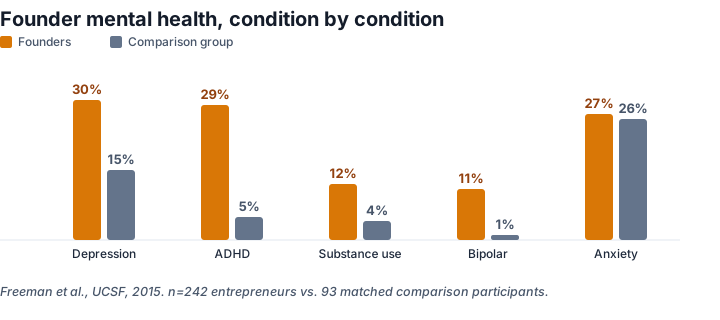
Freeman’s team asked founders and a matched comparison group about their lifetime mental health history. The gaps were wide.
- Depression: 30% of entrepreneurs, 15% of the comparison group
- ADHD: 29% versus 5%
- Substance use conditions: 12% versus 4%
- Bipolar diagnosis: 11% versus 1%
Stacking was common, too. 32% of the entrepreneurs reported two or more lifetime conditions, and 18% reported three or more.
One number stayed flat: anxiety, at 27% of founders and 26% of everyone else. Worry, it turns out, is evenly distributed across the population. The conditions that cluster in founders are the ones tied to drive, mood, attention, and appetite for risk.
The study relied on self-report and a single point in time, so it cannot say whether building companies produces these conditions or whether people wired this way go build companies. Freeman’s own reading leans toward the second: the traits travel together. Which brings up the uncomfortable part.
The same wiring, both directions
The traits that start companies overlap heavily with the traits that show up in clinical charts. Drive that will not switch off. Standards that score every miss as evidence against you. Comfort with risk, including risk to your own body and sleep. Independence that quietly hardens into isolation.
These are assets right up until they are symptoms, and the line between the two moves with your sleep, your cash position, and how long it has been since you took a real day off.
Here is what the crossover looks like in practice. Anxiety runs your mornings and you call it urgency. Your self-worth tracks revenue, so a bad quarter reads as a verdict on you as a person. You scan for threats constantly and call it strategy. The people closest to you get whatever is left at 9 p.m., which is usually nothing, and you know it, and the guilt goes on the pile with everything else.
None of that is a character flaw. It is a nervous system doing exactly what it was trained to do, long past the point where the training helps.
Most founders say nothing
The silence around all of this is measurable. In a 2023 Startup Snapshot survey of more than 400 early-stage founders, 72% said entrepreneurship had affected their mental health. In the same survey, 81% said they do not openly share their stress, fears, and challenges, and only 23% had seen a psychologist or otherwise sought professional support.
Read those three numbers together. Nearly three in four are affected. Four in five are hiding it. Fewer than one in four are talking to someone trained to do something about it.
The reasons founders give are consistent, and none of them are stupid.
The identity problem. If your self-concept is built on handling things, sitting in a room and saying “I am not handling this” feels like structural damage. In practice it is closer to scheduled maintenance.
The math problem. An hour of therapy is an hour off the clock, and founders bill every hour to the company in their heads. Meanwhile untreated depression, impulsive decisions, and burned-out judgment cost far more than the hour. The spreadsheet actually favors treatment. It just never gets built.
The trust problem. Many founders learned early that visible weakness attracts predators, in business and sometimes long before business. A stranger asking about feelings trips every alarm. That wariness is understandable, and it is also workable in treatment.
The comparison problem. You have money and options, so who are you to struggle? That is the trap’s exact wording. A problem does not have to be the worst one in the room to deserve treatment, and nobody applies that test to a torn ACL.
What working on it looks like
Therapy with founders and high performers tends to center on three jobs.
Auditing the fuel. A lot of high output runs on anxiety, and anxiety is expensive fuel. It burns hot, it burns dirty, and it has no interest in your long-term plans. The work is figuring out what the drive is actually made of and whether it can run on something cleaner, like purpose or plain interest in the problem.
Decoupling worth from output. If your value rises and falls with your metrics, that is conditional self-worth wearing a confidence costume. Real steadiness holds through a bad quarter. Building it means looking at where the worth-equals-performance rule got installed, which is usually much older than the company.
Retraining the nervous system. Hypervigilance was probably useful once, maybe in childhood, maybe when the company had six weeks of runway. If the threat has passed and the scanning has not, that is a body problem as much as a thinking problem, and body-level work belongs in the plan.
The part worth keeping
The same survey that found 72% of founders affected also found that 93% would do it again. That number matters. The goal of treatment was never to talk anyone out of building. Drive, risk tolerance, and obsession are legitimate gifts, and the research above suggests they may share wiring with the conditions themselves.
You can keep the ambition. The work is making sure the person doing the wanting is still functional in ten years, with relationships intact and a resting heart rate somewhere reasonable. Founders schedule maintenance for their servers, their books, and their vehicles. The person running all of it deserves the same line item.
Sources
- Freeman, M.A., Johnson, S.L., Staudenmaier, P.J., & Zisser, M.R., “Are Entrepreneurs ‘Touched with Fire’?”, pre-publication manuscript, University of California San Francisco, 2015. https://michaelafreemanmd.com/Research_files/Are%20Entrepreneurs%20Touched%20with%20Fire-summary.pdf Supports: 49% of entrepreneurs versus 32% of comparison participants reporting one or more lifetime mental health conditions; depression 30% versus 15%; ADHD 29% versus 5%; substance use conditions 12% versus 4%; bipolar 11% versus 1%; anxiety 27% versus 26% (no significant difference); 32% reporting two or more and 18% reporting three or more conditions; sample of 242 entrepreneurs and 93 comparison participants.
- Startup Snapshot, “The Untold Toll: The Impact of Stress on the Well-Being of Startup Founders and CEOs,” 2023, survey of 400+ early-stage founders, as reported by Forbes, April 29, 2023. https://www.forbes.com/sites/annefield/2023/04/29/startup-founders-report-entrepreneurship-is-taking-a-toll-on-their-mental-health/ Supports: 72% report entrepreneurship has affected their mental health; 81% do not openly share their stress, fears, and challenges; 23% have seen a psychologist or sought professional support; 93% say they would do it again.
Figures current as of July 2026.
Disclaimer
This article is for educational and informational purposes only. It does not constitute medical, clinical, legal, or therapeutic advice, and reading it does not create a therapist-client relationship with Matthew Sexton, LCSW or Mental Wealth Solutions, Inc. Although the author is a licensed clinical social worker, the content in this article is not clinical assessment, diagnosis, or treatment.
The patterns, concepts, and frameworks described here reflect published research and general clinical observations. Individual experiences vary, and what is described here may not match every reader’s situation. If you are working through the concerns described in this article, please consult a licensed mental health professional who can assess your specific circumstances.
If you are in immediate emotional crisis, you can reach the 988 Suicide & Crisis Lifeline by calling or texting 988 (US). If you are experiencing domestic violence or are in physical danger, contact the National Domestic Violence Hotline at 1-800-799-7233 or visit thehotline.org. In a life-threatening emergency, call 911.
If this named something you're living with —
You don't have to figure it out from articles. Matthew Sexton, LCSW, NATC sees adults in therapy at his separate private practice (telehealth · NY · ME · DE · FL). Or take this piece to your own therapist — it's written to be shared.
Visit the practice