There is a growing resistance to the term “narcissistic abuse.” Some clinicians argue it pathologizes individuals unfairly. Some people accused of these behaviors argue the label is weaponized. And across social media, a recurring deflection has emerged: “Narcissistic abuse isn’t even a real diagnosis.”
They’re right about one thing. It isn’t a diagnosis. It was never meant to be.
Narcissistic abuse describes a pattern of observable, measurable behaviors — coercion, exploitation, manipulation, devaluation, and control — that cause documented psychological harm to the people on the receiving end. The term does not require a clinical diagnosis to be valid. It requires behavior.
And if someone does not like the term, the solution is straightforward: stop engaging in the behavior.
Personality Styles Are Not Diagnoses — They Are Behavioral Patterns
The mental health field has long distinguished between personality disorders and personality styles. The DSM-5-TR recognizes Narcissistic Personality Disorder as a formal diagnosis requiring specific clinical criteria, affecting an estimated 1–6% of the general population depending on methodology (American Psychiatric Association, 2022; Stinson et al., 2008).
But narcissistic traits — entitlement, low empathy, exploitativeness, grandiosity — exist on a dimensional continuum across the general population (Miller et al., 2017; Paulhus & Williams, 2002). The DSM-5-TR itself acknowledges this dimensional reality in its Alternative Model of Personality Disorders, which conceptualizes antagonism as a trait domain rather than a categorical switch (Krueger et al., 2012).
This distinction matters clinically: a person does not need to meet full diagnostic criteria for Narcissistic Personality Disorder to engage in narcissistic behaviors that cause harm. Subclinical narcissism, Machiavellianism, and psychopathy — collectively known as the Dark Triad — represent personality styles defined entirely by their behavioral expressions, not by diagnostic thresholds (Paulhus & Williams, 2002; Jones & Paulhus, 2014).
In practical terms, this means the objection “I don’t have a personality disorder” is clinically irrelevant to the question of whether the behavior is occurring and whether it is causing damage.
The Behavioral Taxonomy of Narcissistic Abuse
Research has identified specific, observable behavioral patterns associated with antagonistic personality styles. These are not interpretive labels — they are documented mechanisms of interpersonal harm.
Love Bombing and Idealization
The initial phase of narcissistic relational patterns involves excessive flattery, accelerated intimacy, and intense positive attention. Termed “love bombing,” this behavior functions as a strategy to establish psychological dependency before devaluation begins (Strutzenberg et al., 2017). Research on intermittent reinforcement demonstrates that alternating between idealization and withdrawal creates a trauma bond neurologically similar to addiction (Dutton & Painter, 1993; Fisher et al., 2016).
Devaluation and Contempt
Following the idealization phase, antagonistic personality styles engage in systematic devaluation — criticism, dismissiveness, contempt, and withdrawal of affection. Gottman’s research identified contempt as the single strongest predictor of relationship dissolution, with physiological effects including elevated cortisol and suppressed immune function in the receiving partner (Gottman & Levenson, 2000).
Gaslighting
Gaslighting — the systematic denial of another person’s reality — has been documented as a form of psychological manipulation that erodes the victim’s trust in their own perception (Stern, 2018; Sweet, 2019). Neuroimaging research suggests that sustained exposure to reality denial activates chronic stress responses in the anterior cingulate cortex, the brain region responsible for conflict monitoring and error detection (Eisenberger et al., 2003).
DARVO: Deny, Attack, Reverse Victim and Offender
Freyd’s (1997) DARVO framework describes a behavioral sequence in which the person engaging in harmful behavior denies the behavior, attacks the person confronting them, and reverses the roles of victim and offender. This pattern has been empirically validated across multiple studies and is particularly prevalent in individuals with high narcissistic and antagonistic traits (Harsey et al., 2017).
Coercive Control
Stark’s (2007) research on coercive control documents how patterns of domination, isolation, and micromanagement create conditions functionally equivalent to captivity. The UK formally criminalized coercive control in 2015 through the Serious Crime Act, recognizing it as a form of domestic abuse independent of physical violence.
The Neurological Impact on Targets
The harm caused by these behavioral patterns is not subjective. It is physiologically measurable.
HPA Axis Dysregulation
Chronic exposure to interpersonal threat — including the unpredictability characteristic of narcissistic relational patterns — produces sustained activation of the hypothalamic-pituitary-adrenal (HPA) axis. Prolonged cortisol elevation has been associated with hippocampal volume reduction, impaired memory consolidation, and increased vulnerability to anxiety and depressive disorders (McEwen, 2007; Sapolsky, 2004).
Betrayal Trauma
Freyd’s (1996) Betrayal Trauma Theory demonstrates that abuse perpetrated by an attachment figure produces distinct neurological consequences, including dissociation, memory fragmentation, and impaired threat detection. The closer the relationship, the more severe the psychological injury — precisely because the victim’s survival system is designed to maintain the attachment, not escape it.
Complex PTSD
The World Health Organization’s ICD-11 formally recognized Complex Post-Traumatic Stress Disorder (C-PTSD) in 2018, defined by exposure to sustained interpersonal trauma including “events which are experienced as extremely threatening or horrific” and from which “escape is difficult or impossible” (WHO, 2018). The behavioral patterns associated with narcissistic abuse — isolation, coercive control, and systematic devaluation — map directly onto the conditions that produce C-PTSD (Herman, 1992; Cloitre et al., 2011).
Why the Terminology Objection Fails
The argument against using the term “narcissistic abuse” typically follows one of three lines:
“It’s not a real diagnosis.” Correct. Neither is domestic violence, emotional abuse, or coercive control. These terms describe patterns of behavior, not psychiatric conditions in the perpetrator. The validity of the term rests on the behavior and its impact, not on a diagnostic code.
“It stigmatizes people with narcissistic traits.” Naming harmful behavior is not stigmatization. Research on accountability in personality psychology demonstrates that individuals with high antagonistic traits who receive clear behavioral feedback show greater capacity for modification than those whose behavior goes unnamed (Ogrodniczuk, 2013). Refusing to name the behavior protects the pattern, not the person.
“Anyone can call anything narcissistic abuse.” This is an argument for better clinical education, not for abandoning the term. The behavioral criteria are well-defined in the literature. Misapplication of a term does not invalidate the construct — it requires more precise use.
Behavior Is the Standard
The clinical reality is this: personality styles are defined by what people do, not by what they are diagnosed with. The Diagnostic and Statistical Manual exists to guide treatment, not to serve as a prerequisite for accountability.
A person who systematically love bombs, devalues, gaslights, employs DARVO, and exercises coercive control is engaging in narcissistic abuse — regardless of whether they meet the full diagnostic criteria for Narcissistic Personality Disorder. The behavior is the evidence. The impact is the proof.
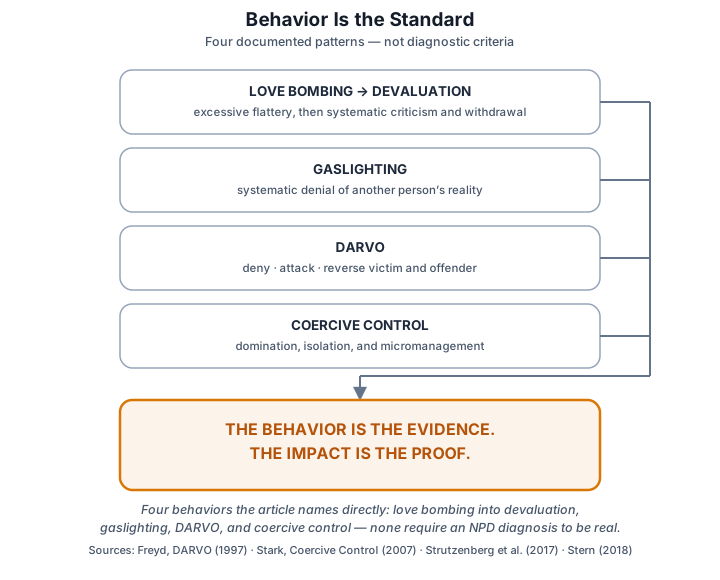
If someone objects to the term, the literature offers a clear response: the term describes a pattern of behavior. Change the behavior, and the term no longer applies.
Implications for Clinical Practice
Clinicians working with survivors of these behavioral patterns have an ethical obligation to name what they observe. Trauma-informed care does not mean consequences-free care. Validating a client’s experience includes validating the reality that what happened to them has a name, a research base, and documented neurological consequences.
Simultaneously, clinicians working with individuals who exhibit antagonistic personality styles have an obligation to provide honest, structured feedback about the impact of their behavior. Research consistently shows that therapeutic progress with high-antagonism clients requires direct confrontation of behavioral patterns within a structured therapeutic frame — not indefinite validation without accountability (Dimaggio et al., 2007; Ronningstam, 2012).
The goal is not to punish. The goal is clarity. Personality styles are not life sentences. They are behavioral patterns — and behavioral patterns, by definition, can be changed.
But they cannot be changed if they are never named.
Moving Forward
If you are experiencing these behavioral patterns in a relationship — the cycling between idealization and devaluation, the reality denial, the systematic erosion of your confidence and autonomy — what you are experiencing has a name. It is documented. It is measurable. And it is not your fault.
At Mental Wealth Solutions, we work with clients navigating the aftermath of antagonistic relational dynamics using evidence-based approaches grounded in the research cited here. No jargon without substance. No labels without evidence. Just clinical work rooted in what the science actually says.
Book a free consultation today and let’s talk about what you’re experiencing — with the clarity it deserves.
Your mental wealth matters. Let’s build it together.
References
American Psychiatric Association. (2022). Diagnostic and statistical manual of mental disorders (5th ed., text rev.). American Psychiatric Publishing.
Cloitre, M., Garvert, D. W., Brewin, C. R., Bryant, R. A., & Maercker, A. (2013). Evidence for proposed ICD-11 PTSD and complex PTSD: A latent profile analysis. European Journal of Psychotraumatology, 4(1), 20706.
Dimaggio, G., Semerari, A., Carcione, A., Nicolò, G., & Procacci, M. (2007). Psychotherapy of personality disorders. Routledge.
Dutton, D. G., & Painter, S. (1993). Emotional attachments in abusive relationships: A test of traumatic bonding theory. Violence and Victims, 8(2), 105–120.
Eisenberger, N. I., Lieberman, M. D., & Williams, K. D. (2003). Does rejection hurt? An fMRI study of social exclusion. Science, 302(5643), 290–292.
Fisher, H. E., Xu, X., Aron, A., & Brown, L. L. (2016). Intense, passionate, romantic love: A natural addiction? Frontiers in Psychology, 7, 687.
Freyd, J. J. (1996). Betrayal trauma: The logic of forgetting childhood abuse. Harvard University Press.
Freyd, J. J. (1997). Violations of power, adaptive blindness, and betrayal trauma theory. Feminism & Psychology, 7(1), 22–32.
Gottman, J. M., & Levenson, R. W. (2000). The timing of divorce: Predicting when a couple will divorce over a 14-year period. Journal of Marriage and Family, 62(3), 737–745.
Harsey, S. J., Zurbriggen, E. L., & Freyd, J. J. (2017). Perpetrator responses to victim confrontation: DARVO and victim self-blame. Journal of Aggression, Maltreatment & Trauma, 26(6), 644–663.
Herman, J. L. (1992). Trauma and recovery: The aftermath of violence. Basic Books.
Jones, D. N., & Paulhus, D. L. (2014). Introducing the Short Dark Triad (SD3): A brief measure of dark personality traits. Assessment, 21(1), 28–41.
Krueger, R. F., Derringer, J., Markon, K. E., Watson, D., & Skodol, A. E. (2012). Initial construction of a maladaptive personality trait model and inventory for DSM-5. Psychological Medicine, 42(9), 1879–1890.
McEwen, B. S. (2007). Physiology and neurobiology of stress and adaptation: Central role of the brain. Physiological Reviews, 87(3), 873–904.
Miller, J. D., Lynam, D. R., Hyatt, C. S., & Campbell, W. K. (2017). Controversies in narcissism. Annual Review of Clinical Psychology, 13, 291–315.
Ogrodniczuk, J. S. (2013). Understanding and treating pathological narcissism. American Psychological Association.
Paulhus, D. L., & Williams, K. M. (2002). The Dark Triad of personality: Narcissism, Machiavellianism, and psychopathy. Journal of Research in Personality, 36(6), 556–563.
Ronningstam, E. (2012). Alliance building and narcissistic personality disorder. Journal of Clinical Psychology, 68(8), 943–953.
Sapolsky, R. M. (2004). Why zebras don’t get ulcers: The acclaimed guide to stress, stress-related diseases, and coping. Holt Paperbacks.
Stark, E. (2007). Coercive control: How men entrap women in personal life. Oxford University Press.
Stern, R. (2018). The gaslight effect: How to spot and survive the hidden manipulation others use to control your life. Harmony Books.
Stinson, F. S., Dawson, D. A., Goldstein, R. B., Chou, S. P., Huang, B., Smith, S. M., … & Grant, B. F. (2008). Prevalence, correlates, disability, and comorbidity of DSM-IV narcissistic personality disorder. Journal of Clinical Psychiatry, 69(7), 1033–1045.
Strutzenberg, C. C., Wiersma-Mosley, J. D., Jozkowski, K. N., & Becnel, J. N. (2017). Love-bombing: A narcissistic approach to relationship formation. University of Arkansas Discovery, 18(1), 81–89.
Sweet, P. L. (2019). The sociology of gaslighting. American Sociological Review, 84(5), 851–875.
World Health Organization. (2018). International classification of diseases for mortality and morbidity statistics (11th rev.). WHO.
If this named something you're living with —
You don't have to figure it out from articles. Matthew Sexton, LCSW, NATC sees adults in therapy at his separate private practice (telehealth · NY · ME · DE · FL). Or take this piece to your own therapist — it's written to be shared.
Visit the practice