High-functioning anxiety hides because it gets rewarded. The deadlines get met, the work is excellent, and nobody worries about you, including you. That cover story has a cost, and the clearest number on it is time: people with anxiety disorders who eventually get treatment wait a median of 9 to 23 years after symptoms begin, according to Wang and colleagues’ analysis of the National Comorbidity Survey Replication in the Archives of General Psychiatry (2005). A decade at the low end. The anxiety that looks like ambition waits the longest, because nothing on the outside ever flags a problem.
What high-functioning anxiety actually is
You will not find high-functioning anxiety in the DSM-5. It is a description, and clinicians keep using it because it names something the manual describes from a different angle: an anxiety disorder, most often generalized anxiety disorder, in a person whose worry drives performance instead of stalling it.
The stereotype of anxiety is avoidance. Someone who cannot make the phone call, cannot send the application, cannot show up. This version runs the other direction. You show up early. You over-show-up. The worry powers the work, and everyone around you experiences the output as competence.
Anxiety disorders are the most common mental health condition in the United States. 19.1% of U.S. adults had one in the past year, and 31.1% will have one at some point in their lives, per the National Institute of Mental Health’s summary of National Comorbidity Survey data. A meaningful share of those people look fine. Some look better than fine. That is the problem with “looks fine” as a screening tool.
Your overthinking is a safety strategy
The most useful reframe I know: the rehearsing, the re-read emails, and the 2 a.m. simulations of tomorrow’s meeting are your threat-detection system doing its job with the volume stuck on high.
A nervous system that learned early that surprises are costly will work hard to eliminate surprise. Overthinking is the tool it built. It scans, it simulates, it pre-lives every version of the conversation so no version can catch you unprepared. Seen that way, the anxiety makes sense. It is a strategy your body built to keep you safe, and it works, which is exactly why you keep running it.
The trouble is the bill. A threat system that never receives the all-clear keeps charging the body: clenched jaw, tight gut, shallow sleep, the wired-and-tired state where you are exhausted and still cannot power down. Stephen Porges’ research on the autonomic nervous system describes this as being stuck in mobilization (Porges, 2011). The alarm stays on because standing down feels unsafe, and the body absorbs the cost of every hour it stays on.
The strategy is smart. It is also expensive, and there are cheaper ways to be safe.
Why it stays hidden for a decade
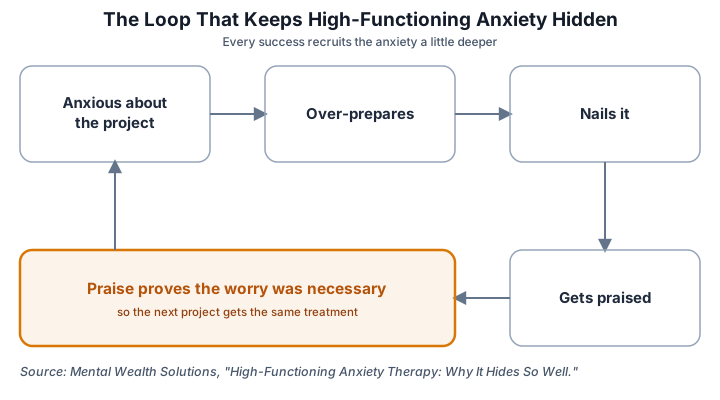
The 9-to-23-year delay makes more sense once you watch the loop run. You feel anxious about the project. The anxiety pushes you to over-prepare. You nail the project. You get praised. The praise lands as proof that the worry was necessary, so the next project gets the same treatment. Every success recruits the anxiety a little deeper. Why would you question the thing that appears to be producing your life?
There is a design problem underneath the personal one. Mental health screening looks for impairment: missed work, avoided situations, visible distress. Your version has none of those on the surface, because performance is the camouflage. A system built to flag people who struggle out loud will keep missing the people who struggle in perfect silence.
Clance and Imes named a related piece of this in 1978: the impostor phenomenon, the persistent sense of being about to be found out despite steady evidence of competence. It shows up constantly alongside high-functioning anxiety, and it does the same hiding work. You cannot ask for help with a struggle you believe would expose you.
Signs worth taking seriously
You do not need all of these. Several together are worth attention:
- Over-preparation as a ritual. Walking in without anticipating every question feels like a threat, so it is never allowed to happen.
- Yes when you mean no. Declining produces a physical stress response, so you accept things that drain you.
- Rest that produces guilt. Downtime generates more anxiety than work does. Sitting still feels like falling behind.
- Body symptoms you have normalized. Jaw clenching, teeth grinding, stomach trouble, tension headaches, waking at 2 a.m. with a full agenda already running.
- The fraud feeling. A quiet certainty that the next project is the one that exposes you.
If you read that list and thought “that’s just being responsible,” notice who taught you that responsible has to feel like this.
The fear of losing your edge
The first thing high achievers ask about treatment, in some form, is whether the performance goes when the anxiety goes. The worry feels like the engine, so removing it sounds like removing the engine.
Performance research has an old answer. Yerkes and Dodson showed in 1908 that performance rises with arousal only up to a point, and past that point it falls. Years of redlining put you past the point. You are not getting your best work from the anxiety. You are getting your most expensive work.
In practice, people who treat this keep their standards and lose the tax: the rumination hours, the double-checking, the recovery time after every ordinary meeting. Preparation becomes a choice rather than a compulsion, and a choice can be scaled to what the situation actually needs.
What therapy for this looks like
Cognitive behavioral therapy targets the thinking patterns that feed the loop: catastrophizing, all-or-nothing standards, the belief that relaxing equals failing. The work is concrete. You test the predictions your anxiety makes and let the results speak.
Acceptance and commitment therapy comes from another angle. Rather than out-arguing the anxious thought, you practice letting it be present without obeying it. For people whose whole strategy is control, allowing a feeling without acting on it is often the missing skill.
Somatic approaches work on the body’s side of the loop: teaching a mobilized nervous system what the all-clear feels like, so rest becomes something you can actually enter rather than a screen you collapse in front of. Regulation itself is a learnable skill, and it responds to structured practice.
The goal in all of it is a changed relationship with anxiety. The feeling still shows up. It gets to inform you. It no longer gets to drive.
FAQ
Is high-functioning anxiety a real diagnosis? No. It is a widely used description, and underneath it there is usually a diagnosable condition, most often generalized anxiety disorder. The label is useful because it helps people recognize themselves in it. What it cannot do is assess you; that takes a clinician.
Will treating my anxiety hurt my performance? The research points the other way. Performance rises with arousal only up to a point, a curve Yerkes and Dodson documented in 1908, and chronic anxiety keeps you past that point. People who treat high-functioning anxiety typically keep their standards and drop the costs: rumination, compulsive over-preparation, and the physical wear of a body that never stands down.
How is high-functioning anxiety different from being conscientious? A conscientious person can skip the triple-check when the stakes are low, and can rest without symptoms. With high-functioning anxiety, skipping preparation produces real distress, and rest reliably produces guilt and agitation. If stopping costs you that much, the pattern is worth a professional look.
Sources
Wang, P. S., Berglund, P., Olfson, M., Pincus, H. A., Wells, K. B., & Kessler, R. C. (2005). Failure and delay in initial treatment contact after first onset of mental disorders in the National Comorbidity Survey Replication. Archives of General Psychiatry, 62(6), 603–613, https://pubmed.ncbi.nlm.nih.gov/15939838/ — supports the 9-to-23-year median delay between symptom onset and first treatment contact for anxiety disorders. National Institute of Mental Health, Any Anxiety Disorder statistics (National Comorbidity Survey Replication, 2001–2003), https://www.nimh.nih.gov/health/statistics/any-anxiety-disorder — supports 19.1% past-year and 31.1% lifetime prevalence of anxiety disorders among U.S. adults. Yerkes, R. M., & Dodson, J. D. (1908). The relation of strength of stimulus to rapidity of habit-formation. Journal of Comparative Neurology and Psychology, 18(5), 459–482, https://onlinelibrary.wiley.com/doi/10.1002/cne.920180503 — supports the arousal-performance curve. Porges, S. W. (2011). The Polyvagal Theory. W. W. Norton, https://wwnorton.com/books/9780393707007 — supports the description of a nervous system stuck in mobilization. Clance, P. R., & Imes, S. A. (1978). The impostor phenomenon in high achieving women. Psychotherapy: Theory, Research & Practice, 15(3), 241–247, https://doi.org/10.1037/h0086006 — supports the naming of the impostor phenomenon. Figures current as of July 2026.
Disclaimer
This article is for educational and informational purposes only. It does not constitute medical, clinical, legal, or therapeutic advice, and reading it does not create a therapist-client relationship with Matthew Sexton, LCSW or Mental Wealth Solutions, Inc. Although the author is a licensed clinical social worker, the content in this article is not clinical assessment, diagnosis, or treatment.
The patterns, concepts, and frameworks described here reflect published research and general clinical observations. Individual experiences vary, and what is described here may not match every reader’s situation. If you are working through the concerns described in this article, please consult a licensed mental health professional who can assess your specific circumstances.
If you are in immediate emotional crisis, you can reach the 988 Suicide & Crisis Lifeline by calling or texting 988 (US). If you are experiencing domestic violence or are in physical danger, contact the National Domestic Violence Hotline at 1-800-799-7233 or visit thehotline.org. In a life-threatening emergency, call 911.
Frequently asked questions.
- Is high-functioning anxiety a real diagnosis?
- No. It is a widely used description, and underneath it there is usually a diagnosable condition, most often generalized anxiety disorder. The label is useful because it helps people recognize themselves in it. What it cannot do is assess you; that takes a clinician.
- Will treating my anxiety hurt my performance?
- The research points the other way. Performance rises with arousal only up to a point, a curve Yerkes and Dodson documented in 1908, and chronic anxiety keeps you past that point. People who treat high-functioning anxiety typically keep their standards and drop the costs: rumination, compulsive over-preparation, and the physical wear of a body that never stands down.
- How is high-functioning anxiety different from being conscientious?
- A conscientious person can skip the triple-check when the stakes are low, and can rest without symptoms. With high-functioning anxiety, skipping preparation produces real distress, and rest reliably produces guilt and agitation. If stopping costs you that much, the pattern is worth a professional look.
If this named something you're living with —
You don't have to figure it out from articles. Matthew Sexton, LCSW, NATC sees adults in therapy at his separate private practice (telehealth · NY · ME · DE · FL). Or take this piece to your own therapist — it's written to be shared.
Visit the practice