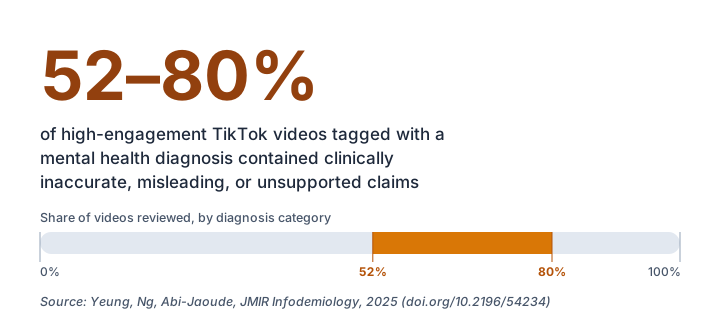
Evidence-based therapy means the method your therapist uses was tested in controlled clinical studies before it reached your session, and it helped more people than doing nothing did. That is the whole definition. The label matters because most of the mental health advice competing for your attention never faced a test of any kind. A 2025 study in JMIR Infodemiology found that between 52 and 80 percent of high-engagement TikTok videos tagged with mental health diagnoses contained clinically inaccurate, misleading, or unsupported claims, depending on the diagnosis. “Evidence-based” is a checkable claim in a market full of uncheckable ones. This post covers what the claim includes, what it leaves out, and how to check it before you spend your money and your Tuesday evenings.
The definition of evidence-based therapy, in plain terms
A treatment earns the label through a specific process. Researchers gather a group of people dealing with the same problem, say panic attacks. Half get the treatment. Half get something else, usually a waitlist or a different treatment. Everyone gets measured before and after. If the treated group does meaningfully better, and other research teams repeat the study and get the same result, the approach starts qualifying as evidence-based.
Three words in that paragraph do the work: measured, compared, and repeated. Anyone can report that their clients feel better. People often feel better after talking with a warm person for a few months, under almost any conditions. The evidence bar asks a harder question. Did this method beat the alternative, on a measurement chosen in advance, more than once?
You already expect this standard from the rest of medicine. A prescription drug has to survive trials before a pharmacy can hand it to you. Therapy methods earn trust the same way. The difference is that nobody regulates the word “therapy” on an Instagram graphic, so the checking falls to you.
The four approaches you will run into most
You do not need to memorize the research literature. Knowing the names helps you read a therapist’s website without a translator.
Cognitive behavioral therapy (CBT). Works on the loop between your thoughts, feelings, and behavior. It is the most-studied talk therapy in existence, with a large trial record for depression, anxiety, PTSD, and OCD. In practice it is structured and goal-oriented, and often runs shorter-term than other approaches.
Dialectical behavior therapy (DBT). Originally built for borderline personality disorder, now used more broadly where emotions run hot and fast. It pairs acceptance skills with change skills: learning to sit with a feeling and learning to act differently anyway.
Eye movement desensitization and reprocessing (EMDR). A trauma treatment. You process a painful memory while following a back-and-forth cue, often guided eye movements. It sounds strange. The trial record for PTSD is real, which is why major clinical guidelines include it.
Acceptance and commitment therapy (ACT). Centers on accepting what sits outside your control while committing to actions that match your values. It has been studied for anxiety, depression, and chronic pain.
What the label leaves out
The label tells you a method was tested on groups. It cannot tell you what will happen with you, an individual with a history no study ever enrolled. Good clinicians treat the research as a map and then adjust for the terrain in front of them. A therapist who recites the manual while ignoring what you say has confused the map for the trip.
The label also says nothing about the person delivering the method. Which brings up the part of the research that surprises people.
The relationship is also evidence
The working bond between you and your therapist has its own research base, and it is one of the sturdiest findings in the field. A meta-analysis published in Psychotherapy in 2018 pooled 295 independent studies covering more than 30,000 patients and found that the quality of the therapist-client alliance predicted outcomes consistently, across treatment approaches, patient problems, and countries. The correlation, r = .278, sounds modest. In psychotherapy research, few numbers hold up that reliably across that many studies.
Here is what that means for you in practice. Feeling heard by your therapist is a clinical ingredient, on top of being a pleasant experience. If several sessions in you feel talked at, dismissed, or vaguely embarrassed to be honest, the evidence supports acting on that. Switching therapists is a reasonable, research-backed move, and a competent clinician will help you do it rather than take it personally.
How long it takes
The evidence covers pace, too. The American Psychological Association reports that on average 15 to 20 sessions are required for 50 percent of patients to recover, as measured by self-reported symptoms. People working through several overlapping conditions may need longer, sometimes 12 to 18 months.
Those numbers are worth keeping in your pocket for one reason: anyone guaranteeing to fix you in three sessions is quoting a study that does not exist. Real research reports averages and ranges. It never issues certainties.
Red flags worth your attention
A few patterns should make you slow down, whatever the marketing says.
- Guaranteed outcomes. “You will be free of anxiety in six weeks” is a sales pitch wearing a lab coat.
- An approach with no name. “I use an eclectic blend” is fine as a starting point. As a complete answer to “what do you do and why,” it is thin.
- Scientific costume. Words like “clinically proven” and “neuro-optimized” with no citations attached borrow the sound of research without the substance.
- Defensiveness about questions. You are hiring someone for intimate, difficult work. Wanting to understand their method is diligence, and a professional will treat it that way.
Four questions to ask any therapist
- What approach would you use for a problem like mine?
- What is the research behind it?
- How will we both know whether it is working?
- What training do you have in this method?
An ethical therapist answers these without flinching. Most will be glad you asked, because clients who understand the method tend to do the work that makes it succeed.
FAQ
Is evidence-based therapy better than other therapy? It carries less risk of wasting your time and money, because the method has already beaten comparison treatments in controlled studies. The person delivering it still matters a great deal: a meta-analysis of 295 studies covering more than 30,000 patients found the quality of the therapist-client relationship predicted outcomes across every treatment type studied (Psychotherapy, 2018). The best case is both: a tested method and a therapist you can work with.
Does evidence-based mean the therapy will definitely work for me? No. It means the method helped more people than the alternative did, on average, in controlled studies. Averages include people who improved a lot and people who improved a little. The American Psychological Association reports that on average 15 to 20 sessions are needed for half of patients to recover on self-reported symptom measures, and people with several overlapping conditions may need longer. If a fair trial of a method is not helping, that is useful information to bring into the room, not a verdict on you.
How do I check whether a therapy is actually evidence-based? Ask your therapist to name the approach, then search that name along with the words “randomized controlled trial” and your concern. Professional bodies such as the American Psychological Association and the UK’s NICE publish lists of supported treatments by condition. A therapist making an honest claim will name the method without hesitation and can tell you why they chose it for problems like yours.
Sources
- Yeung A., Ng E., Abi-Jaoude E., study of high-engagement TikTok videos tagged with mental health diagnoses, JMIR Infodemiology, 2025. https://doi.org/10.2196/54234 — between 52 and 80 percent of videos, depending on diagnosis, rated clinically inaccurate, misleading, or unsupported by independent clinical raters.
- Flückiger C., Del Re A.C., Wampold B.E., Horvath A.O., “The Alliance in Adult Psychotherapy: A Meta-Analytic Synthesis,” Psychotherapy, 2018. https://doi.org/10.1037/pst0000172 — 295 independent studies, more than 30,000 patients, alliance-outcome correlation r = .278 across treatment approaches, problems, and countries.
- American Psychological Association, “How Long Will It Take for Treatment to Work?” (accessed July 2026). https://www.apa.org/ptsd-guideline/patients-and-families/length-treatment — on average 15 to 20 sessions required for 50 percent of patients to recover per self-reported symptom measures; 12 to 18 months for people with co-occurring conditions.
Figures current as of July 2026.
Disclaimer
This article is for educational and informational purposes only. It does not constitute medical, clinical, legal, or therapeutic advice, and reading it does not create a therapist-client relationship with Matthew Sexton, LCSW or Mental Wealth Solutions, Inc. Although the author is a licensed clinical social worker, the content in this article is not clinical assessment, diagnosis, or treatment.
The patterns, concepts, and frameworks described here reflect published research and general clinical observations. Individual experiences vary, and what is described here may not match every reader’s situation. If you are working through the concerns described in this article, please consult a licensed mental health professional who can assess your specific circumstances.
If you are in immediate emotional crisis, you can reach the 988 Suicide & Crisis Lifeline by calling or texting 988 (US). If you are experiencing domestic violence or are in physical danger, contact the National Domestic Violence Hotline at 1-800-799-7233 or visit thehotline.org. In a life-threatening emergency, call 911.
Frequently asked questions.
- Is evidence-based therapy better than other therapy?
- It carries less risk of wasting your time and money, because the method has already beaten comparison treatments in controlled studies. The person delivering it still matters a great deal: a meta-analysis of 295 studies covering more than 30,000 patients found the quality of the therapist-client relationship predicted outcomes across every treatment type studied (Psychotherapy, 2018). The best case is both: a tested method and a therapist you can work with.
- Does evidence-based mean the therapy will definitely work for me?
- No. It means the method helped more people than the alternative did, on average, in controlled studies. Averages include people who improved a lot and people who improved a little. The American Psychological Association reports that on average 15 to 20 sessions are needed for half of patients to recover on self-reported symptom measures, and people with several overlapping conditions may need longer. If a fair trial of a method is not helping, that is useful information to bring into the room, not a verdict on you.
- How do I check whether a therapy is actually evidence-based?
- Ask your therapist to name the approach, then search that name along with the words 'randomized controlled trial' and your concern. Professional bodies such as the American Psychological Association and the UK's NICE publish lists of supported treatments by condition. A therapist making an honest claim will name the method without hesitation and can tell you why they chose it for problems like yours.
If this named something you're living with —
You don't have to figure it out from articles. Matthew Sexton, LCSW, NATC sees adults in therapy at his separate private practice (telehealth · NY · ME · DE · FL). Or take this piece to your own therapist — it's written to be shared.
Visit the practice