Emotional regulation is a skill, and skills respond to practice. That is a research finding, and the strongest version of it comes from the hardest test in the field: in a two-year randomized trial, people who received dialectical behavior therapy, a treatment built largely around teaching emotional skills, were half as likely to attempt suicide as people treated by expert community therapists (Linehan et al., Archives of General Psychiatry, 2006). Skills training held its own against expertise at the highest stakes there are. If regulation can be taught there, it can be taught to someone whose Tuesday just went sideways.
Where “I’m just an emotional person” comes from
People say it like a fixed identity. I cry at commercials. I snap when I’m stressed. I shut down when things pile up. I’m just like this.
The difference between people who handle feelings well and people who drown in them is mostly history. A nervous system takes its shape from what it grew up around. If the adults in the room modeled naming a feeling, tolerating it, and acting anyway, you got thousands of free lessons. If feelings around you were punished, dismissed, or treated as manipulation, you learned a different lesson: make it stop. Marsha Linehan built her biosocial model on this pairing of a sensitive temperament with an environment that invalidates it (Linehan, 1993). Her conclusion is the useful part: what got learned can be retrained.
Suppression deserves its own sentence, because most people who “hold it together” are doing suppression and calling it regulation. Suppression is holding the lid on. Regulation is turning down the burner. The first one costs more the longer it runs, and it tends to fail at the worst possible moment.
Emotions unfold in steps, and each step is a door
James Gross, who runs one of the most cited research programs in affective science, mapped where regulation can actually happen (Gross, 2015). An emotion is a sequence: a situation shows up, you attend to part of it, you interpret what it means, and your body and behavior respond. His process model identifies five places to step in.
- Pick the situation. Some emotional weather is optional. The 9 p.m. news scroll is a choice.
- Change the situation. Ask for the agenda before the meeting. Move the hard conversation off text.
- Move your attention. Attention works like a spotlight, and you have more say over where it points than it feels like mid-spiral.
- Change the story. The same email reads as an attack or as a rushed colleague, depending on the interpretation you build. This one is called cognitive reappraisal, and it is among the best-studied strategies in the field, linked to lower negative emotion and better relationships (Gross & John, 2003).
- Work with the response. Paced breathing, movement, cold water. The wave is already rolling; you shape how it lands.
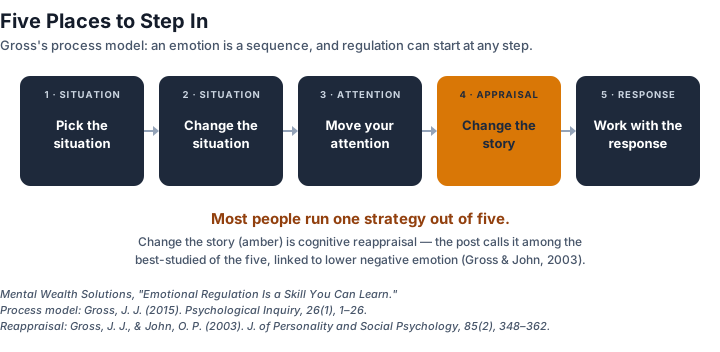
Most people were never taught any of the five. They inherited one default, usually suppression or venting, and concluded from its failure that they are bad at feelings. You have been running one strategy out of five families. That is a curriculum problem, not a talent problem.
Why “just calm down” never worked
Nobody learns to lift by starting at their max. Skills get built under low load. In the middle of an emotional spike, the reasoning parts of the brain are exactly the parts with degraded access, which is why insight evaporates right when you need it. Telling a flooded person to calm down is handing them a manual in a language they can only read once they’re calm.
So practice happens between storms. Dan Siegel’s “window of tolerance” (1999) is a useful picture: the band of emotional intensity you can experience while staying present. Inside the window, you can feel and think at the same time. Practice happens inside the window, and the window widens with use, the way range of motion widens with stretching.
This is also why new skills feel fake at first. Rehearsing a breathing pattern on a calm Tuesday feels pointless right up until the Friday it deploys on its own.
What emotional regulation practice actually looks like
Therapy, done well, is structured training. You identify your default strategy, understand where it came from, test new ones in session, and then run them in the wild. Progressive loading, with a spotter.
A concrete version. The email lands at 6 p.m. and reads as an accusation. The old sequence: read it four times, draft three replies, snap at whoever is nearby, sleep badly. The practiced sequence: notice the heat in your chest, name it (“threatened”), put the phone in the other room, and reread once in the morning, where it turns out to be two sentences from a tired coworker. Nothing dramatic happened. A skill ran instead of a reflex. Multiply that by a few hundred evenings and you have a different life.
The trial behind this article’s opening number found the same pattern at clinical scale. Along with fewer suicide attempts, people in the skills-based treatment had fewer psychiatric hospitalizations and were far less likely to drop out of care (Linehan et al., 2006). Practice compounds.
Where you start matters less than starting below your max. Name feelings with more precision than “stressed.” Pick one of the five entry points above and run it for two weeks. If your history has made the window narrow, a therapist trained in DBT, CBT, or somatic work can structure the progression the way a good coach structures a season, and the sequencing is most of the value.
None of this makes you a person without weather. The feelings keep coming; that is what it means to be alive and paying attention. What changes is what happens in the three seconds after a feeling arrives. Those three seconds are trainable, and everything downstream of them gets easier.
Sources
Linehan, M. M., Comtois, K. A., Murray, A. M., et al. (2006). Two-year randomized controlled trial and follow-up of dialectical behavior therapy vs therapy by experts for suicidal behaviors and borderline personality disorder. Archives of General Psychiatry, 63(7), 757–766, https://pubmed.ncbi.nlm.nih.gov/16818865/ — supports the finding that DBT recipients were half as likely to attempt suicide (hazard ratio 2.66), had fewer psychiatric hospitalizations, and were less likely to drop out of treatment. Gross, J. J. (2015). Emotion regulation: Current status and future prospects. Psychological Inquiry, 26(1), 1–26, https://doi.org/10.1080/1047840X.2014.940781 — supports the process model and its five families of regulation strategies. Gross, J. J., & John, O. P. (2003). Individual differences in two emotion regulation processes. Journal of Personality and Social Psychology, 85(2), 348–362, https://doi.org/10.1037/0022-3514.85.2.348 — supports cognitive reappraisal’s association with lower negative emotion and better interpersonal functioning. Linehan, M. M. (1993). Cognitive-Behavioral Treatment of Borderline Personality Disorder. Guilford Press, https://www.guilford.com/books/Cognitive-Behavioral-Treatment-of-Borderline-Personality-Disorder/Marsha-Linehan/9780898621839 — supports the biosocial model of emotional vulnerability and invalidating environments. Siegel, D. J. (1999). The Developing Mind. Guilford Press, https://www.guilford.com/books/The-Developing-Mind/Daniel-Siegel/9781462542758 — supports the window-of-tolerance concept. Figures current as of July 2026.
Disclaimer
This article is for educational and informational purposes only. It does not constitute medical, clinical, legal, or therapeutic advice, and reading it does not create a therapist-client relationship with Matthew Sexton, LCSW or Mental Wealth Solutions, Inc. Although the author is a licensed clinical social worker, the content in this article is not clinical assessment, diagnosis, or treatment.
The patterns, concepts, and frameworks described here reflect published research and general clinical observations. Individual experiences vary, and what is described here may not match every reader’s situation. If you are working through the concerns described in this article, please consult a licensed mental health professional who can assess your specific circumstances.
If you are in immediate emotional crisis, you can reach the 988 Suicide & Crisis Lifeline by calling or texting 988 (US). If you are experiencing domestic violence or are in physical danger, contact the National Domestic Violence Hotline at 1-800-799-7233 or visit thehotline.org. In a life-threatening emergency, call 911.
If this named something you're living with —
You don't have to figure it out from articles. Matthew Sexton, LCSW, NATC sees adults in therapy at his separate private practice (telehealth · NY · ME · DE · FL). Or take this piece to your own therapist — it's written to be shared.
Visit the practice